The global magazine and marketplace for classic car enthusiasts, by enthusiasts.


Filter
Classic Dodge, Vulcan for sale - Dodge, Vulcan cars for sale
-

1926 Dodge Roadster
Offered due to trade-in:Unique 1926 Dodge Roadster.Originated from collection.Engine runs well. Comes with USA Title.Very original condition.

Dodge
US, 1914 to date
(1) Dodge Brothers, Detroit, Mich., 1914 – 1928
(2) Chrysler Corp, Detroit, Mich., 1928 to date
The brothers John and Horace Dodge, early Ford shareholders and builders of engines for the Ford Motor Co, produced their first Dodge car in November 1914. It was a conventional side valve Monobloc four of 3½-litres, developing 25bhp. The Dodge was noted for its 12-volt electrics, and ‘back-to-front’ gear change, features that were not discarded until 1926. The tough Dodge 4 won early acceptance by the American army after being used in General Pershing’s punitive expedition to Mexico in 1916, and the Dodge type was widely used in World War 1 as a staff car and ambulance. Also in 1916 Budd all-steel tourer bodywork was adopted; some saloons were also made in this year, using the same construction. The price of open Dodge cars was $785, and Dodge was fourth in overall US sales in 1916 with 70.700 Dodge cars delivered, following this up with a second place in 1920. The Dodge four was still the staple product in 1924, when 1.000 cars were being made a day. A new departure for Dodge in 1927 was a 3.7-litre side-valve six with internal-expanding hydraulic brakes.
In July 1928, Walter P. Chrysler paid $175.000.000 for the Dodge company. Discontinuation of the Dodge four, now developing 40bhp and fitted with front-wheel brakes, followed almost immediately, but for the next three years Dodges preserved their individual appearance. Though their cars were reckoned more expensive than DeSotos, Dodge offered a very cheap Dodge Standard 6 at $765 in 1929, their other models being the Dodge Victory at about $1.000, and a big Dodge Senior which paralleled Chrysler’s 75 at $1.675. A straight-8 was listed from 1930 to 1933. Free wheels were among the regular Chrysler improvements which appeared on the scene in 1932, followed by synchromesh gearboxes in 1933. In this year Dodge again took fourth place in sales, with 86.062 Dodge cars delivered. There were no Dodge versions of the Chrysler Airflow, but 1935 Dodge cars had the Airstream styling and side-valve 6-cylinder engines of 3.6-litre capacity. Overdrive, hypoid rear axles and independent front suspension made their appearance in the later 1930s, and Dodge cars of the 1940s were hard to distinguish from DeSotos or the de luxe Plymouths.
The expected ohv V8, publicized under the name Dodge Red Ram, materialized in 1952; it was a modest-sized 3.8-litre unit, and in 1955, when Chryslers were largely restyled, the Dodge cars were available both with the old 3.8-litre side-valve six and with V8s in three ratings up to 193bhp. By 1959 – the last year of the sv 6-cylinder – the most powerful eight disponed of some 345bhp, from 6.3-litres. Dodge has continued to offer more potent alternatives to the regular sedans, with a brisk Dodge Charger fastback coupé available in 1966. A ‘compact’ car, the Dodge Lancer, was listed in 1961, but this was vitually indistinguishable from the Plymouth Valiant. Regular 1967 Dodges had Chrysler’s unitary construction and alternator ignition introduced in 1960, and there were three basic ranges: the semi-compact Dodge Dart on a 9ft 3in wheelbase; the medium-sized Dodge Coronet; and the big Dodge Polara and Dodge Monaco on a wheelbase of 10ft 1in, with V8 engines of up to 7.2-litres’ capacity. The more sporting Dodge Charger coupé appeared in 1968, available with a 6.981cc hemi-head V8 of 425bhp; concealed wipers came on the 1969 Dodge models; and in 1970 the Dodge Challenger filled the gap between Dart and Coronet: standard engines were a 3.7-litre six or a 5.2-litre V8. There was a Dart sports coupé, the Dodge Demon, in 1971, but this was also the last year of the hemi-head engine and of convertibles in the Dodge range.
For 1973 there was the Dodge Dart on a 9ft wheelbase, the Dodge Challenger coupé, the Dodge Coronet and its sporting sister, the Dodge Charger, and the full-sized Dodge Polara and Dodge Monaco series. The Monaco had concealed headlamps. The biggest Dodge cars had V8 engines, automatic transmissions and power steering as standard. Electronic ignition was standard on all Dodge models, and all but the basic Darts had front disc brakes. Engines available were sixes of 3.245cc and 3.688cc, and V8s of 5.2, 5.6, 6.6 and 7.2 litres.
Since 1970 Dodge have been selling the Japancese Mitsubishi Colt as a small-car line in the USA.
Source: Georgano, encyclopedia of motorcar; MCS
The information is written with the greatest of care. However, if you have any suggested amendments please contact us at office@prewarcar.com
Vulcan
GB, 1902 – 1928
(1) Vulcan Motor Manufacturing and Engineering Co Ltd, Southport, Lancs., 1902 – 1906
(2) Vulcan Motor and Engineering Co Ltd, Southport, Lancs., 1906 – 1928
The Vulcan car firm was better known for commercial vehicles. Private Vulcan cars stemmed from experiments conducted in the 1897-1899 period by the brothers Thomas and Joseph Hampson. A belt-driven single-cylinder voiturette Vulcan car with lateral radiators was shown in 1902, being replaced a year later by a 6hp Vulcan car with armoured wood frame, mechanically-operated inlet valves, and shaft drive. This Vulcan car was listed at only £105, and this Vulcan car was soon followed by a 10hp twin, also T-headed but with a steel frame, selling for £200. 4-cylinder Vulcan cars of 12 and 16hp, still modestly priced, were available in 1905, while the biggest 1906 Vulcan cars, with capacities of 3.1- and 5.2-litres, had gate change. No 2-cylinder Vulcan cars were catalogued after 1908, but a year previously Vulcan cars had joined the ranks of 6-cylinder manufacturers with a 4.8-litre T-headed machine featuring dual ignition and cone clutch, at £600 for a Vulcan car chassis. Unlike other makers, Vulcan cars retained their interest in this type, which Vulcan car had acquired a 4-speed box and had grown to 6-litres by 1908, and the 1909 Vulcan car range consisted of four 4-cylinder cars and the six, all shaft-driven and still with T-heads; the smallest Vulcan car, rated at 12hp, had a 3-speed gearbox and worm drive. A new 3.6-litre six Vulcan car with unit gearbox and worm drive followed in 1911, along with an L-head 2.4-litre fifteen. Worm drive was standardized on the 1912 Vulcan cars, when the bigger Vulcan cars had T-heads, and a 1.8-litre, 2-cylinder with an Aster engine was offered. All but the smallest Vulcan car had detachable wheels as standard in 1913, and by the outbreak of World War 1 the Vulcan car company was well established with a range of solidly-built Vulcan cars: a 2.4-litre 10/15, a 2.6-litre 15.9, and a 3-litre monobloc 15/20 Vulcan car at £375. All these Vulcan cars had L-heads and bull-nose radiators, though the similarly styled six retained the older Vulcan car configuration. A 1½-litre Vulcanette with a 3-speed rear-axle gearbox and full electrical equipment was announced for 1915 but the war intervened.
After 1918 the Vulcan car company concentrated increasingly on trucks, and a brief association with the Harper Bean Group (1919-1920) did no good to finances. Some odd experiments by Vulcan cars included a worm-drive 3½-litre V8 tourer Vulcan car intended to sell for £625 (1919), and two Vulcan cars in 1922 with Howard sleeve-valve engines, a big 3.6-litre sports-touring four Vulcan car and a 10hp 1.4-litre flat-twin listed at £315. However, none of these Vulcan cars reached the public, the regular Vulcan car lines being a 1.8-litre ohv 12 and a 2.6-litre sv 16/20, both with Dorman engines. There was also a conservative 20hp Vulcan carmodel with the Vulcan car company’s own 3.3-litre sv fixed-head engine and 4-speed separate gearbox, this Vulcan car was selling for £850 in 1921; by this time flat radiators were again being used on Vulcan cars. The Vulcan 20 was available to military order with full wireless equipment in 1923, in which year C.B. Wardman effected a liaison of Vulcan cars and Lea-Francis. The two companies pooled their dealer network, Vulcan cars became responsible for certain Lea-Francis power units and bodies, and Lea-Francis made gear and steering boxes for Vulcan cars. A 1½-litre sv Dorman-engined Vulcan 12 was listed at £295 in 1925, followed a year later by an ohv worm-driven derivative, also with Dorman engine, and looking very like a Lea-Francis. 4-wheel brakes were available on Vulcan cars in 1925 and standardized in 1926. Last of the line Vulcan cars were the 14/40 and 16/60, with the disastrous twin ohc 6-cylinder engines of their own make. Short-chassis Vulcan cars were worm-driven, but bevel drive was adopted for long-chassis versions. Vulcan cars wore artillery wheels, but were otherwise identical to their Lea-Francis counterparts which Vulcan cars were made alongside them at Southport. Not many of these Vulcan cars were made, and after 1928 only commercial vehicles were produced. The Vulcan car firm subsequently amalgamated with Tilling-Stevens and thus were abrorbed into the Rootes Group after World War 2. Truck production ceased in 1953.
US, 1913 – 1914
(1) Vulcan Motor Car Co, Painesville, Ohio, 1913
(2) Vulcan Manufacturing Co, Painesville, Ohio, 1913 – 1914
This Vulcan car was a cleanly-designed light car with a 27hp 4-cylinder engine. A two-seater speedster Vulcan car on an 8ft 9in wheelbase with electric lights sold for $750. A five-seater version of this Vulcan car with the same engine, but on a longer wheelbase, cost $850.
Source: Georgano, encyclopedia of motorcar; MCS, GMN
The information is written with the greatest of care. However, if you have any suggested amendments please contact us at office@prewarcar.com


Featured
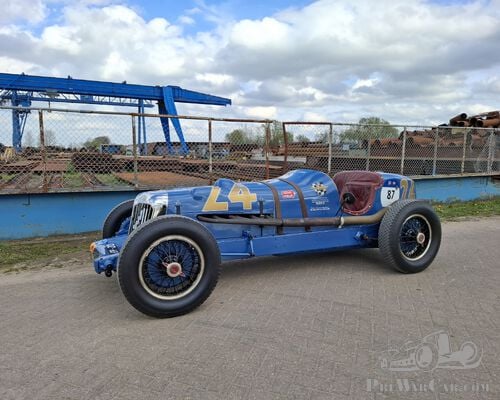
1932 - Graham " Lucenti " Indianapolis
Original participant of the 1932, 1934 and 1935 Indy 500. Best result: finishing 10th overall in the 1934 Indy 500 with driver “Herb” Ardinger...
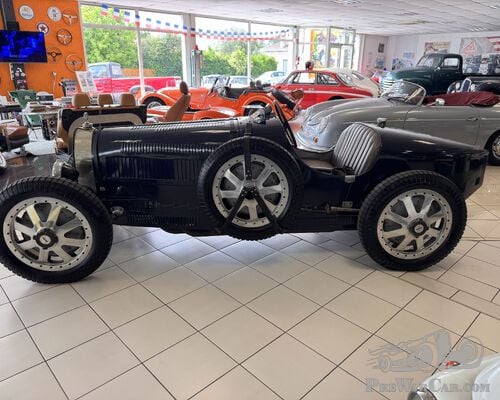
Bugatti 35 B Pur Sang
Bugatti 35 B Pur Sang,importée par un membre délégué de la FFVE il y’a une quinzaine d années.Participation à de nombreux Rallyes Bug..