The global magazine and marketplace for classic car enthusiasts, by enthusiasts.


Filter
Classic Donnet/ Donnet-Zédel, Orient for sale - Donnet/ Donnet-Zédel, Orient cars for sale
-

1905/6 Orient Buckboard
Build by Waltham , mass. Usa . very original and unrestored , except the engine which is restored and running .Known history back to before ww2 . Last ovner found it in 1950.Eur 25.800

Donnet / Donnet-Zédel
France, 1924 – 1934
SA des Automobiles Donnet, Nanterre, Seine; Neuilly, Seine, Pontarlier, Doubs.
After Zédel and Vinot et Deguingand ceased production, Donnet, a new company constituted from them in 1924, offered two new cars called Donnet-Zédel. A light car was made, the 7CV Donnet-Zedel Type G, which had a side-valve 4-cylinder engine of 1100cc and (unusual for so small a vehicle) a 4-speed gearbox. It was a solidly-built machine, and a Donnet-Zedel sports model was listed. There was, in addition, a medium-sized four of about 2¼-litres. From 1926, the Donnet-Zedel firm came to concentrate upon a 2½-litre six, also with side valves, which proved a popular car. Another, smaller six with 1.3-litres (later 1.8-litre) Sainturat-designed engine was also offered by Donnet-Zedel. In the 1932 range however, was a new small Donnet-Zedel car in the shape of a 750cc 2-stroke. This, a violet design, had been sold as the Dequingand until 1930. A fwd 2-litre 6-cylinder Donnet-Zedel, shown at the 1931 Paris Salon came to nothing. With the demise of Donnet, Simca took over the Donnet-Zedel factory.
Source: Georgano, encyclopedia of motorcar; TRN
The information is written with the greatest of care. However, if you have any suggested amendments please contact us at office@prewarcar.com
Orient
US, 1898 – 1908
Waltham Mfg Co, Waltham, Mass.
The Orient car company made an experimental electric runabout in 1898, but did not put this Orient car into production. Their first petrol-engined Orient cars were motor cycles, tricycles and light runabouts powered by De Dion engines. In 1902 they introduced the Orient Buckboard, a very simple Orient car consisting of two seats on a wooden platform, with a 4hp air-cooled engine geared to the rear axle, and, originally, only one speed. There were no springs on this Orient car, as the wooden platform was said to have enough resilience. The weight was 350lb and the price $375.
Although the simple Buckboard was continued, more sophisticated Orient cars were gradually introduced, including a four-seater version Orient car which in turn became a side-entrance tonneau. Wheel steering and small bonnets to cover the driver’s feet appeared in 1904, although the engine of the Orient car was still at the back, and the Buckboard ancestry remained obvious.
In 1905 a completely new Orient car appeared, known as the Waltham Orient. This Orient car had a 4-cylinder air-cooled 18/20hp engine mounted in front in the conventional manner, friction transmission and shaft drive. A slightly smaller 16hp Orient car model was also made. In 1908 Waltham merged with the C.H. Metz Company, and for the following year the cars were known as Metz.
Source: Georgano, encyclopedia of motorcar; GNG
The information is written with the greatest of care. However, if you have any suggested amendments please contact us at office@prewarcar.com


Featured

K3 Replica on KN Chassis
"The K3 Magnette must rank in the history books as the most famous and successful of all the record breaking MGs. With only 33 examples produced durin..
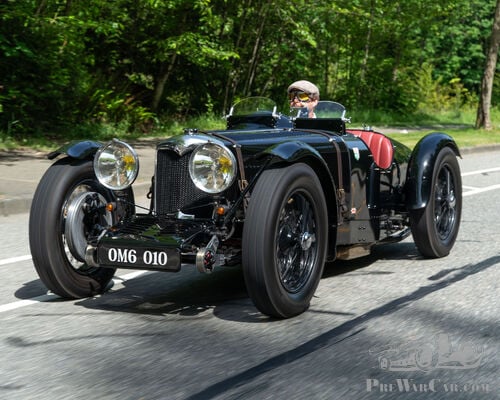
Riley 14/6 Special 1933
The ExperienceStep into the golden age of British motoring. This 1933 Riley 14/6 Special is a masterclass in pre-w..