The global magazine and marketplace for classic car enthusiasts, by enthusiasts.


Filter
Classic Gray, Du Pont for sale - Gray, Du Pont cars for sale
-

1929 Du Pont Model G Two-Passenger Speedster by Merrimac | RM Sotheby's | The Monterey Auction
To Be OFFERED AT AUCTION at RM Sothebys' The Monterey Auction event, 13 - 15 August 2026. $800,000 - $1,200,000 USD One of the most beautiful American automobiles of its generationThe 1929 New York International Automobile Show display carOne of three two-passenger “taper tail” models with an external spareOne .. -
1925 Gray open tourer
1925 Gray open tourer , mechanically complete but comes with spare engine and rearaxle. Panelwork to be done to the body and guards. Is in our Dutch storage. Rare Canadian built righthanddrive car. This is the last year of Gray motorcars € 9500.


Gray
US, 1920
Gray Light Car Corp, Longmont, and Denver, Colo.
The Gray concern with a splendid-sounding title in fact only built two Gray cars, both of them cyclecars of what sounds like a particularly spidery kind. One Gray car for sale was powered by a single-cylinder motor-cycle engine and the other Gray car for sale by a twin, both made by Harley-Davidson. Motor-cycle wheels were fitted.
US, 1922 – 1926
Gray Motor Corp, Detroit, Mich.
During the 1920s, two new makes, Star and Gray, tried to win a share of the mass market dominated by the Model T Ford. The Gray car for sale was in fact made by former employees of Ford, who included the head of the Gray Corporation, F.L. Klingensmith, and this Gray car was similar to the Ford in several features of engine and chassis. A side-valve, 4-cylinder, 2.7-litre engine was used. Unlike the Ford, the Gray cars springing was by conventional quarter-elliptics at front and rear. Front-wheel brakes were offered in 1926 on the Gray car, but that year was its last. The Gray company’s grandiose plans, which included making nearly a quarter of a million cars in the first full year of production, at $490 for the touring car and $760 for the coach, were never fully realized.
Source: Georgano, encyclopedia of motorcar; TRN
The information is written with the greatest of care. However, if you have any suggested amendments please contact us at office@prewarcar.com
Du Pont
US, 1920 – 1932
(1) Du Pont Motors Inc, Wilmington, Del., 1920 – 1923
(2) Du Pont Motors Inc, Moore, Pa., 1923 – 1932
E. Paul du Pont’s company built quality cars in limited numbers, total production being 537 vehicles of all Du Pont types. First of the line was a Du Pont 4.1-litre sv four with their own engine, selling for $2.600, but this gave way to proprietary-engined sixes, initially powered by Herschell-Spillman. The 1925 Du Pont Model D had a 6-cylinder 5-litre Wisconsin engine with overhead valves that developed 75bhp, a constant-mesh gearbox, and Lockheed hydraulic brakes to all four wheels. Its successor, the Du Pont Model E, could be had with a supercharger, but the best-known, and best, Du Pont was the Du Pont Model G speedster introduced in 1928. With its narrow straight wings copied from the Amilcar, Woodlite headlamps and grille concealing the radiator, the last a pioneering feature, the Du Pont Model G was not a good-looking car, but it was a very effective one. Like all the DuPont speedsters it had four forward speeds. The 5.3-litre, sv straight-8 engine, by Continental, gave 114bhp at 3600rpm with catalogued modifications. With the latter, 100mph was guaranteed. In the 1929 Le Mans 24 Hours race the Du Pont Model G proved itself faster than the other American entries, Stutz and Chrysler. Touring bodywork was, of course, available on the Du Pont car, and in 1931 came the long wheelbase (12ft 2 in) Du Pont Model H, built in a Stearns Knight frame. The later Du Pont cars were assembled in the Indian motorcycle factory at Springfield, after E. Paul du Pont had acquired this concern.
Source: Georgano, encyclopedia of motorcar; TRN
The information is written with the greatest of care. However, if you have any suggested amendments please contact us at office@prewarcar.com


Featured
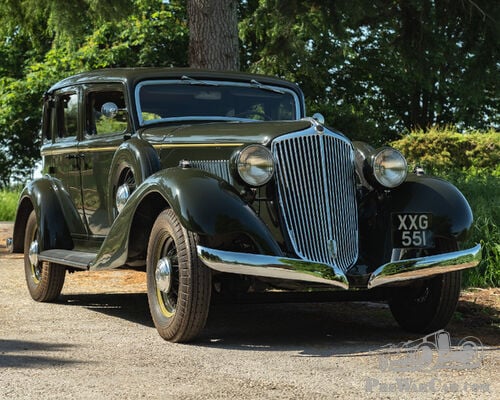
Graham Model 64 Standard Eight 'Blue Streak'
UK Registration No: XXG 551Chassis No: 1801069MOT: ExemptH&H ClassicsKelham Hall | Newark, Nottinghamshire
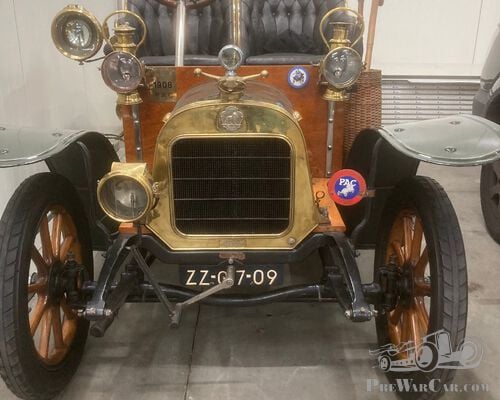

Lagonda LC Tourer 1934
The Lagonda story began in 1901 in Staines, a small town in the UK. The company enjoyed its greatest successes around 1935. During this period, the..