The global magazine and marketplace for classic car enthusiasts, by enthusiasts.


Filter
Classic Benz, Duesenberg for sale - Benz, Duesenberg cars for sale
-

Open to Offers! Duesenberg Model J Dual Cowl Phaeton coachwork built in the style of LaGrande with Engine J-241
Open to Offers! Duesenberg Model J Dual Cowl Phaeton coachwork built in the style of LaGrande with Engine J-241 Not complete - Great Restoration project -
1886 Benz Patent Motorwagen
The Benz Patent-Motorwagen (or motorcar), built in 1886, is widely regarded as the world's first automobile. The original cost of the vehicle in 1885 was $1,000 (equivalent to $26,337 in 2016). This is an exact replica of the original painstakingly constructed with reference to the original plans. The quality is superb & the car easy to driv.. -
1899 Benz Velo 3.5HP Dogcart - VCC Dated
1899 Benz Velo 3.5HP DogcartRegistration No. ST5979Chassis No. 1577 Engine No. 1472VCC Dating Certificate No. 3899 After developing a successful gasoline-powered engine in 1873, Benz focused on developing a motorised vehicle. Following disputes, he spli.. -
1931 Duesenberg Model J convertible sedan
Vehicle Highlights Chassis No. 2479Engine No. J 464ACD Category One Certified Original CarOne-Off CoachworkCCCA National First, Senior And Premier Award WinnerKnown Ownership History from New Vehicle DescriptionThis legendary Model J, with Chassis No. 2479.. -
1931 Duesenberg Model J Tourster by Derham | RM Sotheby's | The Monterey Auction
To Be OFFERED AT AUCTION at RM Sothebys' The Monterey Auction event, 13 - 15 August 2026. $2,250,000 - $3,250,000 USD One of the eight original, authentic Derham TourstersOriginal chassis, firewall, engine, and coachworkFormerly owned by Dr. Irwin Ginsberg, Andy Granatelli, and Joseph and Margie CassiniMeticulo.. -
1922 Duesenberg Model A Phaeton by Millspaugh & Irish For Sale
1922 Duesenberg Model A Phaeton by Millspaugh & Irish Chassis number: 798 Registration Number: Not currently registered. Engine Number 1111 Concours condition. This car when launched was a true standout. It was the very first seria.. -
1935 Duesenberg Model J "Sweep Panel" Dual-Cowl Phaeton by LaGrande | RM Sotheby's | Private Sales
Asking | $3,300,000 USD The final “Sweep Panel” Dual-Cowl Phaeton built by LaGrandeOriginally the New York Duesenberg factory branch demonstratorMultiple award-winning restoration by the noted Steve Babinsky, with further recent servicingA respected example with original frame, firewall, engine, and coachwork -
1935 Duesenberg Model JN Convertible Coupe by Rollston and Bohman & Schwartz | RM Sotheby's | The Monterey Auction
To Be OFFERED AT AUCTION at RM Sothebys' The Monterey Auction event, 13 - 15 August 2026. $5,750,000 - $8,000,000 USD Built for legendary actor Clark Gable, “The King of Hollywood”Restyled to Gable’s wishes by Bohman & Schwartz; a truly bespoke commissionUsed extensively by Gable with his beloved wife, Carole Lombar.. -
1886 Benz Patent Motor Wagen Replica
1886 Benz Patent Motor Wagen Replica.Chassis number: TBARegistration number: TBAVintage and Prestige Fine Motor Cars are proud to be offering this 1886 Benz Patent-Motorwagen Replica for sale. The Benz Patent-Motorwagen (or motorcar), built in 1886, is widely regarded as the world's first automobile. The original cost of the vehic..


Benz
D, 1885 – 1926
(1) Benz & Co, Rheinische Gasmotorenfabrik, Mannheim, 1885 – 1899
(2) Benz & Cie, Rheinische Gasmotorenfabrik AG, Mannheim, 1899 – 1911
(3) Benz & Cie, Rheinische Automobil- und Motorenfabrik AG, Mannheim, 1911 – 1926
Karl Benz is honoured throughout the world as the man who designed and built the first workable motor car driven by an internal combustion engine. It is established that in 1885 his first Benz car was ready and made its first trials. Benz’s ideas were concentrated from the beginning on a car as an organic unit of chassis and engine, not on motorization of existing vehicles. The first Benz car was a three-wheeler with two driven rear wheels. The engine was a horizontal single-cylinder with a vertical crankshaft which had a horizontal flywheel. It developed ¾hp and a speed of 8mph is recorded for one of the first trial runs. This prototype Benz car had some featured which are still very extensively used in automobile construction: the water-cooled engine, electric ignition, mechanically operated inlet valve, and a differential gear. This first Benz car still exists and belongs to the Deutsches Museum, Munich, to which it was presented by its inventor. Several Benz Patentwagen replicas were built and are now in different museums.
Only a few Benz cars were produced and for sale in the following years. At the Munich Exhibition of 1888 Benz had the opportunity of showing his improved Benz car to a wider public. Instead of the wire wheels of the first Benz Patentwagen the later models had wooden-spoked wheels. Engine output was increased to 2hp. Sales of Benz’ stationary gas engines were quite satisfactory, while interest in Benz motor cars was very limited and it was not until 1890 that Benz started a real, if small, ‘to order’ production. This was partly a result of exhibiting his Benz car at the Paris World Fair in 1889 which led to increasing sales by his French agent Emile Roger, who already sold Benz stationary engines. The other important factor was that Benz was joined by two new partners in 1890. These two men who possibly saved Benz from the fate of numerous other inventors, driven aground by financial difficulties, were Friedrich von Fischer and Julius Ganss. Fischer took over internal administration and Ganss became responsible for sales. Benz himself was free for further developments on the technical side of the business, which made sound progress. 1893 saw the production of the first 4-wheeled Benz car, the Benz Victoria. This model was also the basis for the first Benz van and Benz bus in 1895; its technical conception was also adopted for the Benz Velo of 1894. This model has a place in the history of motoring as the world’s first production car. Production figures for 1885 to 1893 were 69 cars. 67 cars left the factory in 1894, mainly Benz Velos. These figures increased to 135 cars in 1895 and 181 in 1896.
In 1896 the first Benz Kontra-Motor appeared, an engine with two horizontally opposed cylinders. The first Benz lorry was produced in the same year. In 1898 pneumatic tyres were adopted for the Benz Comfortable. Production in 1899 was 572 cars, which brought Benz into the first rank of car producers. This number was surpassed in the following year with a production of 603 units. The first Benz racing car appeared in 1899 and was the start of numerus racing successes.
After 1901 sales of Benz cars declined as Benz stuck to his now outdated designs. Mercedes’ successes led him to evolve new concepts of construction; the result was the 2-cylinder front-engined Parsifal presented in 1903, available with cardan or chain drive and various engine outputs. In the same year a new 4-cylinder engine appeared and was used in all subsequent Benz models. A 1903 racing car developed 60hp and participated in the Paris-Madrid race. Karl Benz himself left the company in 1903 although he rejoined shortly afterwards. In 1906 he joined his sons in the firm of C. Benz Söhne.
1906 saw Benz gaining a second place in the Herkomer Trial while in the same event in 1907 a 5hp Benz finished first. Second and third place in the Coppa Florio, 1907, first place in the Florida 100-Miles Race, 1908, second and third place in the French Grand Prix, 1908, and second and fourth place in the American Grand Prix, 1908, led the world records which were set with 150hp and 200hp Benz cars by Bruce-Brown, Robertson, Oldfield and Hémery. With the 200hp Blitzen Benz Burman covered a mile in 25.4 seconds from a flying start at Daytona Beach in 1911. This was a speed of 140.8mph, but was not recognized internationally as a Land Speed Record.
In 1910 Benz acquired the Süddeutsche Automobil-Fabrik of Gaggenau. Production of private Benz cars in this factory was given up and in the following years Benz concentrated on commercial vehicles there.
A wide range of Benz cars for sale was marketed in the 1910-1914 period, ranging from the 2-litre Benz 8/20ps up to really big machines like the 10.1-litre Benz 39/100ps, all with side valve engines and shaft drive. However, the 22-litre Benz 200hp (which cost £1800 in England in 1912, and must have been the largest-engined private car to go on the market) had ohv and final drive by side chains. Benz were successful in the Austrian Alpine Trials, the Tatra-Adria Trial and various trials in Russia, to name only a few. The great promoter of German motoring, Prince Henry of Prussia, used only Benz cars.
The first Benz 6-cylinder car was produced in 1914 with the type Benz 25/65ps 6.5 litre. In 1918 the Benz 6/18ps 4-cylinder 1540cc appeared, a type developed during the war. A very important Benz development was the precombustion chamber diesel engine. It was first used in 1922 for Benz Sendling agricultural tractors, and the first diesel-engined lorry by Benz appeared in 1924. These were steps towards later Mercedes-Benz diesel-engined cars. Another idea introduced by Benz which also appeared in later Mercedes-Benz cars was the swing axle. It was one feature of the 2-litre 6-cylinder Benz ‘teardrop’ racing car designed on Rumpler principles. However, this car was not a great success either in its racing or in its sports version. In the Grand Prix of Italy in 1923 they gained fourth and fifth place. In 1924 Benz and Mercedes began to combine their interests, amalgamating in 1926.
Source: Georgano, encyclopedia of motorcar; HON
The information is written with the greatest of care. However, if you have any suggested amendments please contact us at office@prewarcar.com
Duesenberg
US, 1920 – 1937, 1966
(1) Duesenberg Motor Co, Indianapolis, Ind., 1920 – 1937
(2) Duesenberg Corporation, Indianapolis, Ind., 1966
Fred Duesenberg began by making bicycles and designed his first Duesenberg car, the Mason, in 1904. He and his brother August made engines with horizontal overhead valves for the 1912 Mason racing cars, and founded Duesenberg Motors in the following year in order to produce marine engines and complete racing cars bearing the Duesenberg name. The most famous of the latter appeared in 1920: a 3-litre Bugatti-inspired Duesenberg straight-8 with single overhead camshaft and three (vertical) valves per cylinder. This Duesenberg won the 1921 French Grand Grand Prix. In the 1920s the Duesenberg racing cars were the great rivals of the Millers at Indianapolis, and victory was assured in 1924 by the adoption of a centrifugal blower on Duesenberg cars. Though a two-stroke 1½-litre 8-cylinder racing engine capable of 7.000rpm was made in 1926, this was not proceeded with. The horizontal-valve Duesenberg engine was taken over in 1920 by the Rochester Motor Manufacturing Co Inc and was used in various sporting and luxury cars.
Meanwhile, at the end of 1920, the first Duesenberg production car made its debut. This Duesenberg Model A was an extremely expensive, if very advanced, luxury car, embodying an 8-cylinder in-line engine – the first to be seen in an American production car – of 4.2 litres, basically similar to the Duesenberg racing unit, but with only two valves per cylinder and developing about 100bhp. There were also hydraulically-operated front wheel brakes – another ‘first’ as far as America was concerned. The Model A was current until 1926. A handful of its little-altered successor, the Duesenberg Model X, was made in 1926-1927, but in the former year E.L. Cord of Auburn acquired control of the Duesenberg company. He stipulated that Fred Duesenberg’s next car should be completely new, and a quite exceptional machine. In fact, the Duesenberg Model J, which made its bow at the end of 1928, was the most remarkable automobile in America: bigger, faster, more elaborate and more expensive than any other, yet also superior to them in refinement and good looks. Its 6.9-litre, 8-cylinder engine, made by Lycoming (a firm which Cord had also bought), had two chain-driven overhead camshafts operating four valves per cylinder; a layout of racing type unique among American cars at the time and said to develop 265bhp at 4250rpm – more than double the output of any rival. Although the complete Duesenberg car weighed more than 4980lb, it was claimed to be capable of 116mph in top gear and 89mph in second. Only Duesenberg Model J chassis were made for which $8500 was asked in 1929. Immensely long and strong and lowbuilt, Duesenberg cars were very popular with all the leading coachbuilders. The Duesenberg company preferred to sell cars complete with bodies designed by them but made by approved builders, such as Murphy, Bohman & Schwarts, Judkins, Derham and Le Baron. In this form, catalogued Duesenberg models cost up to $17.950. The transmission – apart form the double dry-plate clutch – was conventional, as was the suspension by half-elliptic springs and hydraulic shock absorbers. The brakes, of course, were hydraulic, with vacuum servo assistance from late 1929.
In 1932 a supercharged version of the Model J, the Duesenberg SJ, was added. To cope with the 320bhp now alleged to be available, bearings, reciprocating parts and valve springs were strengthened. Usually, the shortest Duesenberg J chassis was used, with the highest axle ratio and stronger front springs. A maximum speed of 129mph was attributed to the Duesenberg SJ, with an acceleration figure of 0-100mph in 17 seconds.
Duesenberg survived the Depression, but died in the collapse of the Cord Corporation in 1937. Attempts to revive the Duesenberg name were made in 1947 and in 1966. The first Duesenberg was unsuccessful, and in 1966 only one Duesenberg car was actually made, powered by a 7-litre V8 Chrysler engine with push-rod overhead valves, developing 431bhp at 5.000rpm. Transmission was automatic, front suspension was independent, and there were disc brakes. Body styling was by Ghia. This Duesenberg venture, too, collapsed.
Source: Georgano, encyclopedia of motorcar; TRN
The information is written with the greatest of care. However, if you have any suggested amendments please contact us at office@prewarcar.com


Featured
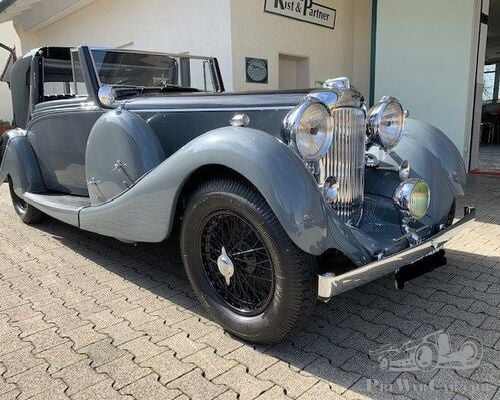
Lagonda LG 45 Coupe de Ville Sedanca by Mayfair
The successor to the M45, the LG45 was built around the same highly capable, competition-proven 4.5-litre Meadows inline-six engine, but featured r..
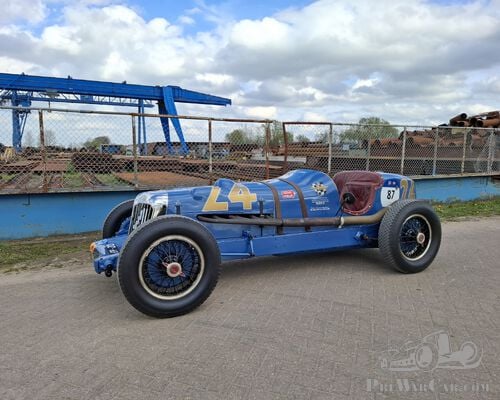
1932 - Graham " Lucenti " Indianapolis
Original participant of the 1932, 1934 and 1935 Indy 500. Best result: finishing 10th overall in the 1934 Indy 500 with driver “Herb” Ardinger...
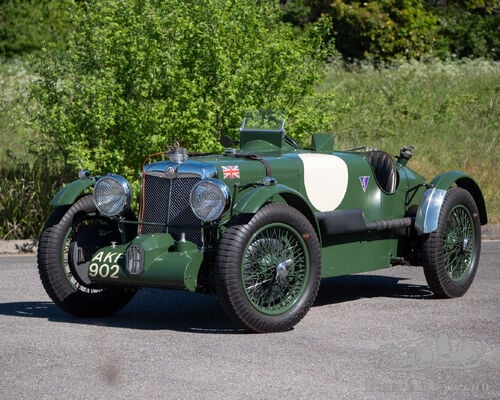
K3 Replica on KN Chassis
"The K3 Magnette must rank in the history books as the most famous and successful of all the record breaking MGs. With only 33 examples produced durin..