The global magazine and marketplace for classic car enthusiasts, by enthusiasts.


Filter
Classic Chenard Walcker, Duesenberg for sale - Chenard Walcker, Duesenberg cars for sale
-

Chenard & Walcker Model G
The Chenard & Walcker is a 1905 Model G, equipped with a 5-liter, four-cylinder engine producing 20 horsepower, enabling the car to reach a top speed of approximately 85 km/h | 50 mp/h. The body is a Double Phaeton and was crafted by the renowned coachbuilder Jean-Henri Labouredette. In addition to the radiator b.. -
Open to Offers! Duesenberg Model J Dual Cowl Phaeton coachwork built in the style of LaGrande with Engine J-241
Open to Offers! Duesenberg Model J Dual Cowl Phaeton coachwork built in the style of LaGrande with Engine J-241 Not complete - Great Restoration project -
1931 Duesenberg Model J convertible sedan
Vehicle Highlights Chassis No. 2479Engine No. J 464ACD Category One Certified Original CarOne-Off CoachworkCCCA National First, Senior And Premier Award WinnerKnown Ownership History from New Vehicle DescriptionThis legendary Model J, with Chassis No. 2479.. -
1931 Duesenberg Model J Tourster by Derham | RM Sotheby's | The Monterey Auction
To Be OFFERED AT AUCTION at RM Sothebys' The Monterey Auction event, 13 - 15 August 2026. $2,250,000 - $3,250,000 USD One of the eight original, authentic Derham TourstersOriginal chassis, firewall, engine, and coachworkFormerly owned by Dr. Irwin Ginsberg, Andy Granatelli, and Joseph and Margie CassiniMeticulo.. -
1922 Duesenberg Model A Phaeton by Millspaugh & Irish For Sale
1922 Duesenberg Model A Phaeton by Millspaugh & Irish Chassis number: 798 Registration Number: Not currently registered. Engine Number 1111 Concours condition. This car when launched was a true standout. It was the very first seria.. -
1935 Duesenberg Model J "Sweep Panel" Dual-Cowl Phaeton by LaGrande | RM Sotheby's | Private Sales
Asking | $3,300,000 USD The final “Sweep Panel” Dual-Cowl Phaeton built by LaGrandeOriginally the New York Duesenberg factory branch demonstratorMultiple award-winning restoration by the noted Steve Babinsky, with further recent servicingA respected example with original frame, firewall, engine, and coachwork -
1935 Duesenberg Model JN Convertible Coupe by Rollston and Bohman & Schwartz | RM Sotheby's | The Monterey Auction
To Be OFFERED AT AUCTION at RM Sothebys' The Monterey Auction event, 13 - 15 August 2026. $5,750,000 - $8,000,000 USD Built for legendary actor Clark Gable, “The King of Hollywood”Restyled to Gable’s wishes by Bohman & Schwartz; a truly bespoke commissionUsed extensively by Gable with his beloved wife, Carole Lombar..


Chenard-Walcker
France, 1901 – 1946
(1) Chenard, Walcker et Cie, Asnières, Seine, 1901 – 1907
(2) SA des Anciens Établissements Chenard et Walcker, Gennevilliers, Seine, 1907 – 1946
The Chenard-Walcker company was founded in 1899 and made tricycles before exhibiting the first Chenard-Walcker car at the 1901 Paris Salon. It was a 1.160cc twin with mechanically operated side valves in a T-head, coil ignition, four forward speeds, and a flitchplate frame. The most interesting feature was, however, the ‘double’ back axle with the drive taken by two cardan shafts independently of a second, dead axle beam. This was to be a feature of the Chenard-Walcker make until the middle 1920s, though at first a cheaper Chenard-Walcker 10hp car was for sale with conventional drive, and there as also a short-lived Chenard-Walcker 12hp twin with side-chain transmission in 1904. A 4.1-litre 4-cylinder with Iow-tension magneto ignition followed in 1903, and by 1905 only Chenard-Walcker fours were made, the smallest short-stroke 2.6-litre was made exclusively for export to Britain. By 1906 the Chenard-Walcker cars for sale had the classic radiator with round core. In 1907 Chenard-Walcker cars had pressed-steel chassis, twin transmission brakes, and no hand throttle. New during 1908 was a 9/10hp single that had a 4-speed gearbox, though neither this nor its companion twin was quoted after 1910, by which time L-head engines had arrived on the 2.1-litre P-type. From 1912 to 1914 the Chenard-Walcker cars had monobloc power units with full-pressure lubcrication. Friction dampers were standard, and capacities of the fours were 1.6-litres and 3-litres. A big six joined the Chenard-Walcker range in 1913.
The staple 1919 Chenard-Walcker was the usual uprated 1914 design, the 3-litre Chenard-Walcker UU, still with separate 4-speed gearbox and foot transmission brake; it was joined by a 2651cc Chenard-Walcker 12CV in 1920, and by a 2-litre, the Chenard-Walcker TT, in 1921, and a 3-speed 1½-litre Chenard-Walcker Type Y, appeared in 1923, these old-fashioned machines persisiting for several years. New in 1922, however, was the Touté-designed 3-litre, an ohc four with dry-sump lubcrication that gave close on 90bhp, and had the usual Hallot servo brakes on front wheels and transmission only. These Chenard-Walcker cars finished 1st and 2nd in the first Le Mans 24-Hour Race of 1923, as well as winning the 1924 Circuit des Routes Pavées. A 2-litre edition followed soon afterwards, these sports Chenard-Walcker cars being made until 1927. From 1925 there were also parallel sv touring editions of Chenard-Walcker with similar chassis and plug covers giving the appearance of ohv units.
In 1924 and 1925 the Chenard-Walcker company raced a bi-block straight-8 which in its final form had brakes on all four wheels, and achieved nearly 110mph on 130bhp. But it was never reliable though it was catalogued, at 84.525 francs for a Chenard-Walcker tourer. Much more successful were the 1100cc ‘Chenard-Walcker tanks’ for sale with 55bhp 2-bearing pushrod engines and differential-less back axles that had two successful racing seasons (1925 and 1926) and even staged a comeback in 1937, when two Chenard-Walcker examples finished 1st and 2nd in the Bol d’Or. For 1927 the company introduced the 8CV Chenard-Walcker Z2, a tough little family car with 1300cc sv short-stroke engine, magneto ignition, 4-speed gearbox, conventional rear axle, and fabric bodywork; it sold for 24.000 francs. That year, however, an association with Delahaye, which lasted until 1932, led to the rationalization of both companies’ ranges, and it became difficult to tell the two makes apart. A production edition of the ‘Chenard-Walcker tank’ came out in 1928 with a 1½-litre ioe engine, but this was the last Chenard-Walcker with any sporting potential; the range now consisted of pedestrian sv fours, plus a couple of Delahaye-like ioe sixes with capacities of 2½-litres and 2.9-litres. The smaller of these, the Chenard-Walcker 14CV, was still being made in 1934. In 1932 the Chenard-Walcker T11 appeared, a new 12CV four on the usual lines with a free-wheel as standard equipment. Then in 1934 Chenard-Walcker cars, now free of Delahaye influence, adopted transverse ifs. They also offered a 3560cc sv V8, the Chenard-Walcker Aigle 8, which used their own engine, in effect a double T11 unit. In 1935 the Chenard-Walcker cars had torsion-bar front suspension and the option of a Cotal gearbox, and ohv engines became available; the range consisted of two fours and the eight. A 4-cylinder fwd car did not go into production.
From 1937 onwards Chenard-Walcker cars slowly lost their individuality. Their bodies were replaced by Chausson coachwork identical to that of the Matford, and only one Chenard-Walcker model retained the 2.180cc ohv Chenard-Walcker engine. The other Chenard-Walcker cars had 1911cc 4-cylinder Citroën and 3622cc Matford units. Finally Citroën and Matford chassis were adopted as well and the Chenard engine dropped, the only ‘native’ components of the cars being their back axles – though the cabriolets were quite handsome, being of Vutotal type with no screen pillars. A few Chenard-Walcker 11CV and 21CV cars were made after World War 2, but from 1947 the staple Chenard-Walcker product was a forward-control light van, the development of which was continued by Peugeot after that company took over in 1951.
Source: Georgano, encyclopedia of motorcar; MCS
The information is written with the greatest of care. However, if you have any suggested amendments please contact us at office@prewarcar.com
Duesenberg
US, 1920 – 1937, 1966
(1) Duesenberg Motor Co, Indianapolis, Ind., 1920 – 1937
(2) Duesenberg Corporation, Indianapolis, Ind., 1966
Fred Duesenberg began by making bicycles and designed his first Duesenberg car, the Mason, in 1904. He and his brother August made engines with horizontal overhead valves for the 1912 Mason racing cars, and founded Duesenberg Motors in the following year in order to produce marine engines and complete racing cars bearing the Duesenberg name. The most famous of the latter appeared in 1920: a 3-litre Bugatti-inspired Duesenberg straight-8 with single overhead camshaft and three (vertical) valves per cylinder. This Duesenberg won the 1921 French Grand Grand Prix. In the 1920s the Duesenberg racing cars were the great rivals of the Millers at Indianapolis, and victory was assured in 1924 by the adoption of a centrifugal blower on Duesenberg cars. Though a two-stroke 1½-litre 8-cylinder racing engine capable of 7.000rpm was made in 1926, this was not proceeded with. The horizontal-valve Duesenberg engine was taken over in 1920 by the Rochester Motor Manufacturing Co Inc and was used in various sporting and luxury cars.
Meanwhile, at the end of 1920, the first Duesenberg production car made its debut. This Duesenberg Model A was an extremely expensive, if very advanced, luxury car, embodying an 8-cylinder in-line engine – the first to be seen in an American production car – of 4.2 litres, basically similar to the Duesenberg racing unit, but with only two valves per cylinder and developing about 100bhp. There were also hydraulically-operated front wheel brakes – another ‘first’ as far as America was concerned. The Model A was current until 1926. A handful of its little-altered successor, the Duesenberg Model X, was made in 1926-1927, but in the former year E.L. Cord of Auburn acquired control of the Duesenberg company. He stipulated that Fred Duesenberg’s next car should be completely new, and a quite exceptional machine. In fact, the Duesenberg Model J, which made its bow at the end of 1928, was the most remarkable automobile in America: bigger, faster, more elaborate and more expensive than any other, yet also superior to them in refinement and good looks. Its 6.9-litre, 8-cylinder engine, made by Lycoming (a firm which Cord had also bought), had two chain-driven overhead camshafts operating four valves per cylinder; a layout of racing type unique among American cars at the time and said to develop 265bhp at 4250rpm – more than double the output of any rival. Although the complete Duesenberg car weighed more than 4980lb, it was claimed to be capable of 116mph in top gear and 89mph in second. Only Duesenberg Model J chassis were made for which $8500 was asked in 1929. Immensely long and strong and lowbuilt, Duesenberg cars were very popular with all the leading coachbuilders. The Duesenberg company preferred to sell cars complete with bodies designed by them but made by approved builders, such as Murphy, Bohman & Schwarts, Judkins, Derham and Le Baron. In this form, catalogued Duesenberg models cost up to $17.950. The transmission – apart form the double dry-plate clutch – was conventional, as was the suspension by half-elliptic springs and hydraulic shock absorbers. The brakes, of course, were hydraulic, with vacuum servo assistance from late 1929.
In 1932 a supercharged version of the Model J, the Duesenberg SJ, was added. To cope with the 320bhp now alleged to be available, bearings, reciprocating parts and valve springs were strengthened. Usually, the shortest Duesenberg J chassis was used, with the highest axle ratio and stronger front springs. A maximum speed of 129mph was attributed to the Duesenberg SJ, with an acceleration figure of 0-100mph in 17 seconds.
Duesenberg survived the Depression, but died in the collapse of the Cord Corporation in 1937. Attempts to revive the Duesenberg name were made in 1947 and in 1966. The first Duesenberg was unsuccessful, and in 1966 only one Duesenberg car was actually made, powered by a 7-litre V8 Chrysler engine with push-rod overhead valves, developing 431bhp at 5.000rpm. Transmission was automatic, front suspension was independent, and there were disc brakes. Body styling was by Ghia. This Duesenberg venture, too, collapsed.
Source: Georgano, encyclopedia of motorcar; TRN
The information is written with the greatest of care. However, if you have any suggested amendments please contact us at office@prewarcar.com


Featured
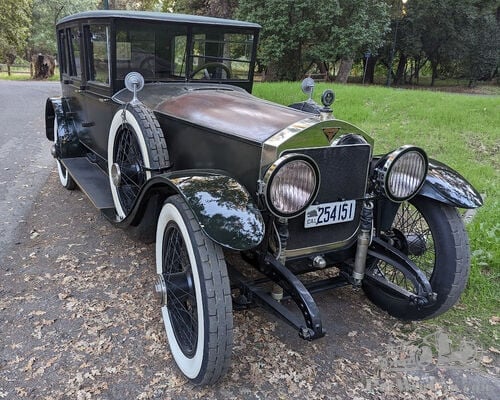
1916 Simplex, Crane model 5
1916 Simplex, Crane MODEL 5CUSTOM MADE HISTORIC PRESERVATION VEHICLE – READY TO TOUR!This Simplex recently completed th..
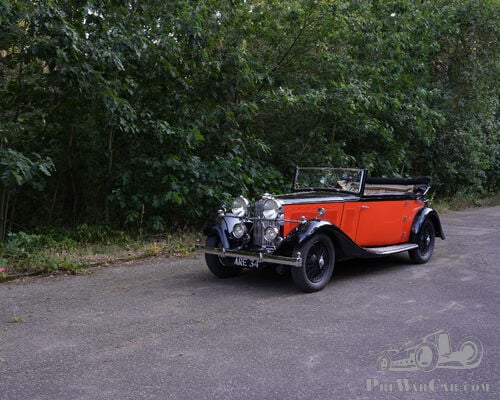
1934 Talbot AV105 Three Position Drophead Coupé
Registration no. ARE 34Chassis no. 35488 Much supporting paperworkRestored exampleVery usa..
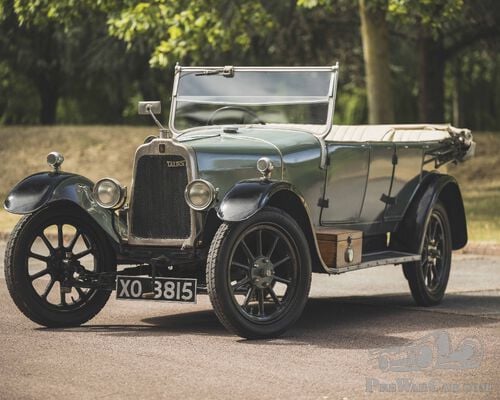
Rare RHD, low miles & great history file
This is an ONLINE-ONLY AUCTION at THE MARKET. The price shown here is the lower estimate. To see all the details, description, 250+ high-res photog..