The global magazine and marketplace for classic car enthusiasts, by enthusiasts.


Filter
Classic Nash, Duesenberg for sale - Nash, Duesenberg cars for sale
-

1931 Nash 4 door special sedan
Model: series 870, model 877-1560, 4-door special saloon Colour: dark blueInterior: beige fabricEngine: 8-cylinder in-line, 227.5 cubic inches, 78 hpTransmission: manual, 3 gearsCondition: unrestoredPrice: € 25,000 Description:Incredibly beautiful unrestored car in superb condition. .. -
Open to Offers! Duesenberg Model J Dual Cowl Phaeton coachwork built in the style of LaGrande with Engine J-241
Open to Offers! Duesenberg Model J Dual Cowl Phaeton coachwork built in the style of LaGrande with Engine J-241 Not complete - Great Restoration project -
1931 Duesenberg Model J convertible sedan
Vehicle Highlights Chassis No. 2479Engine No. J 464ACD Category One Certified Original CarOne-Off CoachworkCCCA National First, Senior And Premier Award WinnerKnown Ownership History from New Vehicle DescriptionThis legendary Model J, with Chassis No. 2479.. -
1931 Nash 480-455 Landaulette Sedan
Nash 480-455 Landaulette from 1931 only a few from these Landaulettes are made they say about 29 cars are produced like this. Frank Kennis Phone: 00.31.622.420.766 or mail me: info@KennisCars.NL www.KennisCars.NL Classic Car Dealer for Europe Cadillac ; Mercedes ; Rolls-Royce ; Delage ; Bugatti ; Bentley ; Dodge ; Opel.. -
1931 Duesenberg Model J Tourster by Derham | RM Sotheby's | The Monterey Auction
To Be OFFERED AT AUCTION at RM Sothebys' The Monterey Auction event, 13 - 15 August 2026. $2,250,000 - $3,250,000 USD One of the eight original, authentic Derham TourstersOriginal chassis, firewall, engine, and coachworkFormerly owned by Dr. Irwin Ginsberg, Andy Granatelli, and Joseph and Margie CassiniMeticulo.. -
Nash 1933 Club Sedan Big Six 1127
Beautifull Nash 1127 Club Sedan with 6 cylinder engine 3835 CC with 75 HP. The Nash has dutch documents and is in a good running condition. This could be your ultimate Bony and Clide car. Frank Kennis Phone: 00.31.622.420.766 or mail me: info@KennisCars.NL www.KennisCars.NL Classic Car Dealer for Europe Cadillac ; Mercedes ; Rolls-Royce ; .. -
1922 Duesenberg Model A Phaeton by Millspaugh & Irish For Sale
1922 Duesenberg Model A Phaeton by Millspaugh & Irish Chassis number: 798 Registration Number: Not currently registered. Engine Number 1111 Concours condition. This car when launched was a true standout. It was the very first seria.. -
1931 Nash ”Eight-70” 871 2d Convertible Sedan Landau
The car has undergone a complete renovation regarding chassis, engine, driveline and convertible topThe engine is drilled, new pistons and connecting rod bearings and new frame bearings.The body is in new condition and the convertible top is newly manufactured. Some minor work remains to complete it for registration and inspection... -
1935 Duesenberg Model J "Sweep Panel" Dual-Cowl Phaeton by LaGrande | RM Sotheby's | Private Sales
Asking | $3,300,000 USD The final “Sweep Panel” Dual-Cowl Phaeton built by LaGrandeOriginally the New York Duesenberg factory branch demonstratorMultiple award-winning restoration by the noted Steve Babinsky, with further recent servicingA respected example with original frame, firewall, engine, and coachwork -
1935 Duesenberg Model JN Convertible Coupe by Rollston and Bohman & Schwartz | RM Sotheby's | The Monterey Auction
To Be OFFERED AT AUCTION at RM Sothebys' The Monterey Auction event, 13 - 15 August 2026. $5,750,000 - $8,000,000 USD Built for legendary actor Clark Gable, “The King of Hollywood”Restyled to Gable’s wishes by Bohman & Schwartz; a truly bespoke commissionUsed extensively by Gable with his beloved wife, Carole Lombar..


Nash
US, 1917 – 1957
(1) Nash Motor Co, Kenosha, Wisc., 1917 – 1954
(2) American Motors Corp, Kenosha, Wisc., 1954 – 1957
Charles W. Nash, the former President of General Motors, acquired the Thos. B. Jeffery Co in July 1916, and from the 1918 season onwards the cars were marketed under his name, Nash cars. The first Nash car was a 4-litre six with push-rod-operated overhead valves, followed in 1922 by a 4-cylinder Nash car which also had overhead valves at a time when most American manufacturers adhered to the L-head. Rubber-mounted engines appeared in the same year on Nash cars, when Nash sold 41.000 medium-priced Nash cars (the Nash four cost $985, the Nash six about $500 more). In 1924 Nash cars acquired the defunct Mitchell concern at Racine and the ailing Lafayette Co of Milwaukee, producers of a luxury V8 (when the latter name was revived in 1934 it was used for an uninspired sv 6-cylinder machine selling for under $600). They also produced, in 1925 – 1926, the 6-cylinder Nash Ajax, an sv Nash cars that they developed into a cheap line. During the latter part of the Vintage era the Nash carcompany concentrated on 6-cylinder Nash cars, with side valves in the cheaper Nash car models and overhead valves in the higher-priced range, though 1930 saw a Nash car with a 4.9-litre straight-8 with dual coil ignition and overhead valves, a type that was progressively developed until 1942. Engines of this type Nash car were used in the British Jensen of 1939.
The Nash car company successfully rode out the Depression though sales dropped to below 15.000 Nash cars in 1933, when the Nash car company were building a really big eight Nash car with an 11ft 10in wheelbase and a capacity of 5.3-litres as well as two sixes and a smaller straight-8. Synchromesh had been adopted on Nash cars in 1932, and overdrive became an option in 1935, when the bigger Nash cars had the fashionable fastbacks and spatted rear wheels. Other options on the Nash car widely publicized in the later 1930s were seats convertible into a bed and the Nash car firm’s ‘Weather Eye’ system of air conditioning. Coil-spring independent front suspension and steering-column gear-change followed in 1939, in which year a version of the Nash Ambassador Six was available in England with the option of a Perkins 4.7-litre diesel engine in place of the usual push-rod ohv petrol unit. Unitary construction appeared for the first time on the inexpensive sv 6-cylinder 600 Nash car sedan, introduced for 1941 at $785. This Nash car was the ancestor of the famous Rambler series and reappeared in 1945. Only 6-cylinder Nash cars were made from 1945 until 1954, and with the advent of the Nash Airflyte range in 1949 unitary construction was standardized. These Nash cars had all four wheels enclosed, and a one-piece wrap-around windscreen.
In 1950 there came the experimental NXI Nash car convertible with an Austin A40 engine, later made for Nash cars by Austin of Birmingham as the Metropolitan, while in 1951 there appeared the 3.8-litre Nash-Healey roadster, a British Healey with an ohv 6-cylinder Nash car engine. From 1950 onwards the Rambler accounted for most of Nash cars production, but the original Nash carname survived the amalgamation with Hudson and the creation of American Motors in 1954. In 1955 the big Nash cars were fitted with an ohv 5.244cc V8 engine, this and its Ultramatic transmission being made by Packard. A 5.8-litre AMC-built eight was adopted in 1957 by Nash cars, but sales were negligible and the 1958 Nash cars were known as Rambler Ambassadors.
Source: Georgano, encyclopedia of motorcar; MCS
The information is written with the greatest of care. However, if you have any suggested amendments please contact us at office@prewarcar.com
Duesenberg
US, 1920 – 1937, 1966
(1) Duesenberg Motor Co, Indianapolis, Ind., 1920 – 1937
(2) Duesenberg Corporation, Indianapolis, Ind., 1966
Fred Duesenberg began by making bicycles and designed his first Duesenberg car, the Mason, in 1904. He and his brother August made engines with horizontal overhead valves for the 1912 Mason racing cars, and founded Duesenberg Motors in the following year in order to produce marine engines and complete racing cars bearing the Duesenberg name. The most famous of the latter appeared in 1920: a 3-litre Bugatti-inspired Duesenberg straight-8 with single overhead camshaft and three (vertical) valves per cylinder. This Duesenberg won the 1921 French Grand Grand Prix. In the 1920s the Duesenberg racing cars were the great rivals of the Millers at Indianapolis, and victory was assured in 1924 by the adoption of a centrifugal blower on Duesenberg cars. Though a two-stroke 1½-litre 8-cylinder racing engine capable of 7.000rpm was made in 1926, this was not proceeded with. The horizontal-valve Duesenberg engine was taken over in 1920 by the Rochester Motor Manufacturing Co Inc and was used in various sporting and luxury cars.
Meanwhile, at the end of 1920, the first Duesenberg production car made its debut. This Duesenberg Model A was an extremely expensive, if very advanced, luxury car, embodying an 8-cylinder in-line engine – the first to be seen in an American production car – of 4.2 litres, basically similar to the Duesenberg racing unit, but with only two valves per cylinder and developing about 100bhp. There were also hydraulically-operated front wheel brakes – another ‘first’ as far as America was concerned. The Model A was current until 1926. A handful of its little-altered successor, the Duesenberg Model X, was made in 1926-1927, but in the former year E.L. Cord of Auburn acquired control of the Duesenberg company. He stipulated that Fred Duesenberg’s next car should be completely new, and a quite exceptional machine. In fact, the Duesenberg Model J, which made its bow at the end of 1928, was the most remarkable automobile in America: bigger, faster, more elaborate and more expensive than any other, yet also superior to them in refinement and good looks. Its 6.9-litre, 8-cylinder engine, made by Lycoming (a firm which Cord had also bought), had two chain-driven overhead camshafts operating four valves per cylinder; a layout of racing type unique among American cars at the time and said to develop 265bhp at 4250rpm – more than double the output of any rival. Although the complete Duesenberg car weighed more than 4980lb, it was claimed to be capable of 116mph in top gear and 89mph in second. Only Duesenberg Model J chassis were made for which $8500 was asked in 1929. Immensely long and strong and lowbuilt, Duesenberg cars were very popular with all the leading coachbuilders. The Duesenberg company preferred to sell cars complete with bodies designed by them but made by approved builders, such as Murphy, Bohman & Schwarts, Judkins, Derham and Le Baron. In this form, catalogued Duesenberg models cost up to $17.950. The transmission – apart form the double dry-plate clutch – was conventional, as was the suspension by half-elliptic springs and hydraulic shock absorbers. The brakes, of course, were hydraulic, with vacuum servo assistance from late 1929.
In 1932 a supercharged version of the Model J, the Duesenberg SJ, was added. To cope with the 320bhp now alleged to be available, bearings, reciprocating parts and valve springs were strengthened. Usually, the shortest Duesenberg J chassis was used, with the highest axle ratio and stronger front springs. A maximum speed of 129mph was attributed to the Duesenberg SJ, with an acceleration figure of 0-100mph in 17 seconds.
Duesenberg survived the Depression, but died in the collapse of the Cord Corporation in 1937. Attempts to revive the Duesenberg name were made in 1947 and in 1966. The first Duesenberg was unsuccessful, and in 1966 only one Duesenberg car was actually made, powered by a 7-litre V8 Chrysler engine with push-rod overhead valves, developing 431bhp at 5.000rpm. Transmission was automatic, front suspension was independent, and there were disc brakes. Body styling was by Ghia. This Duesenberg venture, too, collapsed.
Source: Georgano, encyclopedia of motorcar; TRN
The information is written with the greatest of care. However, if you have any suggested amendments please contact us at office@prewarcar.com


Featured
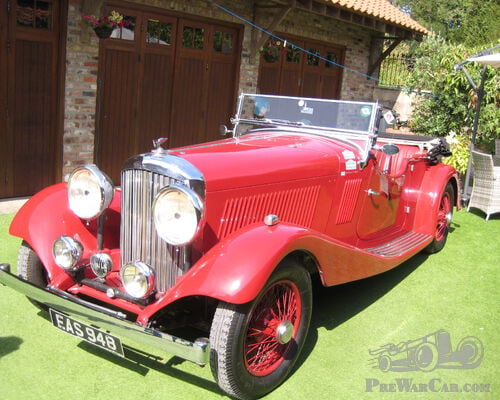
1935 Bentley 3.5 ltr. VDP 4str. Tourer
Chassis B 123 CW was first registered 14th March 1935, and in the late eighties underwent a " body-off" restoration and fitted with VANDEN PLAS
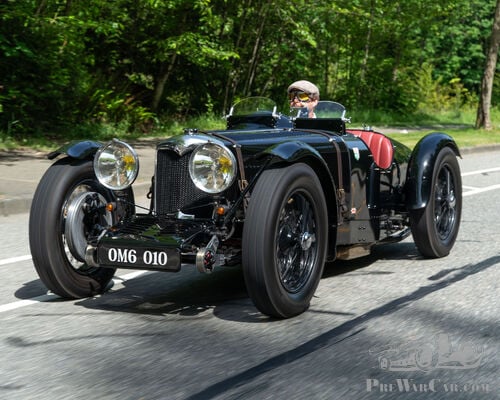
Riley 14/6 Special 1933
The ExperienceStep into the golden age of British motoring. This 1933 Riley 14/6 Special is a masterclass in pre-w..
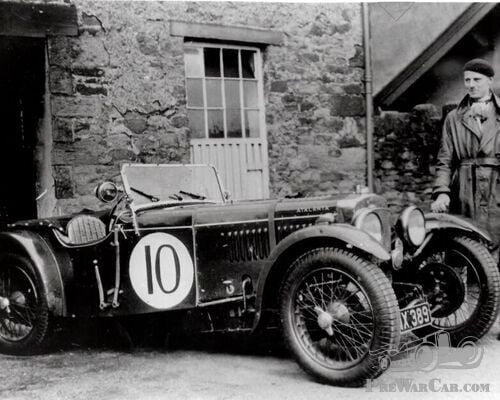
Fraser Nash TT Replica
AHX 389 ( chassis no. 2073, engine no. 10367).An important and correct short-chassis TT Replica with known history from new. Ex. H. P..