The global magazine and marketplace for classic car enthusiasts, by enthusiasts.


Filter
Classic Duesenberg, Plymouth for sale - Duesenberg, Plymouth cars for sale
-

1940 Plymouth P10 Deluxe Convertible Coupe | RM Sotheby's | The Hershey Auction
To Be OFFERED AT AUCTION WITHOUT RESERVE at RM Sothebys' The Hershey Auction event, 7 - 8 October 2026. Offered Without Reserve | $60,000 - $80,000 USD Please check back soon as our dedicated cataloguing team is preparing the description for this lot. To view this car and others currently consigned to this auction, please visit the RM website a.. -
1935 Duesenberg Model J "Sweep Panel" Dual-Cowl Phaeton by LaGrande | RM Sotheby's | Private Sales
Asking | $3,300,000 USD The final “Sweep Panel” Dual-Cowl Phaeton built by LaGrandeOriginally the New York Duesenberg factory branch demonstratorMultiple award-winning restoration by the noted Steve Babinsky, with further recent servicingA respected example with original frame, firewall, engine, and coachwork -
1935 Duesenberg Model JN Convertible Coupe by Rollston and Bohman & Schwartz | RM Sotheby's | The Monterey Auction
To Be OFFERED AT AUCTION at RM Sothebys' The Monterey Auction event, 13 - 15 August 2026. $5,750,000 - $8,000,000 USD Built for legendary actor Clark Gable, “The King of Hollywood”Restyled to Gable’s wishes by Bohman & Schwartz; a truly bespoke commissionUsed extensively by Gable with his beloved wife, Carole Lombar.. -
Open to Offers! Duesenberg Model J Dual Cowl Phaeton coachwork built in the style of LaGrande with Engine J-241
Open to Offers! Duesenberg Model J Dual Cowl Phaeton coachwork built in the style of LaGrande with Engine J-241 Not complete - Great Restoration project -
1931 Duesenberg Model J convertible sedan
Vehicle Highlights Chassis No. 2479Engine No. J 464ACD Category One Certified Original CarOne-Off CoachworkCCCA National First, Senior And Premier Award WinnerKnown Ownership History from New Vehicle DescriptionThis legendary Model J, with Chassis No. 2479.. -
1922 Duesenberg Model A Phaeton by Millspaugh & Irish For Sale
1922 Duesenberg Model A Phaeton by Millspaugh & Irish Chassis number: 798 Registration Number: Not currently registered. Engine Number 1111 Concours condition. This car when launched was a true standout. It was the very first seria.. -
1931 Duesenberg Model J Tourster by Derham | RM Sotheby's | The Monterey Auction
To Be OFFERED AT AUCTION at RM Sothebys' The Monterey Auction event, 13 - 15 August 2026. $2,250,000 - $3,250,000 USD One of the eight original, authentic Derham TourstersOriginal chassis, firewall, engine, and coachworkFormerly owned by Dr. Irwin Ginsberg, Andy Granatelli, and Joseph and Margie CassiniMeticulo..


Duesenberg
US, 1920 – 1937, 1966
(1) Duesenberg Motor Co, Indianapolis, Ind., 1920 – 1937
(2) Duesenberg Corporation, Indianapolis, Ind., 1966
Fred Duesenberg began by making bicycles and designed his first Duesenberg car, the Mason, in 1904. He and his brother August made engines with horizontal overhead valves for the 1912 Mason racing cars, and founded Duesenberg Motors in the following year in order to produce marine engines and complete racing cars bearing the Duesenberg name. The most famous of the latter appeared in 1920: a 3-litre Bugatti-inspired Duesenberg straight-8 with single overhead camshaft and three (vertical) valves per cylinder. This Duesenberg won the 1921 French Grand Grand Prix. In the 1920s the Duesenberg racing cars were the great rivals of the Millers at Indianapolis, and victory was assured in 1924 by the adoption of a centrifugal blower on Duesenberg cars. Though a two-stroke 1½-litre 8-cylinder racing engine capable of 7.000rpm was made in 1926, this was not proceeded with. The horizontal-valve Duesenberg engine was taken over in 1920 by the Rochester Motor Manufacturing Co Inc and was used in various sporting and luxury cars.
Meanwhile, at the end of 1920, the first Duesenberg production car made its debut. This Duesenberg Model A was an extremely expensive, if very advanced, luxury car, embodying an 8-cylinder in-line engine – the first to be seen in an American production car – of 4.2 litres, basically similar to the Duesenberg racing unit, but with only two valves per cylinder and developing about 100bhp. There were also hydraulically-operated front wheel brakes – another ‘first’ as far as America was concerned. The Model A was current until 1926. A handful of its little-altered successor, the Duesenberg Model X, was made in 1926-1927, but in the former year E.L. Cord of Auburn acquired control of the Duesenberg company. He stipulated that Fred Duesenberg’s next car should be completely new, and a quite exceptional machine. In fact, the Duesenberg Model J, which made its bow at the end of 1928, was the most remarkable automobile in America: bigger, faster, more elaborate and more expensive than any other, yet also superior to them in refinement and good looks. Its 6.9-litre, 8-cylinder engine, made by Lycoming (a firm which Cord had also bought), had two chain-driven overhead camshafts operating four valves per cylinder; a layout of racing type unique among American cars at the time and said to develop 265bhp at 4250rpm – more than double the output of any rival. Although the complete Duesenberg car weighed more than 4980lb, it was claimed to be capable of 116mph in top gear and 89mph in second. Only Duesenberg Model J chassis were made for which $8500 was asked in 1929. Immensely long and strong and lowbuilt, Duesenberg cars were very popular with all the leading coachbuilders. The Duesenberg company preferred to sell cars complete with bodies designed by them but made by approved builders, such as Murphy, Bohman & Schwarts, Judkins, Derham and Le Baron. In this form, catalogued Duesenberg models cost up to $17.950. The transmission – apart form the double dry-plate clutch – was conventional, as was the suspension by half-elliptic springs and hydraulic shock absorbers. The brakes, of course, were hydraulic, with vacuum servo assistance from late 1929.
In 1932 a supercharged version of the Model J, the Duesenberg SJ, was added. To cope with the 320bhp now alleged to be available, bearings, reciprocating parts and valve springs were strengthened. Usually, the shortest Duesenberg J chassis was used, with the highest axle ratio and stronger front springs. A maximum speed of 129mph was attributed to the Duesenberg SJ, with an acceleration figure of 0-100mph in 17 seconds.
Duesenberg survived the Depression, but died in the collapse of the Cord Corporation in 1937. Attempts to revive the Duesenberg name were made in 1947 and in 1966. The first Duesenberg was unsuccessful, and in 1966 only one Duesenberg car was actually made, powered by a 7-litre V8 Chrysler engine with push-rod overhead valves, developing 431bhp at 5.000rpm. Transmission was automatic, front suspension was independent, and there were disc brakes. Body styling was by Ghia. This Duesenberg venture, too, collapsed.
Source: Georgano, encyclopedia of motorcar; TRN
The information is written with the greatest of care. However, if you have any suggested amendments please contact us at office@prewarcar.com
Plymouth
US, 1928 to date
Chrysler Corporation, Detroit, Mich.
The 4-cylinder 21hp Plymouth car appeared in 1928 at a list price of $725 for a sedan. This Plymouth car replaced the earlier 4-cylinder Chryslers and represented a serious challenge for Ford and Chevrolet in their lowest price class. The Plymouth car had side valves, internal-expanding hydraulic brakes and ribbon-type radiator and gave the Plymouth car a close resemblance to the 1928 Chryslers and De Sotos, and Plymouth cars sold over 100.000 in its first year, even improving its sales position in the bleak economic climate of 1932. Plymouth cars adhered to four cylinders until 1933, when the Plymouth PD-series 6-cylinder was listed at less than $600. 1934 de luxe models of Plymouth cars had independent front suspension, but this was dropped after a year and did not reappear for some time on Plymouth cars. The standard engine in the later 1930 Plymouth cars had a capacity of 3.3-litres, rather smaller than that used in comparable Chevrolets and Fords: a small-bore 2.8-litre version Plymouth car was made for export up to 1939, but the name Plymouth was not usually found on Plymouth cars sold in England, which were nominally Chrysler Kew and Wimbledon sixes. After World War 2 evolution followed that of other Chrysler Corporation cars closely, the old-fashioned styling losing the Plymouth car division its long-held third place in American sales to Buick. Further, Plymouth cars retained the L-head six as its staple power unit right up to 1955, when Flight Sweep versions were introduced with over-square ohv V8 engines on accepted American lines in a variety of powers from 157 to 177bhp. The capacity of these Plymouth cars had 4.3-litres, while the six, now of 3.8-litres, remained available. These 1955 Plymouth cars were lower and longer than their predecessors and could be obtained with synchromesh, overdrive or automatic gearboxes.
The Plymouth Fury models of the ensuing decade represented a breakaway from the traditional Plymouth stolid family car, while the Plymouth Car Division was also responsible for Chrysler’s contribution to the compacts, the Plymouth Valiant launched for 1960. This Plymouth car had rather more European styling than its competitors, with a dummy spare-wheel moulding on the tail; interesting items of specification were the unitary construction of the Plymouth car, alternator ignition, and inclined in-line 2.8-litre ohv 6-cylinder engine. The influence of the Plymouth GT car on America resulted in the Plymouth Barracuda of 1965, a fastback coupé using the Valiant’s 8ft 10in wheelbase and a 4½-litre V8 power unit. Plymouth cars, like Ford and Chevrolet, was aiming at comprehensive coverage of the low and medium price market in 1966, with the compact Plymouth Valiant, the sports-compact Plymouth Barracuda, the medium-sized Plymouth Belvedere, the full-size Plymouth Fury, and the luxurious ‘VIP’ 4-door hardtop Plymouth car, offered only with a 5.2-litre V8 engine and selling for $2.930. An increasing emphasis on sporting Plymouth cars was detectable by 1968, when in addition to the established Barracuda there were two other sports coupés Plymouth car, the Plymouth GTX and the Plymouth Road Runner. All three Plymouth cars were available with 4-speed manual gearboxes and the 6.981cc 425bhp hemi-head V8 also used by Dodge. In 1970, when Valiant prices started at a low $2.172, there was also a Valiant sports coupé, the Plymouth Duster.
In 1971 Plymouth car company added a sub-compact to their Plymouth car range when they offered the 1½-litre Hillman Avenger as the Plymouth Cricket. The 1972 range of Plymouth cars embraced the Valiant on a 9ft wheelbase, the Barracudas and Satellites, and the full-size Furys with V8 engines and automatic transmission as standard. Engines in the Plymouth cars ranged from the Valiant’s 3.2-litre and 3.7-litre sixes up to the largest Chrysler unit, a V8 of 7.210cc. Electronic ignition was offered on the costliest Barracuda model. Casualties of new Federal regulations were the hemi-head engine and convertibles, and the same range Plymouth cars with minor improvements, among them manually-operated sun roofs, was offerd in 1973.
Source: Georgano, encyclopedia of motorcar; MCS
The information is written with the greatest of care. However, if you have any suggested amendments please contact us at office@prewarcar.com


Featured
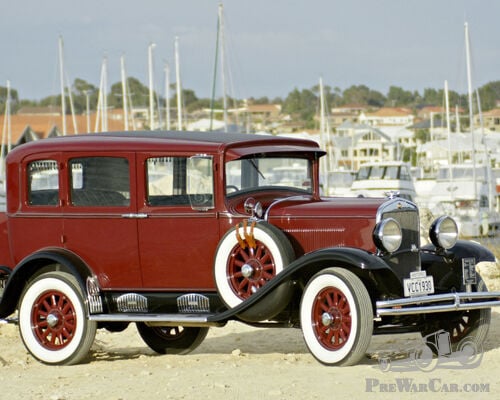
1930 Chrysler 66 Six-Wheel Equipped Royal Sedan
An exceptionally well restored and highly awarded Chrysler 66 Royal Sedan, with only two owners in nearly 97 years.The present owner ..
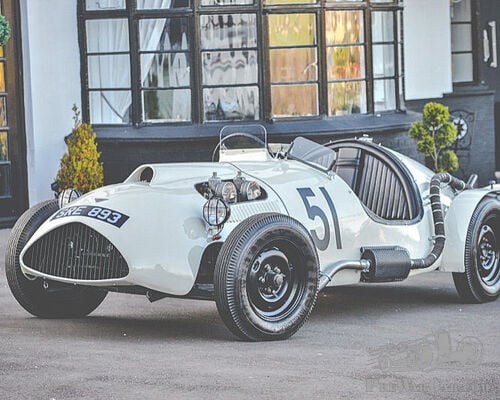
1933 Alvis 3.0 Special - One-Off Alloy Body | Period Competition Car | Featured in “Alvis – A Century of Drivers”
1933 Alvis 3. 0 Special - One-Off Alloy-Body | Period Competition Car | Featured in “Alvis – A Century of Drivers”
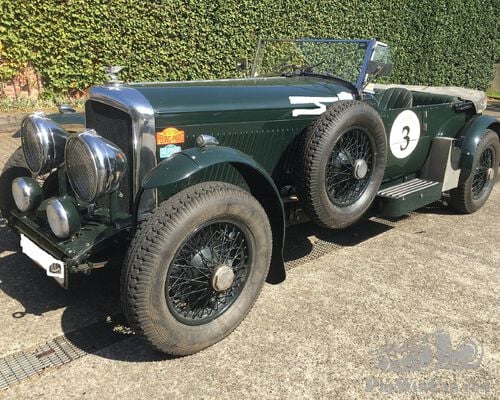
Bentley Derby Special Open Rally Car
This Bentley Derby, manufactured in 1935, has been rebuilt into a short and long-distance rally car. Full rebuilt engine in 2021, Since 2021 low mi..