The global magazine and marketplace for classic car enthusiasts, by enthusiasts.


Filter
Classic Duesenberg, Vulcan for sale - Duesenberg, Vulcan cars for sale
-

1935 Duesenberg Model JN Convertible Coupe by Rollston and Bohman & Schwartz | RM Sotheby's | The Monterey Auction
To Be OFFERED AT AUCTION at RM Sothebys' The Monterey Auction event, 13 - 15 August 2026. $5,750,000 - $8,000,000 USD Built for legendary actor Clark Gable, “The King of Hollywood”Restyled to Gable’s wishes by Bohman & Schwartz; a truly bespoke commissionUsed extensively by Gable with his beloved wife, Carole Lombar.. -
Open to Offers! Duesenberg Model J Dual Cowl Phaeton coachwork built in the style of LaGrande with Engine J-241
Open to Offers! Duesenberg Model J Dual Cowl Phaeton coachwork built in the style of LaGrande with Engine J-241 Not complete - Great Restoration project -
1931 Duesenberg Model J convertible sedan
Vehicle Highlights Chassis No. 2479Engine No. J 464ACD Category One Certified Original CarOne-Off CoachworkCCCA National First, Senior And Premier Award WinnerKnown Ownership History from New Vehicle DescriptionThis legendary Model J, with Chassis No. 2479.. -
1931 Duesenberg Model J Disappearing Top Convertible Coupe by Murphy | RM Sotheby's | Private Sales
Sale Agreed Formerly part of the Paul and Chris Andrews CollectionRetains numbers-matching chassis, firewall, engine, and coachwork; wonderful purity throughoutAuburn Cord Duesenberg (ACD) Club Certified Category 1 (D-146)Well-preserved, multiple award-winning restoration For many enthusiasts, Murphy.. -
1922 Duesenberg Model A Phaeton by Millspaugh & Irish For Sale
1922 Duesenberg Model A Phaeton by Millspaugh & Irish Chassis number: 798 Registration Number: Not currently registered. Engine Number 1111 Concours condition. This car when launched was a true standout. It was the very first seria.. -
1931 Duesenberg Model J Tourster by Derham | RM Sotheby's | The Monterey Auction
To Be OFFERED AT AUCTION at RM Sothebys' The Monterey Auction event, 13 - 15 August 2026. $2,250,000 - $3,250,000 USD One of the eight original, authentic Derham TourstersOriginal chassis, firewall, engine, and coachworkFormerly owned by Dr. Irwin Ginsberg, Andy Granatelli, and Joseph and Margie CassiniMeticulo..


Duesenberg
US, 1920 – 1937, 1966
(1) Duesenberg Motor Co, Indianapolis, Ind., 1920 – 1937
(2) Duesenberg Corporation, Indianapolis, Ind., 1966
Fred Duesenberg began by making bicycles and designed his first Duesenberg car, the Mason, in 1904. He and his brother August made engines with horizontal overhead valves for the 1912 Mason racing cars, and founded Duesenberg Motors in the following year in order to produce marine engines and complete racing cars bearing the Duesenberg name. The most famous of the latter appeared in 1920: a 3-litre Bugatti-inspired Duesenberg straight-8 with single overhead camshaft and three (vertical) valves per cylinder. This Duesenberg won the 1921 French Grand Grand Prix. In the 1920s the Duesenberg racing cars were the great rivals of the Millers at Indianapolis, and victory was assured in 1924 by the adoption of a centrifugal blower on Duesenberg cars. Though a two-stroke 1½-litre 8-cylinder racing engine capable of 7.000rpm was made in 1926, this was not proceeded with. The horizontal-valve Duesenberg engine was taken over in 1920 by the Rochester Motor Manufacturing Co Inc and was used in various sporting and luxury cars.
Meanwhile, at the end of 1920, the first Duesenberg production car made its debut. This Duesenberg Model A was an extremely expensive, if very advanced, luxury car, embodying an 8-cylinder in-line engine – the first to be seen in an American production car – of 4.2 litres, basically similar to the Duesenberg racing unit, but with only two valves per cylinder and developing about 100bhp. There were also hydraulically-operated front wheel brakes – another ‘first’ as far as America was concerned. The Model A was current until 1926. A handful of its little-altered successor, the Duesenberg Model X, was made in 1926-1927, but in the former year E.L. Cord of Auburn acquired control of the Duesenberg company. He stipulated that Fred Duesenberg’s next car should be completely new, and a quite exceptional machine. In fact, the Duesenberg Model J, which made its bow at the end of 1928, was the most remarkable automobile in America: bigger, faster, more elaborate and more expensive than any other, yet also superior to them in refinement and good looks. Its 6.9-litre, 8-cylinder engine, made by Lycoming (a firm which Cord had also bought), had two chain-driven overhead camshafts operating four valves per cylinder; a layout of racing type unique among American cars at the time and said to develop 265bhp at 4250rpm – more than double the output of any rival. Although the complete Duesenberg car weighed more than 4980lb, it was claimed to be capable of 116mph in top gear and 89mph in second. Only Duesenberg Model J chassis were made for which $8500 was asked in 1929. Immensely long and strong and lowbuilt, Duesenberg cars were very popular with all the leading coachbuilders. The Duesenberg company preferred to sell cars complete with bodies designed by them but made by approved builders, such as Murphy, Bohman & Schwarts, Judkins, Derham and Le Baron. In this form, catalogued Duesenberg models cost up to $17.950. The transmission – apart form the double dry-plate clutch – was conventional, as was the suspension by half-elliptic springs and hydraulic shock absorbers. The brakes, of course, were hydraulic, with vacuum servo assistance from late 1929.
In 1932 a supercharged version of the Model J, the Duesenberg SJ, was added. To cope with the 320bhp now alleged to be available, bearings, reciprocating parts and valve springs were strengthened. Usually, the shortest Duesenberg J chassis was used, with the highest axle ratio and stronger front springs. A maximum speed of 129mph was attributed to the Duesenberg SJ, with an acceleration figure of 0-100mph in 17 seconds.
Duesenberg survived the Depression, but died in the collapse of the Cord Corporation in 1937. Attempts to revive the Duesenberg name were made in 1947 and in 1966. The first Duesenberg was unsuccessful, and in 1966 only one Duesenberg car was actually made, powered by a 7-litre V8 Chrysler engine with push-rod overhead valves, developing 431bhp at 5.000rpm. Transmission was automatic, front suspension was independent, and there were disc brakes. Body styling was by Ghia. This Duesenberg venture, too, collapsed.
Source: Georgano, encyclopedia of motorcar; TRN
The information is written with the greatest of care. However, if you have any suggested amendments please contact us at office@prewarcar.com
Vulcan
GB, 1902 – 1928
(1) Vulcan Motor Manufacturing and Engineering Co Ltd, Southport, Lancs., 1902 – 1906
(2) Vulcan Motor and Engineering Co Ltd, Southport, Lancs., 1906 – 1928
The Vulcan car firm was better known for commercial vehicles. Private Vulcan cars stemmed from experiments conducted in the 1897-1899 period by the brothers Thomas and Joseph Hampson. A belt-driven single-cylinder voiturette Vulcan car with lateral radiators was shown in 1902, being replaced a year later by a 6hp Vulcan car with armoured wood frame, mechanically-operated inlet valves, and shaft drive. This Vulcan car was listed at only £105, and this Vulcan car was soon followed by a 10hp twin, also T-headed but with a steel frame, selling for £200. 4-cylinder Vulcan cars of 12 and 16hp, still modestly priced, were available in 1905, while the biggest 1906 Vulcan cars, with capacities of 3.1- and 5.2-litres, had gate change. No 2-cylinder Vulcan cars were catalogued after 1908, but a year previously Vulcan cars had joined the ranks of 6-cylinder manufacturers with a 4.8-litre T-headed machine featuring dual ignition and cone clutch, at £600 for a Vulcan car chassis. Unlike other makers, Vulcan cars retained their interest in this type, which Vulcan car had acquired a 4-speed box and had grown to 6-litres by 1908, and the 1909 Vulcan car range consisted of four 4-cylinder cars and the six, all shaft-driven and still with T-heads; the smallest Vulcan car, rated at 12hp, had a 3-speed gearbox and worm drive. A new 3.6-litre six Vulcan car with unit gearbox and worm drive followed in 1911, along with an L-head 2.4-litre fifteen. Worm drive was standardized on the 1912 Vulcan cars, when the bigger Vulcan cars had T-heads, and a 1.8-litre, 2-cylinder with an Aster engine was offered. All but the smallest Vulcan car had detachable wheels as standard in 1913, and by the outbreak of World War 1 the Vulcan car company was well established with a range of solidly-built Vulcan cars: a 2.4-litre 10/15, a 2.6-litre 15.9, and a 3-litre monobloc 15/20 Vulcan car at £375. All these Vulcan cars had L-heads and bull-nose radiators, though the similarly styled six retained the older Vulcan car configuration. A 1½-litre Vulcanette with a 3-speed rear-axle gearbox and full electrical equipment was announced for 1915 but the war intervened.
After 1918 the Vulcan car company concentrated increasingly on trucks, and a brief association with the Harper Bean Group (1919-1920) did no good to finances. Some odd experiments by Vulcan cars included a worm-drive 3½-litre V8 tourer Vulcan car intended to sell for £625 (1919), and two Vulcan cars in 1922 with Howard sleeve-valve engines, a big 3.6-litre sports-touring four Vulcan car and a 10hp 1.4-litre flat-twin listed at £315. However, none of these Vulcan cars reached the public, the regular Vulcan car lines being a 1.8-litre ohv 12 and a 2.6-litre sv 16/20, both with Dorman engines. There was also a conservative 20hp Vulcan carmodel with the Vulcan car company’s own 3.3-litre sv fixed-head engine and 4-speed separate gearbox, this Vulcan car was selling for £850 in 1921; by this time flat radiators were again being used on Vulcan cars. The Vulcan 20 was available to military order with full wireless equipment in 1923, in which year C.B. Wardman effected a liaison of Vulcan cars and Lea-Francis. The two companies pooled their dealer network, Vulcan cars became responsible for certain Lea-Francis power units and bodies, and Lea-Francis made gear and steering boxes for Vulcan cars. A 1½-litre sv Dorman-engined Vulcan 12 was listed at £295 in 1925, followed a year later by an ohv worm-driven derivative, also with Dorman engine, and looking very like a Lea-Francis. 4-wheel brakes were available on Vulcan cars in 1925 and standardized in 1926. Last of the line Vulcan cars were the 14/40 and 16/60, with the disastrous twin ohc 6-cylinder engines of their own make. Short-chassis Vulcan cars were worm-driven, but bevel drive was adopted for long-chassis versions. Vulcan cars wore artillery wheels, but were otherwise identical to their Lea-Francis counterparts which Vulcan cars were made alongside them at Southport. Not many of these Vulcan cars were made, and after 1928 only commercial vehicles were produced. The Vulcan car firm subsequently amalgamated with Tilling-Stevens and thus were abrorbed into the Rootes Group after World War 2. Truck production ceased in 1953.
US, 1913 – 1914
(1) Vulcan Motor Car Co, Painesville, Ohio, 1913
(2) Vulcan Manufacturing Co, Painesville, Ohio, 1913 – 1914
This Vulcan car was a cleanly-designed light car with a 27hp 4-cylinder engine. A two-seater speedster Vulcan car on an 8ft 9in wheelbase with electric lights sold for $750. A five-seater version of this Vulcan car with the same engine, but on a longer wheelbase, cost $850.
Source: Georgano, encyclopedia of motorcar; MCS, GMN
The information is written with the greatest of care. However, if you have any suggested amendments please contact us at office@prewarcar.com


Featured
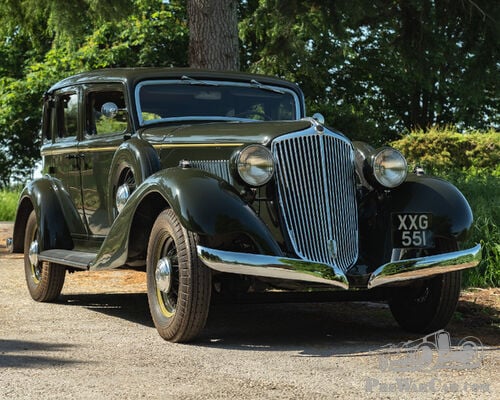
Graham Model 64 Standard Eight 'Blue Streak'
UK Registration No: XXG 551Chassis No: 1801069MOT: ExemptH&H ClassicsKelham Hall | Newark, Nottinghamshire
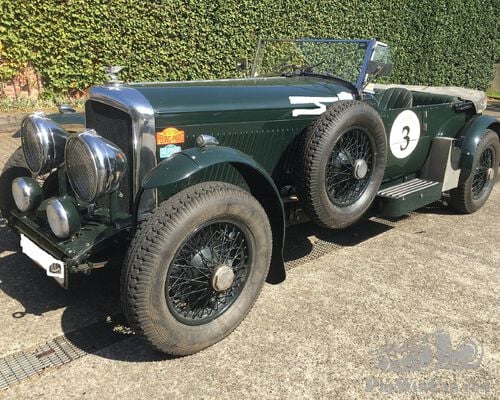
Bentley Derby Special Open Rally Car
This Bentley Derby, manufactured in 1935, has been rebuilt into a short and long-distance rally car. Full rebuilt engine in 2021, Since 2021 low mi..
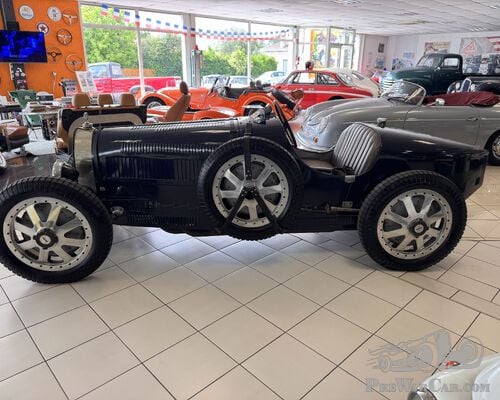
Bugatti 35 B Pur Sang
Bugatti 35 B Pur Sang,importée par un membre délégué de la FFVE il y’a une quinzaine d années.Participation à de nombreux Rallyes Bug..