The global magazine and marketplace for classic car enthusiasts, by enthusiasts.


Filter
Classic Du Pont, Essex for sale - Du Pont, Essex cars for sale
-

1929 Du Pont Model G Two-Passenger Speedster by Merrimac | RM Sotheby's | The Monterey Auction
To Be OFFERED AT AUCTION at RM Sothebys' The Monterey Auction event, 13 - 15 August 2026. $800,000 - $1,200,000 USD One of the most beautiful American automobiles of its generationThe 1929 New York International Automobile Show display carOne of three two-passenger “taper tail” models with an external spareOne ..


Du Pont
US, 1920 – 1932
(1) Du Pont Motors Inc, Wilmington, Del., 1920 – 1923
(2) Du Pont Motors Inc, Moore, Pa., 1923 – 1932
E. Paul du Pont’s company built quality cars in limited numbers, total production being 537 vehicles of all Du Pont types. First of the line was a Du Pont 4.1-litre sv four with their own engine, selling for $2.600, but this gave way to proprietary-engined sixes, initially powered by Herschell-Spillman. The 1925 Du Pont Model D had a 6-cylinder 5-litre Wisconsin engine with overhead valves that developed 75bhp, a constant-mesh gearbox, and Lockheed hydraulic brakes to all four wheels. Its successor, the Du Pont Model E, could be had with a supercharger, but the best-known, and best, Du Pont was the Du Pont Model G speedster introduced in 1928. With its narrow straight wings copied from the Amilcar, Woodlite headlamps and grille concealing the radiator, the last a pioneering feature, the Du Pont Model G was not a good-looking car, but it was a very effective one. Like all the DuPont speedsters it had four forward speeds. The 5.3-litre, sv straight-8 engine, by Continental, gave 114bhp at 3600rpm with catalogued modifications. With the latter, 100mph was guaranteed. In the 1929 Le Mans 24 Hours race the Du Pont Model G proved itself faster than the other American entries, Stutz and Chrysler. Touring bodywork was, of course, available on the Du Pont car, and in 1931 came the long wheelbase (12ft 2 in) Du Pont Model H, built in a Stearns Knight frame. The later Du Pont cars were assembled in the Indian motorcycle factory at Springfield, after E. Paul du Pont had acquired this concern.
Source: Georgano, encyclopedia of motorcar; TRN
The information is written with the greatest of care. However, if you have any suggested amendments please contact us at office@prewarcar.com
Essex
US, 1906
Essex Motor Car Co, Boston Mass.
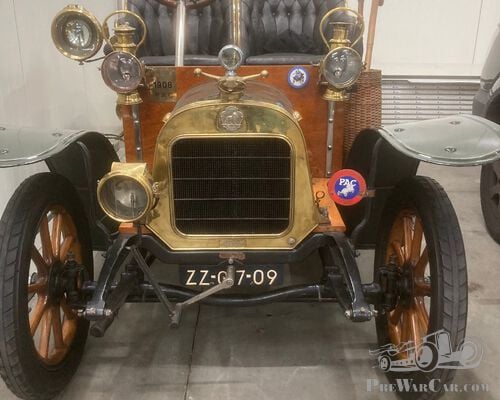
This Essex was a steamer with a single-acting, 4-cylinder engine. Cylinders were of 82,5mm bore and 101,5mm stroke. Poppet valves were used. The Essex side-entrance tonneau was similar in appearance to the French Serpolet.
US, 1918 – 1932
Hudson Motor Car Co, Detroit, Mich.
The Essex, introduced as a low-priced line at $1.595 by Hudson in 1918, featured a 2.9-litre ioe 4-cylinder engine developing 55bhp, which gave the Essex a top speed of 60mph in standard form. The Essex was recognizable by its angular lines and radiator shutters and the very cheap coach (2-door-sedan) available at $1295 in 1922 made the Essex car a best-seller. In 1924 the Essex rapid four was supplanted by a 2.1-litre side-valve six, later enlarged to 2.5-litres. This Essex model pushed Hudson sales up to over 300.000 in 1929, in which year the company ranked third in the USA with 6.6 per cent of total registrations. Four-wheel brakes were an optional extra in 1927, and standard in 1928. The Essex was equally popular in Britain as the cheapest form of multi-cylinder motoring available – costing £250 from 1927 to 1929 and £235 in 1930, when the new 18.2hp Essex Challenger with ribbon radiator and 6-bhp engine was introduced. In 1931 the Essex car sold for a mere £185. In 1932 the Essex grew up into a 3.2-litre car with V radiator, detachable wire hweels, free wheel and Startix automatic starter, but it was supplanted the following season by the Terraplane.
Source: Georgano, encyclopedia of motorcar; GMN, MCS
The information is written with the greatest of care. However, if you have any suggested amendments please contact us at office@prewarcar.com


Featured
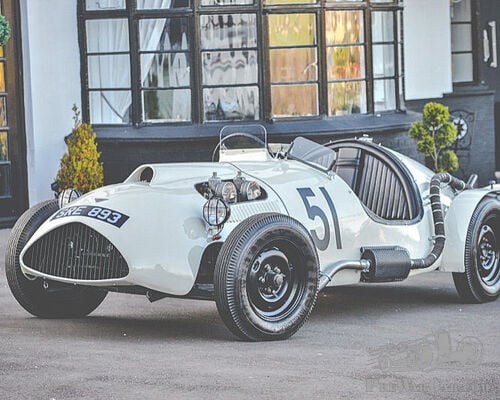
1933 Alvis 3.0 Special - One-Off Alloy Body | Period Competition Car | Featured in “Alvis – A Century of Drivers”
1933 Alvis 3. 0 Special - One-Off Alloy-Body | Period Competition Car | Featured in “Alvis – A Century of Drivers”

Lagonda LC Tourer 1934
The Lagonda story began in 1901 in Staines, a small town in the UK. The company enjoyed its greatest successes around 1935. During this period, the..