The global magazine and marketplace for classic car enthusiasts, by enthusiasts.


Filter
Classic E.R.A., Essex for sale - E.R.A., Essex cars for sale

E.R.A.
GB, 1934 – 1952
(1) English Racing Automobiles Ltd, Bourne, Lincs., 1934 – 1945
(2) English Racing Automobiles Ltd, Dunstable, Bedfordshire, 1946 – 1952
The ERA was produced by Raymond Mays, Humphrey Cook and Peter Berthon as a challenger in the 1500cc racing class. The ERA used a conventional chassis, a 4-speed pre-selector gearbox and a highly-developed version of the blown 6-cylinder ohv Riley engine giving 165bhp. There were 1100cc and 2-litre power units as alternatives, and with the D-series Porsche trailing-arm independent front suspension was introduced. Only 16 ERA cars were made, but the ERA car dominated the voiturette class in the hands of such drivers as Mays, B. Bira, Seaman, Fairfield, Arthur Dobson and Earl Howe. Victories outside Britain included the Eifelrenne, the Coppa Acerbo, Berne and Masaryk in 1935; the Prince Rainier Cup and Albi in 1936; the Avus, Picardie, Albi and Berne in 1937; and Picardie again in 1938. The ERA cars also dominated British road racing in their day and Raymond Mays achieved numerous fastest times at Shelsley Walsh with his ERA 2-litre car. Fifteen ERA cars still survive and are prominent in ‘historic’ racing. A sports-car project in 1937 came to nothing, but a new ERA 240bhp short-stroke six, the E-type with torsion-bar independent front suspension, a De Dion rear axle, synchromesh gearbox and streamlined body, appeared in 1939.
After World War 2 Mays and Berthon worked on the BRM V16, while ERA, now under the control of Leslie Johnson, struggled on with the unsuccessful ERA E-types until 1949. The company assisted in the design of Jowett’s 1950 ‘Jupiter’ sports car, but their last racing machine, the ERA G-type, was designed for Formula 2, and had a 150bhp 6-cylinder Bristol engine and tubular frame to the designs of David Hodkin. This final ERA product was sold to Bristol’s for testing.
Source: Georgano, encyclopedia of motorcar; MCS
The information is written with the greatest of care. However, if you have any suggested amendments please contact us at office@prewarcar.com
Essex
US, 1906
Essex Motor Car Co, Boston Mass.
This Essex was a steamer with a single-acting, 4-cylinder engine. Cylinders were of 82,5mm bore and 101,5mm stroke. Poppet valves were used. The Essex side-entrance tonneau was similar in appearance to the French Serpolet.
US, 1918 – 1932
Hudson Motor Car Co, Detroit, Mich.
The Essex, introduced as a low-priced line at $1.595 by Hudson in 1918, featured a 2.9-litre ioe 4-cylinder engine developing 55bhp, which gave the Essex a top speed of 60mph in standard form. The Essex was recognizable by its angular lines and radiator shutters and the very cheap coach (2-door-sedan) available at $1295 in 1922 made the Essex car a best-seller. In 1924 the Essex rapid four was supplanted by a 2.1-litre side-valve six, later enlarged to 2.5-litres. This Essex model pushed Hudson sales up to over 300.000 in 1929, in which year the company ranked third in the USA with 6.6 per cent of total registrations. Four-wheel brakes were an optional extra in 1927, and standard in 1928. The Essex was equally popular in Britain as the cheapest form of multi-cylinder motoring available – costing £250 from 1927 to 1929 and £235 in 1930, when the new 18.2hp Essex Challenger with ribbon radiator and 6-bhp engine was introduced. In 1931 the Essex car sold for a mere £185. In 1932 the Essex grew up into a 3.2-litre car with V radiator, detachable wire hweels, free wheel and Startix automatic starter, but it was supplanted the following season by the Terraplane.
Source: Georgano, encyclopedia of motorcar; GMN, MCS
The information is written with the greatest of care. However, if you have any suggested amendments please contact us at office@prewarcar.com


Featured
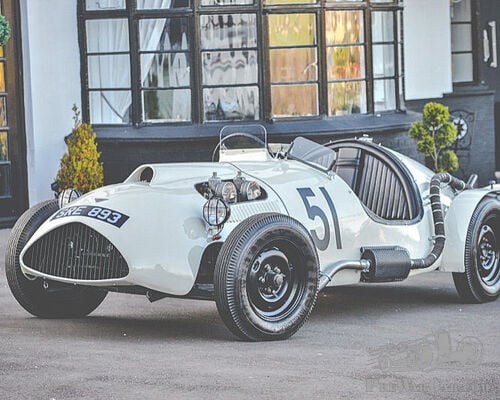
1933 Alvis 3.0 Special - One-Off Alloy Body | Period Competition Car | Featured in “Alvis – A Century of Drivers”
1933 Alvis 3. 0 Special - One-Off Alloy-Body | Period Competition Car | Featured in “Alvis – A Century of Drivers”

1915 Rolls-Royce Silver Ghost Barker Tourer
⁃ An exceptionally rare original bodied pre-war Silver Ghost⁃ Desirable Barker tourer in exciting barn find condition⁃ ..