The global magazine and marketplace for classic car enthusiasts, by enthusiasts.


Filter
Classic Essex, Kissel for sale - Essex, Kissel cars for sale

Essex
US, 1906
Essex Motor Car Co, Boston Mass.
This Essex was a steamer with a single-acting, 4-cylinder engine. Cylinders were of 82,5mm bore and 101,5mm stroke. Poppet valves were used. The Essex side-entrance tonneau was similar in appearance to the French Serpolet.
US, 1918 – 1932
Hudson Motor Car Co, Detroit, Mich.
The Essex, introduced as a low-priced line at $1.595 by Hudson in 1918, featured a 2.9-litre ioe 4-cylinder engine developing 55bhp, which gave the Essex a top speed of 60mph in standard form. The Essex was recognizable by its angular lines and radiator shutters and the very cheap coach (2-door-sedan) available at $1295 in 1922 made the Essex car a best-seller. In 1924 the Essex rapid four was supplanted by a 2.1-litre side-valve six, later enlarged to 2.5-litres. This Essex model pushed Hudson sales up to over 300.000 in 1929, in which year the company ranked third in the USA with 6.6 per cent of total registrations. Four-wheel brakes were an optional extra in 1927, and standard in 1928. The Essex was equally popular in Britain as the cheapest form of multi-cylinder motoring available – costing £250 from 1927 to 1929 and £235 in 1930, when the new 18.2hp Essex Challenger with ribbon radiator and 6-bhp engine was introduced. In 1931 the Essex car sold for a mere £185. In 1932 the Essex grew up into a 3.2-litre car with V radiator, detachable wire hweels, free wheel and Startix automatic starter, but it was supplanted the following season by the Terraplane.
Source: Georgano, encyclopedia of motorcar; GMN, MCS
The information is written with the greatest of care. However, if you have any suggested amendments please contact us at office@prewarcar.com
Kissel
US, 1906 – 1931
Kissel Motor Co, Hartford, Wisc.
At first the name of Kissel was associated with agricultural equipment, then with stationary gas engines. A conventional shaft-driven 35hp 4-cylinder Kissel automobile called, rather unfortunately, the Kissel Kar (originally the Badger), was offered from 1906. This Kissel car was made almost entirely by the company; few parts were bought out. A Kissel six with ‘square’ dimensions (121x121mm) appeared in 1909, electric starting came in 1913 on the Kissel car, and there was a short-lived Kissel V12 powered by Weidely, built from 1917 to 1918. None of these Kissel cars had any sporting pretensions. From 1918, however, the policy of the Kissel car company changed rapidly. The metamorphosis had begun in the previous year, when the Kissel Kar Silver Special Speedster was unveiled. This Kissel car was named after its designer, C.T. Silver. At the New York Show of January 1918 the Kissel car firm’s new speedster policy was taken a step further with the Kissel Gold Bug, a development of the Kissel Silver Special Speedster. It earned its name because from 1919 chrome yellow was the make’s standard colour. It had a Kissel-made 6-cylinder sv engine at first, of 4.3-litres, later 4.7-litres. More touring Kissel cars were offered as well, such as the Kissel Coach-Sedan and the Kissel Tourer, which used the same engines as the Gold Bug. In 1924 external contracting Lockheed hydraulic brakes were a listed option. In that year, too, the alternative of a straight-8 with a modified Lycoming engine could be had on Kissel cars. 1928 was the last year of Kissel-built engines. The handsome 1929 Kissel White Eagle with 3-litre 6-cylinder and 4- and 4.9-litre straight-8 engines, as well as internally expanding hydraulic brakes, could not compete at prices ranging from $1.595 to $3.885, and only 1.531 Kissel cars were sold. In 1930 the Kissel car firm assembled a few Ruxton cars on contract to New Era Motors, and in 1933 a reorganized company was hired to build Lever engines in order to demonstrate them to a large manufacturer for possible mass production.
Source: Georgano, encyclopedia of motorcar; TRN
The information is written with the greatest of care. However, if you have any suggested amendments please contact us at office@prewarcar.com


Featured
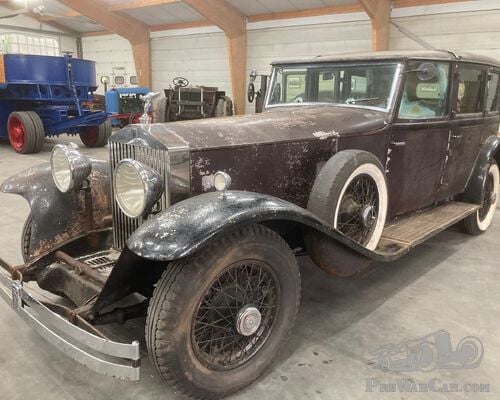
Rolls-Royce
Rolls-Royce Phantom ll chassisnummer 287 AJS. bouwjaar 1932, Links gestuurd, Brewster Keswick Sedance Towncar

Lagonda LC Tourer 1934
The Lagonda story began in 1901 in Staines, a small town in the UK. The company enjoyed its greatest successes around 1935. During this period, the..