The global magazine and marketplace for classic car enthusiasts, by enthusiasts.


Filter
Classic Mitchell, Essex for sale - Mitchell, Essex cars for sale
-

Mitchell Type R Raceabout 1911
A “racing” car from the early 1910s,Equipped with an impressive overhead valve engine that delivers 30 HP.The engine has a starter motor and starts easily.The gearbox has 3 gears and operates normally.This Mitchell rides well.The Mitchell was part of the famous Lindley Bothwell collection in Los Angeles (USA) f.. -
Mitchell Type R Raceabout 1911
A “racing” car from the early 1910s, Equipped with an impressive overhead valve engine that delivers 30 HP. The engine has a starter motor and starts easily. The gearbox has 3 gears and operates normally. This Mitchell rides well. The Mitchell was part of the famous Lindley Bo..


Mitchell
US, 1903 – 1923
(1) Mitchell Motor Car Co, Racine, Wisc., 1903 – 1910
(2) Mitchell-Lewis Motor Co, Racine, Wisc., 1910 – 1916
(3) Mitchell Motors Co Inc, Racine, Wisc., 1916 – 1923
Mitchell and Lweis had been wagon builders since 1834, and their first Mitchell car was a light two-seater powered by a 7hp air-cooled 2-cylinder engine, using single chain drive, and priced at $1.200. In 1905 a 9hp engine was used on the Mitchell car, and air or water cooling was available. 4-cylinder engines of 18 and 30hp appeared in the 1906 Mitchell car range, and in 1907 shaft drive was employed on all Mitchell car models. Until 1910, 20 and 35hp fours were made, having pair-cast cylinders in 1910 when they were joined by a 50hp 6-cylinder Mitchell car. In 1913 a new range of T-head engines was introduced in a Mitchell car designed by René Petard and known as the ‘American-built French car’. A 40hp four and 50 and 60hp sixes were made in this Mitchell car range, which had high-cowled torpedo-style bodies and electric starters. Piston strokes were very long at 7 inches. At this time it was said that the Mitchell car company made 96% of all components. In 1916 a short-lived Mitchell 48hp V8 was made, and the following year the Mitchell car company settled down to making a range of conventional sixes of no great distinction. In 1920 a sloping radiator gave rise to the epithet, ‘the drunken Mitchell’ and this was hastily replaced by a vertical radiator for 1921. However, the company had lost a lot of money on their 1920 Mitchell car models, and few of the redesigned Mitchell cars were sold, as they lacked any distinctive qualities.
The 6-cylinder engines of the Mitchell car had acapacity of 4.7-litres. After production ceased in 1923, the Mitchell car factory was bought by Nash.
Source: Georgano, encyclopedia of motorcar; GNG
The information is written with the greatest of care. However, if you have any suggested amendments please contact us at office@prewarcar.com
Essex
US, 1906
Essex Motor Car Co, Boston Mass.
This Essex was a steamer with a single-acting, 4-cylinder engine. Cylinders were of 82,5mm bore and 101,5mm stroke. Poppet valves were used. The Essex side-entrance tonneau was similar in appearance to the French Serpolet.
US, 1918 – 1932
Hudson Motor Car Co, Detroit, Mich.
The Essex, introduced as a low-priced line at $1.595 by Hudson in 1918, featured a 2.9-litre ioe 4-cylinder engine developing 55bhp, which gave the Essex a top speed of 60mph in standard form. The Essex was recognizable by its angular lines and radiator shutters and the very cheap coach (2-door-sedan) available at $1295 in 1922 made the Essex car a best-seller. In 1924 the Essex rapid four was supplanted by a 2.1-litre side-valve six, later enlarged to 2.5-litres. This Essex model pushed Hudson sales up to over 300.000 in 1929, in which year the company ranked third in the USA with 6.6 per cent of total registrations. Four-wheel brakes were an optional extra in 1927, and standard in 1928. The Essex was equally popular in Britain as the cheapest form of multi-cylinder motoring available – costing £250 from 1927 to 1929 and £235 in 1930, when the new 18.2hp Essex Challenger with ribbon radiator and 6-bhp engine was introduced. In 1931 the Essex car sold for a mere £185. In 1932 the Essex grew up into a 3.2-litre car with V radiator, detachable wire hweels, free wheel and Startix automatic starter, but it was supplanted the following season by the Terraplane.
Source: Georgano, encyclopedia of motorcar; GMN, MCS
The information is written with the greatest of care. However, if you have any suggested amendments please contact us at office@prewarcar.com


Featured
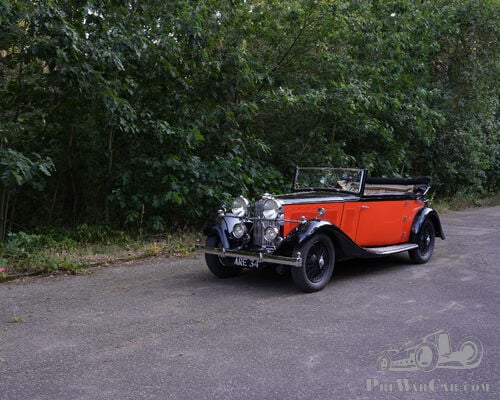
1934 Talbot AV105 Three Position Drophead Coupé
Registration no. ARE 34Chassis no. 35488 Much supporting paperworkRestored exampleVery usa..
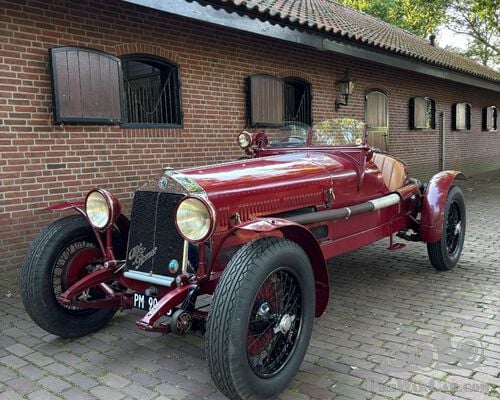
1930 Alfa Romeo 6C 1750 Spider
1930 Alfa Romeo 6C 1750 Spider with complete history from delivery to first owner in 1930 in Firenze till today with copy Libretto/license plate.
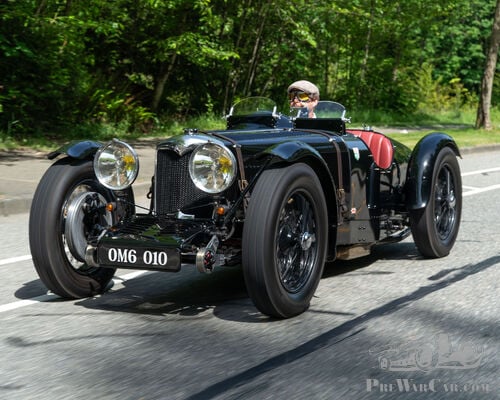
Riley 14/6 Special 1933
The ExperienceStep into the golden age of British motoring. This 1933 Riley 14/6 Special is a masterclass in pre-w..