The global magazine and marketplace for classic car enthusiasts, by enthusiasts.


Filter
Classic Essex, Orient for sale - Essex, Orient cars for sale
-

1905/6 Orient Buckboard
Build by Waltham , mass. Usa . very original and unrestored , except the engine which is restored and running .Known history back to before ww2 . Last ovner found it in 1950.Eur 25.800


Essex
US, 1906
Essex Motor Car Co, Boston Mass.
This Essex was a steamer with a single-acting, 4-cylinder engine. Cylinders were of 82,5mm bore and 101,5mm stroke. Poppet valves were used. The Essex side-entrance tonneau was similar in appearance to the French Serpolet.
US, 1918 – 1932
Hudson Motor Car Co, Detroit, Mich.
The Essex, introduced as a low-priced line at $1.595 by Hudson in 1918, featured a 2.9-litre ioe 4-cylinder engine developing 55bhp, which gave the Essex a top speed of 60mph in standard form. The Essex was recognizable by its angular lines and radiator shutters and the very cheap coach (2-door-sedan) available at $1295 in 1922 made the Essex car a best-seller. In 1924 the Essex rapid four was supplanted by a 2.1-litre side-valve six, later enlarged to 2.5-litres. This Essex model pushed Hudson sales up to over 300.000 in 1929, in which year the company ranked third in the USA with 6.6 per cent of total registrations. Four-wheel brakes were an optional extra in 1927, and standard in 1928. The Essex was equally popular in Britain as the cheapest form of multi-cylinder motoring available – costing £250 from 1927 to 1929 and £235 in 1930, when the new 18.2hp Essex Challenger with ribbon radiator and 6-bhp engine was introduced. In 1931 the Essex car sold for a mere £185. In 1932 the Essex grew up into a 3.2-litre car with V radiator, detachable wire hweels, free wheel and Startix automatic starter, but it was supplanted the following season by the Terraplane.
Source: Georgano, encyclopedia of motorcar; GMN, MCS
The information is written with the greatest of care. However, if you have any suggested amendments please contact us at office@prewarcar.com
Orient
US, 1898 – 1908
Waltham Mfg Co, Waltham, Mass.
The Orient car company made an experimental electric runabout in 1898, but did not put this Orient car into production. Their first petrol-engined Orient cars were motor cycles, tricycles and light runabouts powered by De Dion engines. In 1902 they introduced the Orient Buckboard, a very simple Orient car consisting of two seats on a wooden platform, with a 4hp air-cooled engine geared to the rear axle, and, originally, only one speed. There were no springs on this Orient car, as the wooden platform was said to have enough resilience. The weight was 350lb and the price $375.
Although the simple Buckboard was continued, more sophisticated Orient cars were gradually introduced, including a four-seater version Orient car which in turn became a side-entrance tonneau. Wheel steering and small bonnets to cover the driver’s feet appeared in 1904, although the engine of the Orient car was still at the back, and the Buckboard ancestry remained obvious.
In 1905 a completely new Orient car appeared, known as the Waltham Orient. This Orient car had a 4-cylinder air-cooled 18/20hp engine mounted in front in the conventional manner, friction transmission and shaft drive. A slightly smaller 16hp Orient car model was also made. In 1908 Waltham merged with the C.H. Metz Company, and for the following year the cars were known as Metz.
Source: Georgano, encyclopedia of motorcar; GNG
The information is written with the greatest of care. However, if you have any suggested amendments please contact us at office@prewarcar.com


Featured
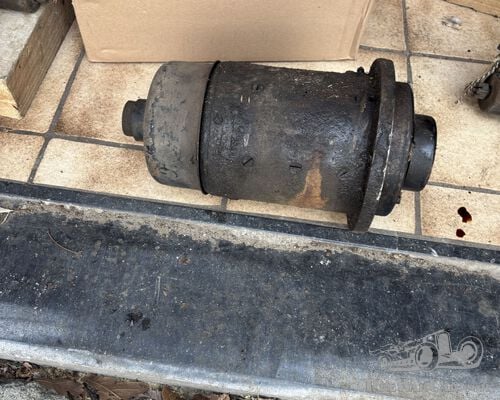
1929 Talbot K74 Limousine – Very comprehensive restoration project
For sale – 1929 Talbot K74 Limousine – Very comprehensive restoration projectAsking price: €19,950 A very rare 1929 Talbot K74..
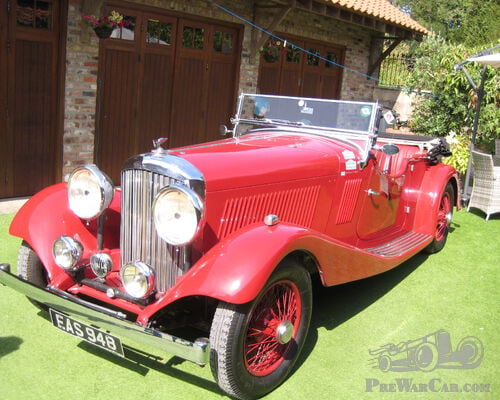
1935 Bentley 3.5 ltr. VDP 4str. Tourer
Chassis B 123 CW was first registered 14th March 1935, and in the late eighties underwent a " body-off" restoration and fitted with VANDEN PLAS
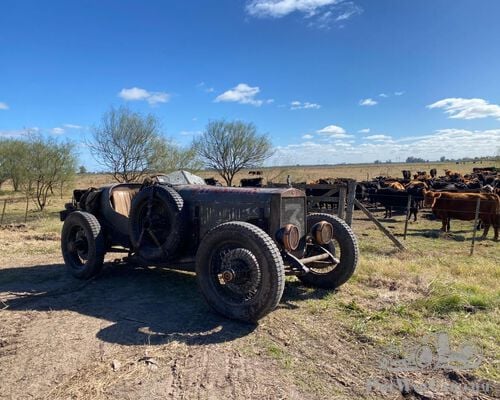
Studebaker 1927 for sale
Authentic race car of the time - Everything is working - All parts of its original mechanics - I have the history of the car - 6 cylinders - Ready ..