The global magazine and marketplace for classic car enthusiasts, by enthusiasts.


Filter
Classic Benjamin, F.N. for sale - Benjamin, F.N. cars for sale
-

Benjamin Type C Economic 1922
Benjamin Type C Economic Company/HistoryBenjamin was a French manufacturer of Cyclecars between 1921 and 1927 and based on the north-west edge of Paris and the firm was established by Maurice Jeanson in Asnieres eight kilometres from the centre of Paris. The business started out with a range of cycle cars, identified..

Benjamin (Benova)
France, 1921 – 1931
Maurice Jeanson, Asnières, Seine
The Benjamin was a typical attempt to build a 4-cylinder light car and still stay below the statutory French weight limit for cyclecars (350kg). Features on the Benjamin for sale were a 750cc sv engine and a 3-speed transaxle with no differential, and suspension followed Austin Seven lines: transverse at the front and quarter-elliptic at the rear. By 1923 this engine was giving 14bhp, long-chassis four-seater versions were catalogued, and an ohc Benjamin sports model was capable of 60mph. Unfortunately in 1924 there was an attempt by Benjamin at a true cyclecar for sale in the shape of a tiny staggered two-seater selling for 5.500fr. This had a 525cc air-cooled vertical twin 2-stroke engine and 2-speed gearbox mounted at the rear of a crude boat-shaped perimeter frame. There was also a similar 3-cylinder Benjamin 9cv model. Although Benjamin tried again with a rear-engined lightweight in 1925, this time with a 630cc 4-stroke motor, their regular offerings were now conventional machines powered by 945cc and 1100cc Chapuis-Dornier 4-cylinder engines, the latter available with ohv. These Benjamin cars had quarter-elliptic springing all round and worm drive. Four-wheel brakes were seen on the 1926 Paris Salon Benjamin cars for sale: these were the last Benjamins, though a year later the marque reappeared under the Benova name. The fours were continued, along with a small straight-8 using the new S.C.A.P. 1500cc ohv proprietary unit. The Benova was still quoted in 1931, when four 4-cylinder Benova models were offered, capacities ranging from 945cc to 2.1 litres.
Source: Georgano, encyclopedia of motorcar; MCS
The information is written with the greatest of care. However, if you have any suggested amendments please contact us at office@prewarcar.com
F.N.
Belgium, 1899 – 1935
Fabrique Nationale d’Armes de Guerre, Liège
The F.N. was Belgium’s longest-lived make an was made in greater numbers than any other Belgian car, even at the bginning of its career. In 1900, 100 examples of a 2-cylinder FN voiturette with a water-cooled (originally air-cooled) 3½hp engine were made. The FN had two forward speeds, with belt primary and chain final drive. This little FN car was well-made on conservative, well-tried lines, typical of FN cars throughout their history. In 1906, FN changed over from chain drive to a live axle. By 1909, car production was running at three or four FN cars a day, rising to five by 1914. The FN 8/10hp of that year was a modern light car with a 60x110mm, 4-cylinder, side-valve 2345cc engine. It was continued after World War 1 as the ‘FN 1250’, and developed in 1923 into the famous ‘FN 1300’, with a bigger bore providing the cubic capacity implied. This FN car also had push-rod overhead valves, unit construction of engine and gearbox, and front wheel brakes. The open FN four-seater had light and elegant lines. With the bore again enlarged, the ‘FN 1300’ became the ‘FN 1400’, with four forward speeds for the first time. A twin-carburettor FN sports model was also offered. The ‘FN 1400’ became the ‘FN 1625’, which was listed until 1933. The 1300 F.N. and its successor were very successful in competitions, with a third place in General Classification in the 1925 Monte Carlo Rally, class wins in the Spa 24 Hours race in 1925, 1926 and 1933 and a Coupe des Alpes for the FN works team of ‘FN 1625s’ in the 1931 Alpine Trial. In 1928, the 1300 FN had become the first normal wheeled vehicle to cross Africa from north to south. Although the small FN cars were always the best known, larger FN cars were made up to the ‘FN 3800’ luxury chassis of 1920. A straight-8 3.2-litre FN model was current from 1930 to 1935, in conformity with fashion. The last small FN vanished with the ‘FN 1625’ which was replaced by the new 2-litre Baudouin. This was now accompanied by the bigger FN Prince Albert model. Production ceased in 1935, though FN motorcycles and FN trucks have been made since World War 2.
Source: Georgano, encyclopedia of motorcar; TRN
The information is written with the greatest of care. However, if you have any suggested amendments please contact us at office@prewarcar.com


Featured
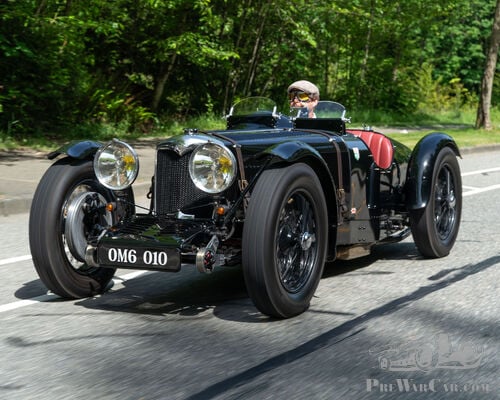
Riley 14/6 Special 1933
The ExperienceStep into the golden age of British motoring. This 1933 Riley 14/6 Special is a masterclass in pre-w..

Lagonda LC Tourer 1934
The Lagonda story began in 1901 in Staines, a small town in the UK. The company enjoyed its greatest successes around 1935. During this period, the..