The global magazine and marketplace for classic car enthusiasts, by enthusiasts.


Filter
Classic F.N., Wanderer for sale - F.N., Wanderer cars for sale
-

Wanderer W40 - 2 Fenster - Gläser Cabrio
Wir bieten Ihnen im Kundenauftrag diesen seltenen Wanderer W40 - 2 Fenster-Cabrio zum Restaurieren an. Der Wagen wurde in Dresden bei Gläser gebaut. Die Frontscheibe, die Seitenscheibe sowie die Rahmen sind alle in guter Qualität vorhanden. Vom Holz sind noch einige Teile vorhanden (Rudimente). Zum Wanderer ist ein 1,7 Liter Motor dazu. Das Ver..

F.N.
Belgium, 1899 – 1935
Fabrique Nationale d’Armes de Guerre, Liège
The F.N. was Belgium’s longest-lived make an was made in greater numbers than any other Belgian car, even at the bginning of its career. In 1900, 100 examples of a 2-cylinder FN voiturette with a water-cooled (originally air-cooled) 3½hp engine were made. The FN had two forward speeds, with belt primary and chain final drive. This little FN car was well-made on conservative, well-tried lines, typical of FN cars throughout their history. In 1906, FN changed over from chain drive to a live axle. By 1909, car production was running at three or four FN cars a day, rising to five by 1914. The FN 8/10hp of that year was a modern light car with a 60x110mm, 4-cylinder, side-valve 2345cc engine. It was continued after World War 1 as the ‘FN 1250’, and developed in 1923 into the famous ‘FN 1300’, with a bigger bore providing the cubic capacity implied. This FN car also had push-rod overhead valves, unit construction of engine and gearbox, and front wheel brakes. The open FN four-seater had light and elegant lines. With the bore again enlarged, the ‘FN 1300’ became the ‘FN 1400’, with four forward speeds for the first time. A twin-carburettor FN sports model was also offered. The ‘FN 1400’ became the ‘FN 1625’, which was listed until 1933. The 1300 F.N. and its successor were very successful in competitions, with a third place in General Classification in the 1925 Monte Carlo Rally, class wins in the Spa 24 Hours race in 1925, 1926 and 1933 and a Coupe des Alpes for the FN works team of ‘FN 1625s’ in the 1931 Alpine Trial. In 1928, the 1300 FN had become the first normal wheeled vehicle to cross Africa from north to south. Although the small FN cars were always the best known, larger FN cars were made up to the ‘FN 3800’ luxury chassis of 1920. A straight-8 3.2-litre FN model was current from 1930 to 1935, in conformity with fashion. The last small FN vanished with the ‘FN 1625’ which was replaced by the new 2-litre Baudouin. This was now accompanied by the bigger FN Prince Albert model. Production ceased in 1935, though FN motorcycles and FN trucks have been made since World War 2.
Source: Georgano, encyclopedia of motorcar; TRN
The information is written with the greatest of care. However, if you have any suggested amendments please contact us at office@prewarcar.com
Wanderer
D, 1911 – 1939
(1) Wanderer Fahrradwerke vorm. Winkelhofer & Jaenicke AG, Schönau, 1911 – 1917
(2) Wanderer-Werke AG, Siegmar, 1917 – 1939
The Wanderer firm – like many others – started with bicycle manufacture; motor cycles followed and led the way to Wanderer cars. Extensive experiments with Wanderer cars were undertaken. In 1905 the 2-cylinder Wanderermobil was ready, but this Wanderer car remained a prototype. Another Wanderer car – which is still in existence – is claimed to date from 1904.
It is reported by some sources that Ettore Bugatti offered a small car design to Wanderer in 1910 before starting manufacturing on his own. But Wanderer cars did not take over the Bugatti car, as their own Wanderer car designs were ready and they started production of these Wanderer cars in 1911. Their first production Wanderer car had a 4-cylinder 1.150cc, 5/12PS engine and a two-seater tandem body. This Wanderer car was popularly known as the Püppchen (doll). Engine capacity was increased to 1.220cc in 1914 and the output raised to 5/15PS. Three- and four-seater Wanderer cars were also available and this model Wanderer carwas listed until 1922. Some 4-cylinder models Wanderer car in the 1½- and 2-litre range followed udring the 1920s. A 6-cylinder Wanderer car (the W11) with a 2.540cc 50bhp engine was built under licence by Martini of Switzerland. The W11 was also available in a sports version of 2.995cc and 65bhp. In addition to 4-cylinder Wanderer cars, a range of 6-cylinder cars was built during the 1930s which were based on a Porsche design. These Wanderer cars had push-rod ohv engines, and later cars had swing-axle rear suspension.
A very sporty looking Wanderer car appeared in 1936, the W25K (K for Kompressor). The 1.936cc engine with blower developed 85bhp and the Wanderer car easily reached 93mph. However, this Wanderer car did not figure much in competitions and was produced in limited numbers only. After 1932 Wanderer was a member of the Auto Union. Their cars had a reputation for quality, finish and good performance although they were intended for workaday use. In the Auto Union catalogues they represented the ‘upper middle-class’. Wanderer car production ceased at the outbreak of World War 2 in 1939, by which time two sv models, with all-round independent suspension, a 1.8-litre four and a 2.6-litre six, were being offered.
Source: Georgano, encyclopedia of motorcar; HON
The information is written with the greatest of care. However, if you have any suggested amendments please contact us at office@prewarcar.com


Featured
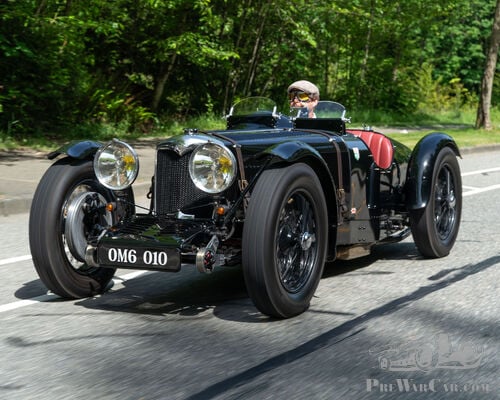
Riley 14/6 Special 1933
The ExperienceStep into the golden age of British motoring. This 1933 Riley 14/6 Special is a masterclass in pre-w..
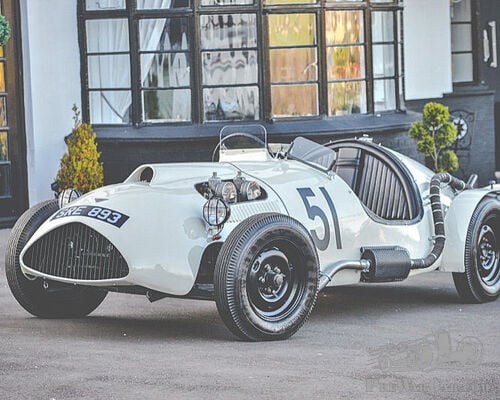
1933 Alvis 3.0 Special - One-Off Alloy Body | Period Competition Car | Featured in “Alvis – A Century of Drivers”
1933 Alvis 3. 0 Special - One-Off Alloy-Body | Period Competition Car | Featured in “Alvis – A Century of Drivers”