The global magazine and marketplace for classic car enthusiasts, by enthusiasts.


Filter
Classic Fiat, Standard for sale - Fiat, Standard cars for sale
-

FIAT 514 S
Already certified by the 1000 Miglia Register and FIVA approved after a meticulous restoration, this beautiful FIAT 514 Spyder has matching chassis and engine numbers as it has been manufactured in 1930 and registered in Sassari (Sardinia) on October 23rd 1931. Still on the old black license plates from that year and a gorgeous set of original docu.. -
FIAT 508 CMM
Built in less than ten examples, this rare and wonderful pre-war “berlinetta” is one of the seven cars that have been entered into the 1939 Tripoli-Tobruk Libyan Coastal Race. The first racing car designed by Engineer Dante Giacosa with the aid of a wind tunnel, our 508 is accompanied by a considerable lot of historical documentation and is in a.. -
1904 F.I.A.T. 24/32 HP Rear-Entrance Tonneau
Sold new to George and Mabel Agassiz of Cape CodBuried on the Agassiz estate in the 1930s before being dug up in 1942Continuous history from new and part of The Uihlein Collection for 55 yearsRegular entrant on the London to Brighton Veteran Car RunSurviving veteran cars from the pioneering days of mo.. -
FIAT 508S Mille Miglia
Original and genuine Fiat Balilla Sport MM, ex-Albino Ferrara in the 10th 1000 Miglia in 1936, in a rare black and red livery, this car was manufactured in Turin on 13 July 1934 and delivered in Catania the following year to the gentleman driver Albino Ferrara from Caltanissetta, who drove it to the 1936 Mille Miglia with race number 9. Already reg.. -
Fiat 1500 Barchetta
The first Fiat 1500 was presented at the car show Milan in 1935. Automotive engineer started to pay attention to aerodynamic considerations. Developed in a wind tunnel, the Fiat 1500 was an outstanding example of this newly acquired knowledge. Fiat 1500 was offered as a standard saloon as well as the cabriolet models. The chassis of the Fiat 150.. -
exceptional one of 4 fiat 508S Balilla's delivered to Ireland
BZ 4078 is FIVA registered and was 1 of 4 Balilla 508S cars that came from italy as rolling chassis to the Fiat assembly plant in Wembley where there were bodied in an aluminium unlike the Italian cars which were steel bodied. They were then shipped to Belfast where BZ4078 was by John McGrattan of Bangor County Down. Together with W. McM.. -
Fiat Biposto Spider 1924
Very original car. Old pictures available. ASI Gold Plate. Dutch license. Regurlary use for rallies in the past years. Very spectactular to drive.


Fiat
Italy, 1899 – 1906, 1907 to date
(1) Fabbrica Italiana Automobili Torino, 1899 – 1918
(2) Fiat SpA, 1918 to date
Fiat is an industrial colossus whose ramifications include commcerical vehicles (since 1903), ball bearings (Giovanni Agnelli of FIAT founded the RIV concern in 1905), ship-building (since 1905), aero engines (since 1908), large marine engines (since 1910), complete aircraft (since 1915) and railway rolling stock. Other car makers have been absorbed by Fiat: S.P.A. in the mid 1920s, Ansaldo in 1929 and O.M. in 1933, while Fiat has a controlling interest in Autobianchi and has helped finance Ferrari’s Grand Prix endeavours. The Fiat company’s share of the Italian private-car market fluctuates between 70 and 90 percent, and in 1962 795.504 of the 946.743 motor vehicles produced in Italy came from factories under the Fiat company’s control.
The founders of the Fiat company were Giovanni Agnelli, di Bricherasio and Count Carlo Biscaretti Di Ruffia, who took over the small Ceirano factory, inheriting with it the services of two great future racing drivers, Felice Nazzaro and Vincenzo Lancia, and the Faccioli patents under which Fiat’s first car was made. This Fiat was a 679cc flat-twin with rear engine, cone clutch and chain drive, rated at 3½hp, but by 1901 the Fiat company were making a front-engined 1.2-litre vertical twin with central chain drive. An aiv 4-cylinder, the work of Ing. Enrico, appeared in 1902 and the Fiat firm soon came under the influence of Mércèdes, with pair-cast cylinders, mechanically-operated sv in a T-head, low-tension magneto ignition, gate gear change and honeycomb radiator. Though the 4.2-litre ‘Fiat 16’ and its companion 6.3-litre model still used armoured wood frames in 1903, the Fiat company adopted the pressed-steel type in 1904, as well as scroll instead of cone clutches and belt-driven lubcricators. Water-cooled transmission brakes made their appearance in 1905, when the biggest Fiat model was a 10.2-litre ‘Fiat 60’. 1907 novelties were the Fiat company’s first six, a chain-driven 11-litre available with compressed-air starter, and the first shaft-driven Fiat (the full stops had been dropped at the end of 1906), a modest Fiat 14/16hp with the differential mounted directly behind the gearbox. In this year licence-production was also started in Vienna; the independently-designed Austro-Fiats did not make their appearance until 1921.
Meanwhile Fiat has been making its name in racing. A team of Mercedes-like racers ran in the 1904 Gordon Bennett Cup, but far more successful were the Fiat’s 16.3-litre successors of 1905 with full ohv, Fiat had to be content with second places in the Grand Prix and the Vanderbilt Cup in 1906, but 1907 was a great year for the Fiat company and Nazzaro alike, since he won the Kaiserpreis, the Targa Florio and the Grand Prix. Both ohv and ioe configurations of the Fiat car were raced in 1908, in which year the formidable 18.2-litre Mephistopheles performed at Brooklands, while an even larger car, the mighty Fiat S76 (nicknamed ‘the Beast of Turin’) was produced in 1911. It used a 28.3-litre 4-cylinder bibloc dirigible engine and the Beast was timed at 132.37mph at Ostend in 1913; the S76 was also the first Fiat to have the pear-shaped radiator. Overhead camshafts were also found on the 10.5-litre Fiat S61 of 1911 and the 14½-litre Fiat cars which contested the 1912 Grand Prix – virtually the last of the chain-driven giants. Fiat entered a team of 4½-litre 135bhp cars with front-wheel brakes for the 1914 Grand Prix, but these Fiat cars met with no success.
1908 saw the beginning of a new era in Fiat’s touring-car design with the 10/14hp cab chassis, a real breakaway from Mercedes ideas. It had a 2-litre 4-cylinder L-head monobloc engine, high-tension magneto ignition, pump and fan cooling, a 3-speed gearbox, multi-plate clutch and bevel drive; 4-speed gearboxes were available on the Fiat by 1909, in which year the older designs also appeared with shaft drive. More important, the ‘Fiat 10/14’ formula had been extended right down the range by 1913. Models available were the Fiat TIpo Zero and Fiat Tipo 1 with 1.8-litre engines, the 2.8-litre Fiat Tipo 2, the 4.4-litre Fiat Tipo 3, the 5.7-litre Fiat Tipo 4 and the enormous 9-litre Fiat Tipo 5 with its chain drive counterpart the Fiat Tipo 6, all fours with 4-speed gearboxes. The larger ones had vaned flywheels to assist cooling and watercooled transmission brakes, There was also a 3.9-litre 6-cylinder Fiat Tipo 57 version made only in 1911 and 1912. An independent Fiat Motor Co was formed in the USA in 1910 to build and market this range. Chain-driven Fiat sports cars were still made in limited numbers, a 10.1-litre ohc Fiat 75/90hp being introduced in 1911, while there was also a 4.8-litre (95x170mm) variants with shaft drive. The pear-shaped radiator was available on Fiat cars by 1914, as were (on the larger Fiat models) wire wheels, and electric lighting and starting. During World War 1 the 15/20hp Fiat Tipo 2B was made in large numbers as a staff car.
In 1919 FIAT emerges as mass-producers with the sv 1½-litre Fiat Tipo 501, a car of great smoothness and durability which featured a detachable head, full electrics and all brakes on the rear wheels – a suprising deviation from a firm who were still using a transmission parking brake on some models in the middle 1960s. The Fiat 501 could be bought in England for £340 in 1925, when front-wheel brakes were optional and there were companion 2.3-litre 4-cylinder and 3.4-litre 6-cylinder derivatives. The old tradition of luxury was carried on by Fiat by a vast 6.8-litre ohv V12 with front-wheel brakes, of which fewer than 10 Fiat cars were made in 1921 – 1922, and by the smaller 4.8-litre Fiat Tipo 519, a 6-cylinder car with hydro-mechanical servo braks which could be bought for less than £1.000 and was still catalogued by Fiat in 1929. Racing acitivites were resumed in 1921 with a Fiat 3-litre dohc straight-8, followed by the Bertarione-designed 2-litre 6-cylinder Fiat machine which won the French and Italian Grands Prix in 1922 and inspired the later 2-litre Sunbeams. The Fiat firm had supercharged racing cars – a 1½-litre 4-cylinder and a 2-litre 130bhp straight-8 – in 1923, and won the European GP with the latter. After 1924 Fiat dropped out of the grandes épreuves, though they were experimented with an opposed-piston 2-stroke engine and made a 175bhp 1½-litre twin-6 with crankshafts geared together which won its only race – the 1927 Milan GP. The old chain-driven Fiat Mephistopheles was re-engined by E.A.D. Eldridge in 1923 with a 21.7-litre 6-cylinder Fiat airship engine and Fiat took the World Land Speed Record in 1924 at 146.01mph.
Fiat radiators, already found on the V12 and the ‘Fiat 519’, were seen on the advanced 990cc ‘Fiat 509’ of 1925, with an ohc engine, low-pressure tyres, fwb, thermos-syphon cooling and single-plate clutch. This Fiat was a best-seller (over 90.000 sold between 1925 and 1929, at a time when only 172.000 private cars were registered in Italy) and could be bought in England for £195 in later years. Fiat-radiator, Ricardo-headed versions of the 1919 sv designs came in 1926, and a year later the Fiat Tipo 520 marked the beginning of a long series of American-styled sv long –stroke 6-cylinder Fiat cars with coil ignition. Bigger models (the 2.5-litre ‘Fiat 521’ and the 3.7-litre ‘Fiat 525’) joined the range in 1928, the latter being the first Fiat to be fitted with hydraulic brakes, late in 1930. A companion straight-8 Fiat never went into production, while the 1.4-litre 4-cylinder ‘Fiat 514’ which replaced the Fiat 509A in 1929 was a dull car and the nearest thing to a failure that Fiat has ever produced in series. Nonetheless, it marked the beginning of NSU’s switch from their own designs to licence-produced Fiat cars, their staple car products until 1957. By 1931 the 6-cylinder Fiat 522 offered a cruciform-braced frame and hydraulic brakes for only £335, and a year later came an advanced small car, the Fiat Tipo 508 Balilla with a 3-bearing, short stroke (65x75mm) 995cc engine and hydraulic brakes. This Fiat had acquired synchromesh, a 4-speed gearbox and 4-door pillarless saloon bodywork by 1934, when a brace of bigger short-stroke fours, the 1.7-litre and 1.9-litre ‘Fiat 518’ models, were also available. The ohv sports Fiat Balilla had a 36bhp engine and dominated the 1100cc class in sports-car events for the next two years, though only a few (about 1.000 out of 113.000 ordinary Fiat Balillas) were produced. It formed the basis for French licence-production of Fiat cars by Simca which started in 1935 and also for the Polski-Fiat cars made in Warsaw up to World War 2: 1938 Fiat Tipo 508Cs were produced later. The last long-stroke 6-cylinder machines (Fiat Tipo 527) were made in 1936, in which year the revolutionary 6-cylinder short-stroke ohv Fiat 1400 went into large-scale production. This had a backbone frame, Dubonnet-type independent front suspension and aerodynamic saloon bodywork with recessed headlamps. It cost £298 in England and paved the way to even greater successes – the legendary Fiat 500 Topolino (for sale in late 1936) and the Fiat 508C Millecento (for sale in 1937). The former had a tiny 570cc sv 4-cylinder engine mounted in front of its radiator, synchromesh, hydraulic brakes, independent front suspension and a 2-seater rolltop convertible body. The English price for the Fiat was £120 and it offered 55mph and 55mpg at the cost of being difficult ot maintain. It continued with little change until 1948. The Fiat Millecento was a 1089cc 4-door saloon on the same lines with ohv and 32bhp; superb handling was combined with 70mph and 35-40mpg. This Fiat was also made in long-chassis taxicab form, and as the Fiat 1100S aerodynamic coupé, a 90mph machine which cost £375 and led to a whole series of Fiat-based sports cars in post-war Italy: among those who have used Fiat components are Abarth, Cisitalia, Giannini, Moretti, Siata, Stanguellini and (on the 1940 Fiat Tipo 815) Ferrari. In 1939 there was also a big 2.8-litre 6-cylinder Fiat with seven-seater bodywork, of which only a few were made.
Fiat made a good recovery from World War 2, turning out an impressive 75.000 Fiat vehicles in 1949. However, nothing new appeared for the first few years apart from a 16.5bhp ohv version of the Fiat Topolino (for sale in 1948) and revised ‘Fiat 1100s’ and ‘Fiat 1500s’ with steering-column change (for sale in 1949). The results of Marshall Aid were seen on Fiat cars in 1950 with the oversquare (82x66mm) 4-cylinder ‘Fiat 1400’, featuring push-rod ohv, unitary construction, hypoid final drive and coil-spring independent front suspension, the Fiat Campagnola, a 1.9-litre diesel model and the luxury ‘Fiat 1900’ of 1953 with a 5-speed gearbox which cost the equivalent of £1060 and came complete with Tachimedion average-speed calculator. All-round independent suspension was seen on the limited-production 2-litre Fiat V8 sports car of 1952, which was capable of 120mph; the chassis was used for Fiat’s experimental gas-turbine coupé of 1955. In 1953 the ‘Fiat 1100’ went over to hypoid rear axle and unitary construction, the standard 35bhp berline being joined shortly afterwards by a 48bhp Fiat turismo veloce type. In 1955 the faithful old ‘Fiat 500C’ gave way to the advanced new ‘Fiat 600’, a 633cc rear-engined unitary-construction Fiat saloon with all-round independent suspension and 21.5bhp. By 1960 a million of these little Fiat cars had been made and it was still listed in 1967 with a 767cc 25bhp power unit. A real minicar was the Fiat Nuova 500 of 1957, a variation of the ‘Fiat 600’ theme with ohv air-cooled vertical-twin engine and 4-speed non-synchromesh gearbox. A slow seller at first, this Fiat formed the basis of Bianchi’s return to private-car manufacture and was subsequently up-rated to 499cc and 22bhp. Fiat stationwagon versions made from 1960 had the engine mounted horizontally under the floor. Some new thinking was seen in 1959 with a brace of 6-cylinder ohv saloons with 1.8-litre 75bhp and 2.1-litre 82bhp engines, torsion-bar independent front suspension and all-synchromesh gearboxes. These acquired disc brakes in 1961 but, like their 4-cylinder derivatives, the ‘Fiat 1300’ and ‘Fiat 1500’ of the same year, they retained non-independent springing at the rear. A stationwagon-cum-taxi variant of the ‘Fiat 600’, the Fiat Multipla, had been introduced in 1956 and from 1959 onward limited-production Fiat sporting models reappeared. The first of these was the hohc ‘Fiat 1500S’ with an Osca-designed engine, which had grown up by 1962 into a disc-braked 1600cc, 85bhp model. This was followed by a 6-cylinder ‘Fiat 2300S’ capable of 120mph.
Fiat’s role as a universal provider has resulted in a steadily widening range. In January 1967, the Fiat make was being manufactured or assembled in 18 different countries, not including the Spanish SEAT, the Austrian Steyr-Puch and the German Neckar (by NSU at Heilbronn) which rate as individual makes, or the agreement negotiated by Fiat with the Sovjet Government in 1966 to build a Fiat car factory in the USSR. Another rear-engined Fiat model of 850cc joined the range in 1964. The ‘Fiat 1100’ was brought up to date in 1966 when the car acquired floor change and front disc brakes and lost its time-honoured transmission handbrake. For those requiring something between this and the roomy ‘Fiat 1300’. There was the 1.2-litre Fiat Tipo 124 with an all-synchromesh gearbox, disc brakes front and rear and a 5-bearing crankshaft. Early in 1967 the Idromatic semi-automatic transmission became available as an optional extra on the ‘Fiat 850’, while two new sports models were announced: the Fiat 124 Sport with twin ohc, cogged-belt camshaft drive and the option of a 5-speed gearbox, and the Ferrari-designed 2-litre 4ohc V6 Fiat Dino with front-mounted engine (unlike its Maranello counterpart). Twin-ohc 4- and 5-speed 124 derivatives, the 1600cc 125 saloons, followed soon afterwards.
Fiat made 1.346.000 private cars in 1968, and extended their interests acquiring a 50 per cent holding in Ferrari and 15 percent in Citroën. At the same time Autobianchi was integrated into the parent Fiat company. Over the next 12 months new Fiat models were limited to a special version of the Fiat 850 saloon with front disc brakes; more powerful 903cc Fiat 850 spyders and coupés; a more powerful Fiat 124, the Special with 1438cc pushrod engine and four headlamps; and a revised Fiat Dino with transistorized ignition. This last was given a 2.4-litre, 180bhp engine and strut-type irs in 1969, when Fiat acquired the Lancia company. But the most important news of the season was a long-awaited 1100 replacement, the fwd Fiat 128 saloon. This derived from the Autobianchi Primula and A112, and featured an 1116cc 4-cylinder transverse engine with cogged-belt ohc, all-independent springing, and front disc brakes. It attained 88mph on 55bhp. By October 1971, 700.000 of these Fiats had been made. The range was widened with a station wagon, a 1290cc Rallye version capable of 95mph, an a series of coupés with various engine options. Also new was the 130, Fiat’s first true prestige car for many years, and their first to have an automatic gearbox as standard, though these had been available on the 6-cylinder Fiat 2300 as long ago as 1963. The 2866cc dohc V6 engine had almost square dimensions. Other featured on the Fiat were alternator ignition, power steering, all-disc brakes, and independent suspension all round. It did not begin to appear in quantity until 1971, by which time there was an alternative coupé version, capacity was up to 3.2-litres, and Fiat-buyers could specify at 5-speed ZF manual gearbox. The 600 and 1100 were finally phased out at Turin by Fiat during 1970. A year later the Fiat 850 saloon had also departed, replaced by the fwd Fiat 127, a scaled down Fiat 128 offered as a 2-door saloon or estate car. It had front disc brakes and the 903cc 850 coupé engine set transversely. Fastest of the Fiat 124s was now the 1.4-litre dohc Special T, and all but the basic 1197cc variant were available with automatic.
Meanwhile Fiat had returned to competitions with a Fiat rally team of 124 Sports, scoring their first big victory in the 1972 Acropolis. During 1972 the 125 was replaced by the Fiat 132, a big saloon styled in the manner of the 130. New 1.6-litre and 1.8-litre dohc 4-cylinder engines were used, and the Fiat cars were available with three transmissions: 4- or 5-speed manual, or automatic. When the 124 was revised for 1973 these new engines were installed in both the Special T and the Sport versions of the Fiat family; spyders and coupés were available with the bigger unit in 118bhp form. Also new for 1973 were the Fiat 126, a four-seater saloon with rear-mounted 594cc air-cooled 2-cylinder engine, and the X1/9, the Fiat company’s first mid-engined sports coupé, powered by a 75bhp 1.3-litre 128 unit.
The rest of the Italian Fiat range comprised the indestructible twin-cylinder 500, as well as the 127, 128, 130 and Dino families. Production was divided among the three major Turin plants (Mirafiori, Rivalta an Lingotto), the overflow handled by Autobianchi of Milan (some 500s), Naples (850 minibuses), and Ferrari (all Dinos). Fiat cars were also manufactured or assembled in some 25 countries, the major subspecies being Fiat-Concord (Argentina), Polski-Fiat (Poland), SEAT (Spain), Steyr-Puch (Austria), VAZ (Russia) and Zastava (Yugoslavia). Obsolete models produced outside Italy included the 600s and 850s of SEAT, and 1963-type 1100s still made in India by Premier of Bombay. During 1973 Fiat (England) Ltd were importing SEAT-built 850s for the British market.
Source: Georgano, encyclopedia of motorcar; MCS
The information is written with the greatest of care. However, if you have any suggested amendments please contact us at office@prewarcar.com
Standard
GB, 1903 – 1963
Standard Motor Co Ltd, Coventry, Warwickshire
R.W. Maudslay’s company started modestly with a single-cylinder Standard car with an under-floor engine of markedly oversquare (5x3in) dimensions, which was the work of Alex Craig who also designed for Maudslay (made by the same family as the Standard cars founder), Lea-Francis, and Singer. A 12/15hp bonneted twin Standard car was also available, while 4-cylinder engines were offered as proprietary units. In 1906 Standard cars offered Britain’s first inexpensive sixes with side valves, 3-speed gearboxes, and shaft drive; a fairly large 24/30hp Standard car being followed by a really big 50hp Standard car at £850, and a 3.3-litre Standard 20 at £450, these Standard cars being energetically marketed in London by Charles Friswell. 6-cylinder Standard cars dominated Standard design for several years, the Standard 20 doing well in its subsequent 4-litre form; a fleet of 70 Standard cars was shipped to India for the Delhi Durbar in 1911. The shouldered radiator of the Standard car first carried the Union Jack badge in 1908. In 1909 a 2.7-litre 4-cylinder 14 with cylinders cast in pairs was being offered for £350, other fours following until the sixes Standard cars were finally dropped at the end of 1912. A big car in miniature, the 9.5hp Standard Rhyl, was announced in 1913 with a 3-speed gearbox, worm drive, and all brakes on the rear wheels, this Standard car was priced at £185. Electric lighting was available on the Standard car in 1915, and at the outbreak of World War 1 there were also two bigger Standard cars, both sv monobloc fours with capacities of 2.4- and 3.3-litres.
In 1919 an enlarged 1.3-litre version of the Standard Rhyl, the Standard SLS, was the staple product of Standard cars, but this had grown up by 1921 into the 11.6hp Standard SLO with exposed overhead valves – these early Vintage Standard cars also had no sides to their radiator shells. There was a short-lived ohv 8hp in 1922, but the most successful mid-Vintage Standard car was the 13.9hp SLO4, this Standard car still was with overhead valves and worm drive, which had rigid side-curtains and the Standard car could be bought for £375 in 1924. From 1923 these Standard cars carried the emblem of the 9th Roman Legion as their radiator mascot. 10.000 Standard cars were sold in 1924, Front-wheel brakes were standard on the 13.9hp Standard cars in 1926. Some less successful 2.2-litre ohv 6-cylinder Standard cars were marketed in 1927, in which year saloon Standard cars could be bought with sliding roofs, while financial difficulties of the Standard car company were circumvented by the hurried introduction of the very reliable 1.155cc worm-drive Standard Nine car with an sv engine and fabric bodywork for 1928. Within a year a roomier, longer-wheelbase version of this Standard car was listed, as well as supercharged and unsupercharged sports two-seater Standard cars, and the first of the Avon Standard Specials, a low-built two-seater styled by the Jensen brothers, had made its appearance. The Avon, both in its original form and in its later manifestations (the work of C.F. Beauvais) continued in a variety of semi-catalogue forms on many Standard car chassis from the Standard Nine to the 20hp Standard car up to 1937. 1929 was the year of chromium plating on Standard cars, of the first of a line of sv sixes with coil ignition and 7-bearing crankshafts that was to persist up to 1940, and of the appointment of Captain J.P. Black, from Hillman, as Managing Director. Under his control Standard cars rode out the Depression with steadily increasing sales, but at the cost of magneto ignition, worm-driven back axles and the traditional radiator, all of which had disappeared on the Standard car by 1931, when Standard car company were offering the Standard Big Nine, a really roomy small saloon for less than £200, and low-priced 16 and 20hp six Standard cars. This range of Standard cars was rounded out in 1932 by a 1-litre Standard Little Nine at £155, and in this year William Lyons, whose 1930 Swallow-bodies Standard cars had anticipated the new 1931 radiator, launched his first S.S. cars. These used specially-built Standard car chassis and his own style of bodywork, and were to evolve into the Jaguar. Standard-built engines were used in all Lyon’s cars up to 1940 and survived on 4-cylinder Jaguars until 1948. Cruciform-braced frames and silent-third gearboxes were features of the 1933 Standard cars, while that year’s complex Standard car range included a couple of short-lived sixes of under 1.500cc, the option of preselector gearboxes on some Standard cars, and a long-wheelbase 20hp Standard car landaulette. Synchromesh, free wheels and integral boots came in 1934, when a new best-seller Standard car was the well-equipped 1.3-litre Standard Ten, and there were six Standard car models for 1935, including a sporting 10/12hp Standard car consisting of a Standard Ten chassis and body, and a 1.6-litre twin-carburettor 12hp engine. Much of the same Standard cars were offered in 1936, but this year also brought the fastback Flying Standard cars with luggage accommodation and spare wheels streamlined into the tail, though retaining the Bendix brakes of earlier versions of Standard cars. Initially offered only in 12, 16, and 20hp sizes, the style of this Standard car was universal by 1937, when buyers had the choice of four 4-cylinder Standard car and two 6-cylinder types, form the Standard Nine at £149 to the Standard Twenty at £299, as well as a rapid compact V8 Standard car with a 2.7-litre 80bhp sv engine in a Standard Twelve chassis. This Standard car failed to catch on, though its fencer’s mask grille was found on all Standard cars from 1938 to 1947, and the engine was used by Raymond Mays. Other makers buying components from Standard were Railton, whose Ten was based on a Standard car chassis, and Morgan, for whom a special ohv 10hp engine was made by the Standard car company from 1939 – 1950.
A 1939 Standard car best seller was the 1-litre Standard Eight at £129, the first British small saloon with independent front suspension: similar layouts were found on Super versions of the Ten and Twelve, but this year’s Flying Standard cars no longer had fastbacks. Of the extensive pre-World War 2 range of Standard cars, only the Eight, Twelve, and Fourteen were continued after the war, the Fourteen using a 1.8-litre engine in the Twelve chassis, although Standard car products now included Triumph, acquired in 1945.
Late in 1947 came the Standard car company’s first true post-war design, the unitary-construction Standard Vanguard with a 2.1-litre ohv wet-liner 4-cylinder engine, full width six-seater bodywork, hydraulic brakes, and a 3-speed gearbox with column change. This Standard car sold for £544, though for some time the Standard car was practically unobtainable on the home market, and was the only Standard car model catalogued between 1949 and 1953. Standard cars were made under licence in Belgium by Imperia, and the Standard car engine also went into the bigger Triumphs, the Ferguson tractor, the earlier Plus-Four Morgan, and, in 2-litre form, into Triumph’s successful TR series. Overdrive became an option in 1950 on Standard cars; the body was restyled in 1953, 1956, and 1959; a diesel version with separate chassis was marketed in 1954 and 1955; and a luxury Sportsman verion with a 90bhp engine, a traditional grille, and overdrive as standard appeared in 1957, though this Standard car was too expensive at £1.231, and did not last long. Towards the end automatic Standard Vanguards were available, but the tough old four Standard car was dropped in 1961.
There were other Standard cars. An 803cc ohv Standard Eight with coil-spring independent front suspension and very basic appointments was announced late in 1953 at £481, followed shortly after by a more luxurious Standard car with 948cc 10hp at £581. These Standard cars were quite best-sellers despite such later options as 2-pedal control, triple overdrive (on the Standard Eight) and the addition of a luxury Pennant version of the Standard Ten in 1957. Fairthrope used this engine, which later served as the basis for the Triumph Herald, but production of the small Standard cars tailed off in 1959. There were other variations on the Vanguard theme: the Standard Ensign with a 1.6-litre 62bhp engine was cooly received, though the Standard car was revived in 1962 with a 75bhp 2.138cc unit and 4-speed gearbox. After the Leyland take-over in 1961, the Standard car company’s efforts concentrated increasingly on the Triumph range, but Standard cars final fling in 1962 was once again Vanguard-based, though the Standard car company broke new ground with a 2-litre short-stroke ohv 6-cylinder engine later used in the Triumph 2000. The last Standard cars were delivered in the summer of 1963. The name died because the term, ‘standard’, when applied to cars, had been debased; it had come to mean the opposite of ‘de luxe’ – and this despite the comfortable appointments of the Luxury Six.
US, 1903 – 1907
Standard/ Standard Tourist
Standard Motor Construction, Jersey City, N.J.
Th Standard car succeeded the US Long Distance. The only model Standard car was a five-seater in wood at $3.250, or in aluminium for $3.500. The engine of this Standard car was a 4-stroke, 4-cylinder one of 25hp.
Italy, 1906 – 1912
Fabbrica Automobili Standard, Turin
Also known as the FAS, the Standard car was a conventional machine with a 14/20hp 4-cylinder engine and 4-speed gearbox. The Standard car company had no known connection with any firm bearing the name Standard.
US, 1909 – 1910
(1) St. Louis Motor Car Co, St. Louis, Mo., 1909
(2) St. Louis Car Co, St. Louis, Mo., 1910
From 1906 to 1909 this Standard car company first made three models of the Mors under the name American Mors, but in 1909 they introduced a car of their own design. This Standard car had an ohv 50hp 6-cylinder engine of 7.8-litre capacity. Five body styles were listed, including a limousine at $4.000. The rear springs were of the platform type.
US, 1910
Standard Gas Electric Power Co, Philadelphia, Pa.
This Standard car had a 4-cylinder, 3.7-litre engine with a 3-speed sliding-gear transmission and shaft drive. The only feature of interest of this Standard car was electric starting. The single model Standard car for 1910 was a four-seater torpedo which weighed 2.000lb.
D, 1911 – 1912
Standard Automobilfabrik GmbH, Berlin-Charlottenburg
This German Standard car was characterized by the use of Henriod rotary-valve engines, but the system proved unsuccessful and production of Standard cars was not on a large scale. Two 4-cylinder Standard car models of 10/28PS and 13/35PS were listed.
US, 1912 – 1915
Standard Electric Car Co, Jackson, Mich.
This electric Standard car used Westinghouse motors and was claimed to have a range of 110 miles on a charge. The Standard car was operated from a tiller on the left-hand side. The controller on the Standard car gave six forward speeds, the maximum speed being 20mph. The Standard Model M, a four-seater closed model, cost $1.885.
US, 1912 – 1923
(1) Standard Steel Car Co, Butler, Pa., 1912 – 1923
(2) Standard Auto Vehicle Co, Butler, Pa., 1923
For most of its life the Standard car was built by a firm whose main product was steel and composite railway carriages and wagons. Up to 1916 the Standard car was a conventional 38hp 6-cylinder car built in touring an closed models, at prices up to $3.600. In 1916 an 8-cylinder Standard car model was introduced which was to become the staple product of the Standard car company. Smaller than the six, this Standard car was rated at 29hp (50bhp) and cost only $1.950 for the most expensive model. For 1917 it was increased to 34hp (80bhp) and by 1921 prices of the Standard cars were up to $5.000. In 1923 a new company acquired the design from the Standard Steel Car Co. They assembled a few of the V8 Standard cars, but did not introduce any new models, and were out of business the same year.
US, 1914
Standard Engineering Co, Chicago, Ill.
This Standard car was a cyclecar powered by an air-cooled 2-cylinder Spacke engine. Transmission was by friction discs, and final drive by single chain.
US, 1920 – 1921
Standard Engineering Co, St. Louis, Mo.
The Standard Steam Car was equipped with a Scott-Newcomb 2-cylinder, horizontal paraffin-burning steam engine and the Standard car was advertised as being able to raise a head of steam in less than 60 seconds. The Standard car carried a Rolls-Royce-type condenser and closely resembled the then well-known Roamer. A touring model was the only body style available. The Standard car was sometimes known as the Scott-Newcomb.
D, 1933 – 1935
Standard Fahrzeugfabrik GmbH, Ludwigsburg
This Standard car firm, owned by Wilhelm Gutbrod, obtained the licence for the production of a small car designed by Josef Ganz. The car appeared under the name of Standard Superior. The Standard car had a 2-cylinder, 2-stroke engine of 396cc developing 12bhp or of 494cc and 16bhp. Special features of this Standard car design were an aerodynamic body, rear engine, centre tubular chassis and independent suspension. Production was given up in 1935, but vans and estate Standard cars were built until 1939. Another car built to Ganz designs was the Swiss Rapid.
Source: Georgano, encyclopedia of motorcar; MCS, GMN, GNG, HON, KM
The information is written with the greatest of care. However, if you have any suggested amendments please contact us at office@prewarcar.com


Featured
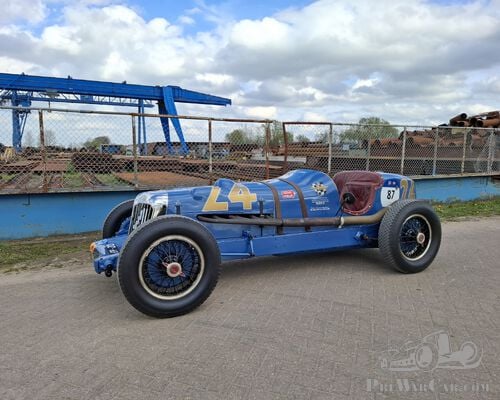
1932 - Graham " Lucenti " Indianapolis
Original participant of the 1932, 1934 and 1935 Indy 500. Best result: finishing 10th overall in the 1934 Indy 500 with driver “Herb” Ardinger...
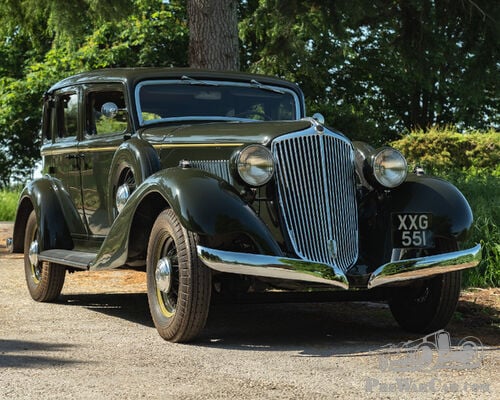
Graham Model 64 Standard Eight 'Blue Streak'
UK Registration No: XXG 551Chassis No: 1801069MOT: ExemptH&H ClassicsKelham Hall | Newark, Nottinghamshire