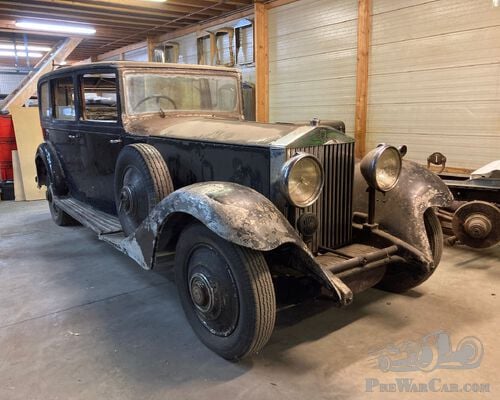
The global magazine and marketplace for classic car enthusiasts, by enthusiasts.


Filter
Classic Star, Franklin for sale - Star, Franklin cars for sale
-

1931 Franklin Series 15, Model 153 DeLuxe Town Car by Derham | RM Sotheby's | Sealed June
To Be OFFERED AT AUCTION WITHOUT RESERVE at RM Sothebys' Sealed June event, Bidding Closes 24-26 June 2026. Offered Without Reserve | $90,000 - $110,000 USD Believed to have been the only example builtA fabulous and very elegant “semi-custom” on the air-cooled Franklin chassisFormerly owned by Jim Mills and Harrah’s Aut.. -
1933 Franklin Series 17-B Twelve Limousine | RM Sotheby's | Sealed June
To Be OFFERED AT AUCTION WITHOUT RESERVE at RM Sothebys' Sealed June event, Bidding Closes 24-26 June 2026. Offered Without Reserve | $150,000 - $200,000 USD Among the rarest and most sought-after CCCA Full ClassicsOne of just 16 surviving Franklin Twelves, the majority in long-term ownershipExceptional quality and engi.. -
1928 Franklin Series 12-A Airman Convertible Sedan by Walker | RM Sotheby's | Sealed June
To Be OFFERED AT AUCTION WITHOUT RESERVE at RM Sothebys' Sealed June event, Bidding Closes 24-26 June 2026. Offered Without Reserve | $60,000 - $80,000 USD Among the most beautiful Franklins ever producedBelieved to be the only example built to this Raymond Dietrich designFormerly part of the renowned Harrah’s Automobil.. -
1927 Franklin 11-B Tandem Sport
1927 Franklin 11-B Tandem Sport Chassis Number: 164935-17 Registration Number: OFL27H (Germany.) Body Number: 58 A rare & unusual air cooled Franklin as used in a similar model by Charles Lindburgh in peiod. Air cooled 3.3l, 6 cyli..


Star
GB, 1898 – 1932
Star/ Starling/ Stuart
(1) Star Motor Co, Wolverhampton, Staffs., 1898 – 1902
(2) Star Engineering Co, Wolverhampton, Staffs., 1902 – 1909
(3) Star Cycle Co, Wolverhampton, Staffs., 1905 – 1909
(4) Star Engineering Co Ltd, Wolverhampton, Staffs., 1909 – 1928
(5) Star Motor Co Ltd, Wolverhampton, Staffs., 1928 – 1932
Edward Lisle Sr’s Star Motor Co, an offshoot of the Star Cycle Co, produced its first Star car in 1898, and offered the Star car for sale in the following year. The Star car was a Benz-based machine, with a single-cylinder, water-cooled 3½hp engine, belt primary drive and chain final drive. It was an improvement in that water circulation on the Star car was assisted by a pump. In 1900 there followed a 2-cylinder Star car with 3 forward speeds, still on Benz lines. 1901 brougth De Dion-engined single-cylinder Star cars, and 1902 an 8hp twin of Panhard type in addition. Other, larger Star cars of Panhard ancestry joined the 8hp, up to a 20hp four Star car. By 1904, although a De Dion-powered single and Panhard-type twin were still there, the bigger machines were of Mercédès pattern, these Star cars came with honeycomb radiators, mechanically-operated inlet valves and pressed-steel frames. All veteran Star cars up to 1914 were extremely well-made, well-furnished, conventional, rather expensive cars lacking in technical originality, showing a line of development appearance in the 1907 range. The best-known Star car of the veteran period was the excellent 15hp Star car of 1909, a shaft-driven 2.8-litre four which had become the 3-litre 15.9hp by 1914. A great variety of other Star cars, basically similar models were turned out, not only by Star but also by the Star Cycle Co. The latter, run by Edward Lisle Jr, had made motor tricycles and bicycles, and produced the Starling car in 1905. It had 2 forward speeds and a De Dion single-cylinder engine, but was otherwise of Panhard type, with armoured wood frame and chain drive. One year later the Star car company supplemented it with the more modern Stuart car, which had 2-cylinders, 3-speeds and shaft drive. This name was dropped in 1908, all models being called Starlings, but these too, disappeared in 1909 when Star cars cheaper line was entrusted to the new Brion Motor Co, a more indepented concern that was still run by Edward Lisle Jr. So popular was the Star car that its makers were among the six largest in the country before 1914.
The 15.9hp Star car was continued after World War 1, together with another sv four Star car of pre-war origin, the 20hp Star car of 3.8-litres. A modern light Star car of fashionable type, the 11.9hp, arrived in 1921. This Star car used a 1.795cc sv engine with a detachable head, made in unit with a 3-speed gearbox which had central change. By 1924, the 11.9 Star car had grown up into the 2-litre 12/25hp Star car. It shared cylinder dimensions with the 18hp Star car, which was a new 3-litre six. The 12/25 Star car could be had as a very fine fast touring car with overhead valves and 54bhp, in which form the Star car was called 12/40hp. Thereafter, the Star car range reverted to its pre-war complexity. By 1927, there were three sv Star car models and two additional and more up-to-date Star cars with overhead valves. The 14/40hp Star car, new in 1926, was a solid 2-litre, ohv machine which in spite of having only 4-cylinders and 3 forward speeds, this Star car was a notably smooth and flexible car, thanks to a 5-bearing crankshaft. The ohv 20/60hp Star car, a 2½-litre six with the same bore and stroke as the 14/40 and a 7-bearing crankshaft, was the most luxurious Star car. A light six, the popular ohv 18/50hp, joined the Star car range in 1928, the year of the Star car company’s acquisition by Guy, and replaced the 14/40 Star car for 1929. By this time, the sv Star cars had gone, leaving the two sixes. As the 18hp Star Comet and the 21hp Star Planet, these Star cars were revised with handsome bodies and very full, luxurious equipment, including one-shot chassis lubrication, thermostatically-controlled radiator shutters and a built-in jacking system. Two other engines, of 14hp (2-litres) and 24hp (3.6-litres) were also obtainable in Star cars for 1932, as alternative Comet and Planet power units. These Star car were the last new Star cars, for they were too expensive to make, and the times favoured the mass-produced economy car. Production of Star cars ended in March 1932, but the unsold stock was sold by McKenzie and Denley of Birmingham, and the Star car was quoted in the Buyer’s Guide lists until 1935.
US, 1903 – 1904
(1) Star Automobile Co, Cleveland, Ohio
(2) H.S. Moore, Cleveland, Ohio
This Star car was driven by a single-cylinder, watercooled engine of 1.9-litres, mounted beneath the front seat, with false bonnet and coil radiator in front. A champion planetary transmission and double chain drive was used on this Star car. Both two- and five-seater Star cars were made, the latter with rear entrance.
US, 1908
Star Automobile Co, Chicago, Ill.
Star runabouts were offered in three models, selling for $500, $600 and $700 respectively. The smallest Star car was an open two-seater, and shaft drive was employed on all Star cars.
US, 1908
Model Automobile Co, Peru, Ind.
The short-lived Star car from Peru was offered in conventional 2- and 4-cylinder forms. The twin was chain-driven, while the big, expensive four Star car ($4.000) had shaft drive.
US, 1922 – 1928
Durant Motor Co of New Jersey, Elizabeth, N.J.; Lansing, Mich; Oakland, Calif.
William Crapo Durant’s Star Four was one of the most serious attempts to take away some of the Model T Ford’s market, for the cheapest practical car. Unlike the Ford, the Star car was an assembled machine.The Star car had a 2.2-litre, 4-cylinder engine by Continental, and was conventional in design in every way except the gearbox, which was separate; a feature common to all the vehicles in Durant’s empire, but very unusual in American mass-produced cars by the early 1920s. The touring Star car cost only $443 in 1923, which helped Star to be the seventh biggest seller in America that year. The Star car was sold outside the United States as the Rugby. In 1926, a 2.8-litre six Star car was introduced. Front wheel brakes appeared in 1927 but a year later the Star car make disappeared in the collapse of the Durant interests. By this time, 250 Star cars a day were being turned out. Only the Four was still called the Star car for the 1928 model year, as the Six was now known as the Durant Model 55.
Source: Georgano, encyclopedia of motorcar; TRN, GMN, MJWW, TRN
The information is written with the greatest of care. However, if you have any suggested amendments please contact us at office@prewarcar.com
Franklin
US, 1901 – 1934
(1) H.H. Franklin Mfg Co, Syracuse, N.Y., 1901 – 1917
(2) Franklin Automobile Co, Syracuse, N.Y., 1917 – 1934
Probably the world’s most successful air-cooled car before the advent of the Volkswagen, the Franklin inspired an intense make-loyalty. H.H. Franklin had founded a factory for the manufacture of die castings in 1895, and in 1901 he was introduced to John Wilkinson’s air-cooled designs by Messsrs Brown and lipe, later well known as manufacturers of proprietary transmissions. The New York Motor Co had already made three prototypes before the first Franklin car went on sale in 1902. These Franklin featured transversely-mounted 1.7-litre 4-cylinder air-cooled engines – the valves were overhead, with mechanically operated inlet valves from 1905 – float-feed carburetors, 2-speed planetary gearboxes, central change, full-elliptic suspension and the wooden frames which were to be standard on all Franklin cars up to the end of 1927. A push-on handbrake was used until 1906. Although a Franklin version with water-jacketed engine was projected, the Franklin company remained faithful to air-cooling until they closed down. Sales rose from 13 in 1902 to 184 in 1903, when wire wheels gave way to the wood artillery type, and in 1904 a Franklin broke the San Francisco-New York record. The transverse-engined Franklin cars were catalogued until the end of 1906, but from 1905 onwards new Franklin models with conventionally-located engines made their appearance. These had auxiliary exhaust valves, shaft drive, 3-speed sliding-type gearboxes and round bonnets modelled on the Delaunay-Belleville. A 4-cylinder Franklin sold for $1800, but there was also a 6-cylinder Franklin Model H with a 7-bearing crankshaft and a 9ft 6in wheelbase for $4.000: all subsequent 6-cylinder Franklin cars had seven main bearings. A straight-8 appeared without success in the 1905 Vanderbilt Cup Eliminating Trials. Franklin’s full-elliptic suspension was continued. This gave an excellent ride and resulted in tyre mileages in the region of 20.000: this is why the Franklin company was refusing to fit detachable rims as standard equipment as late as 1922. In 1907 an automatic advance-and-retard was fitted on the Franklin and in 1908 a gear-driven fan. The 1910 Franklin cars used a suction-driven sirocco fan incorporated in the flywheel. Smallest of the 1909 range was the 18hp Franklin Model G, a 2.3-litre 4-cylinder car with quadrant change sold at $1850. Selective change was used on the bigger Franklin fours and sixes which had oversquare cylinder dimensions and cost $2800 and $3750 respectively. With the 1912 Franklin models came a Renault-type bonnet and full pressure lubrication, and a 4-cylinder was still available at $2.000, or $1.500 less than the big 38.4hp 6-cylinder.
In 1914 only a 6-cylinder car, the ‘Franklin 6/30’, was offered, and Franklin fell into line with the rest of the American industry by going over to left-hand drive, central change and full electrical equipment. A year later aluminium pistons were adopted. A stunt drive by Franklin from Walla Walla, Washington, to San Francisco in bottom gear demonstrated the car’s ability to keep cool. The 1917 models had electric chokes, while imitators arose in the industry to try and cash in on Franklin’s success with air-cooling. One of these firms, Holmes, was headed by former vice-president of the Franklin Automobile Co. By the end of World War 1 a 6-cylinder Franklin could be bought for $2.050, reduced two years later to $2.000. 8.648 Franklin cars were sold in 1920. Late in 1922, came a redesigned Franklin car with a ‘horse-collar’ bonnet allegedly modelled on the Fiat, pressure air-cooling with frontal blower, unit gearbox, single dry-plate clutch, 6-volt instead of 12-volt electrics and detachable rims. Sales rose to 11.000 and the Franklin company which had pioneered series-production closed cars as early as 1913 was offering a Franklin sedan at $2.850. During 1925 the design was face-lifted once again and the De Causse-styled Franklin Series 11 introduced. Cylinder capacity remained a modest 3.3-litres, but appearance was entirely changed with a 9ft 11in wheelbase and a vertical-barred ‘radiator’. This revolutionary step so appalled John Wilkinson that he resigned from the Franklin company forthwith. Some of the semi-custom body styles – especially the boat-taled sports coupé at $3.150 – were remarkably attractive. Subsequently some excellent and expensive custom bodywork was designed for Franklin by such firms as Derham, Willoughby, Holbrook, and (especially) Dietrich. Over 13.000 Franklin Series 11s were sold between mid-1925 and the end of 1926, among those who favoured Franklins being Colonel Charles Lindbergh. Yet even the ‘Franklin 11B’ of 1927 retained the wooden frame, full-elliptic suspension and foot transmission brake. Front-wheel brakes did not arrive until the introduction of the 1928 3.9-litre Franklin Airman, which boasted internal-expanding Lockheed hydraulics at a time when the contracting type was generally favoured in America. In 1928 long-chassis models were given steel frames, standardized in 1929, and a standard sedan sold for £885 in England. All but the cheapest Franklin cars now had silent 2nd gearboxes. This was the period in which Dietrich introduced their delightful speedster (actually a 4-door convertible sedan) and a 4½-litre 6-cylinder Franklin engine actually took to the air in a Waco biplane. Prices were generally in the $2.200 - $3.500 range, with custom Franklin models running up to $7.200.
The 1930 Franklin Series 14 introduced a new radiator and side-blast cooling, an the elegant Pirate models had concealed running-boards as well. The unconventional, however, could no longer sell in America, and only 2.851 Franklin cars were delivered in 1931. In 1932 came synchromesh, free wheels and ‘Startix’ devices, as well as a magnificent Dietrich-styled 6.8-litre supercharged V12 (Franklin Series 17) on a 12ft wheelbase. Unfortunately this was re-engineered to incorporate proprietary axles and semi-elliptic suspension, and in production form it weighed nearer three tons than the two tons of the prototype. It combined elegance, 95mph, and 150bhp for $4.400, but few were sold, though a dratic price cut to $2.885 was made for 1933. The last new Franklin was the Franklin Olympic, an inexpensive 6-cylinder using a Franklin engine wedded to a REO chassis and body. The Franklin factory closed down in 1934. The patents were, however, taken over by the Air-Cooled Motors Corporation (now Franklin Engine Co.), whose Syracuse factory has specialized in light horizontally-opposed aircraft engines: a 6-cylinder Franklin helicopter engine, converted to water-cooling, powered the Tucker of 1947. 2-, 4-, and 6-cylinder untis up to 5.7 litres’ capacity were being produced in 1972.
Source: Georgano, encyclopedia of motorcar; MCS
The information is written with the greatest of care. However, if you have any suggested amendments please contact us at office@prewarcar.com


Featured
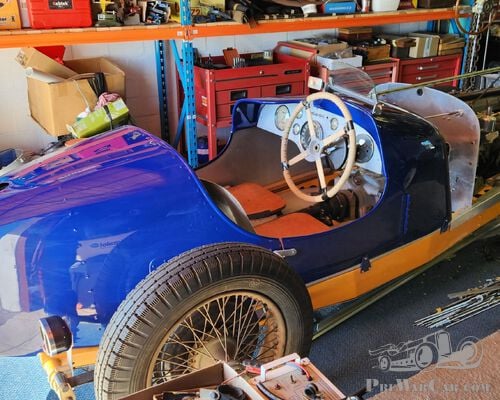
Riley TT Sprite
1935 6-cylinder TT Sprite replica. Chassis # 46A2722. Engine # 6A2722. Original Ulster Imp body. Restoration nearing completion. Engine, G..
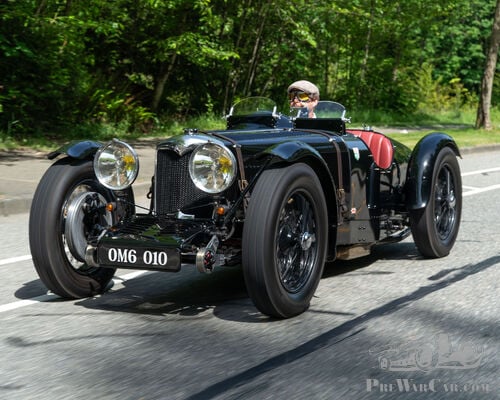
Riley 14/6 Special 1933
The ExperienceStep into the golden age of British motoring. This 1933 Riley 14/6 Special is a masterclass in pre-w..