The global magazine and marketplace for classic car enthusiasts, by enthusiasts.


Filter
Classic Chalmers, Frazer Nash for sale - Chalmers, Frazer Nash cars for sale
-

1927 Frazer Nash Vitesse (Period Brooklands Race History)
1927 Frazer Nash VitesseRegistration: PH 2042Chassis No. 1120Engine No. 126 (Lea-Francis Twin Cam)Few Frazer Nash’s tell a story quite as completely as PH 2042.Supplied new by the Frazer Nash works in 1927 as a Vitesse fitted with a supercharged Anzani engine, this is a car that has spent much of its life doing.. -
Fraser Nash TT Replica
AHX 389 ( chassis no. 2073, engine no. 10367).An important and correct short-chassis TT Replica with known history from new.Ex. H. Porter-Hargreaves, Bunty Richmond & Midge Wilby.Purchased at the renowned sale of Midge Wilby's effects in 1986 and subsequently restored by Derek Hall, a lifelong Fraser Nash enthusiast, aff.. -
1938 Frazer-Nash BMW 320 Coupe
1938 Frazer-Nash BMW 320 Coupe Chassis Number: 92210Rgstration Number: FGC706 BMW’s 320 is quite a rarity among between-the-Wars machinery from the Bavarian manufacturer, having been launched in 1937, with some 4,200 examples produced before it was replaced by the 321 in 1938.Based on the preceding 319.. -
1935 Frazer Nash TT Replica | RM Sotheby's | The Woodcote Park Auction
To Be OFFERED AT AUCTION at RM Sothebys' The Woodcote Park Auction event, 8 July 2026. £180,000 - £260,000 GBP One of just 83 examples of the TT Replica built; delivered new in March 1935Retained by the York Motor Museum in Western Australia for three decadesOverhauled by historic racing specialist Blakeney Motorsport c..


Chalmers / Chalmers-Detroit
US, 1908 – 1924
Chalmers Motor Car Co, Detroit, Mich.
The Chalmers was one of the most popular automobiles made in the United States for more than a decade. The Chalmers was the successor to the Thomas-Detroit which was built by a company which had been founded in 1906 by E.R. Thomas (builder of the Thomas car in Buffalo, N.Y.), Roy D. Chapin and Howard Earle Coffin; the two latter had previously served at Oldsmobile. The Thomas-Detroit of which some 500 were sold during the first year of production, was marketed through the parent firm in Buffalo which manufactured a larger line of cars under the Thomas emblem. The Thomas-Detroit was a medium priced four-cylinder car which had been designed by Coffin. In 1907, Hugh Chalmers, vice president of the National Cash Register Co and a noted salesman, entered the firm. Shortly after, he bought a half of E.R. Thomas’ stock and became president of the company which became the Chalmers-Detroit Motor Company. The Thomas-Detroit became the Chalmers-Detroit in 1908 and in 1910, the Chalmers. Open and closed Chalmers models in two lines comprised the Chalmers four-cylinder cars, with self-starters appearing in 1912. Chalmers (as Chalmers-Detroit) had distinguished itself in road races as early as 1908 when W.R. Burns won the Motor Parkway Sweekstakes at Jericho, N.Y., averaging 48.7mph in the six-lap 140.76 mile run.
In 1913, the Chalmers brought out its first 6-cylinder model, as well as the four and apart from small mechanical and design changes, continued both until 1914. The Chalmers four was dropped from the 1915 line, however, and sixes were to be used exclusively in Chalmers until the ending of manufacture. By 1915, some 20.000 Chalmers cars per year were coming off the Chalmers production line and would even exceed that figure before the advent of World War 1. In 1917, an L-head motor replaced the earlier overhead-valve type and on August 4th, Chalmers again headed racing news when Joe Dawson won the 24-hour stock Car Endurance Run at Sheepshead Bay, N.Y. Sales flagged following the end of the war and Hugh Chalmers, always the salesman, and with the realization that a competitor, Maxwell, wasn’t faring well either, arranged to lease his Chalmers plants to Maxwell, using his salesmanship to promote the two concerns and getting the benefit of Maxwell tooling and manufacturing equipment. By the early 1920s, however, many makes of cars were in financial difficulties due to over-expansion and recession, and Walter P. Chrysler was called in to try and reorganize Maxwell. Chrysler was at this time planning his own corporation and in 1922 Chalmers was taken over by Maxwell which had become a Chrysler subsidiary. The last Chalmer cars for sale were equipped with Lockheed hydraulic brakes but 1923 was the last year of Chalmers production with some 9000 units leaving the factories. The Maxwell survived until 1925 when it became the Chrysler Four.
Source: Georgano, encyclopedia of motorcar; KM
The information is written with the greatest of care. However, if you have any suggested amendments please contact us at office@prewarcar.com
Frazer-Nash
GB, 1924 – 1960
(1) Frazer Nash Ltd, Kingston on Thames, Surrey, 1924 – 1925
(2) William G. Thomas & Frazer Nash Ltd, Kingston on Thames, Surrey, 1925 – 1926
(3) A.F.N. Ltd, Isleworth, Middlesex, 1926 – 1960
After Captain A. Frazer Nash left GN Ltd, the company he had helped to found, he at first made orthodox family Frazer Nash cars with shaft drive and water-cooled 4-cylinder engines of Deemster extraction. However, only a handful of light cars were made before Frazer Nash reverted to type. His new Frazer Nash car of 1924 was based largely on the GN, retaining its dog-clutch gear-change, separate chains for each of the three forward speeds, solid rear axle, hard quarter-elliptic suspension and high ratio steering. After the Plus-Power engine, Frazer Nash adopted the sv water-cooled 4-cylinder 1½-litre Anzani unit, giving 40bhp. Thus the GN’s combination of simplicity, strength, modest price, low weight and high powere were combined in a still brisker sporting machine. The Frazer Nash, together with the Aston-Martin, was Britain’s nearest answer to importe sports cars in the Bugatti Brescia class. It was so popular that the Frazer Nash remained in production, basically unchanged for 15 years, even though clutches and chain drive had been outmoded when the Frazer Nash was first introduced.
The principal alternations were to the power unit. A Meadows engine of the same size, but with overhead valves, and giving 50bhp, supplemented and then replaced the Anzani from 1929 and four forward speeds were provided on the Frazer Nash. Alternatively available from 1934 was the 1½-litre single ohc Frazer Nash engine, known as the Gough after its designer. This unit normally delivered 60bhp, but was also available supercharged in the Frazer Nash Shelsley or Frazer Nash TT replica chassis which had cantilever front springs. The Frazer Nash model names applied to the chassis, which could be fitted with any engine. Thus some Frazer Nash Shelsleys were equipped with the twin ohc 1.675cc 6-cylinder Blackburne, which was a smoother, more flexible unit.
It was clear that such a fundamentally primitive design could not last for ever, however efficient. H.J. Aldington, who had gained control of AFN Ltd in 1929, sought an alternative by importing the German BMW from 1934 – the BMW Type 319 engine was used in the chain-driven Frazer Nash chassis. The last Frazer Nash of the old pattern was made in 1939, but the Frazer Nash name re-appeared 8 years later attached to a thoroughly up-to-date car. Its power unit was developed jointly by AFN and Bristol, using the pre-war BMW Type 328 engine modified for higher output. In the Frazer Nash the 2-litre cross-push-rod operated ohv unit developed from 75 to 135bhp, depending on the stage of tune required. It was installed in a tubular chassis with transverse leaf independent front suspension and torsion bar rear suspension. There was a normal synchromesh gearbox and live axle. The Frazer Nash car was light – the chassis weighed 1.176lb – and held the road extremely well. The Frazer Nash High Speed Model of 1948 was developed into the Frazer Nash Le Mans Replica which gained a 3rd place in that race in 1949, as well as being the only British car to win the Targa Florio, in 1951. From 1953 a De Dion-type rear axle was used in some Frazer Nash cars, including the Frazer Nash Competition Model. When BMW began making a 2.6-litre V8 engine, this was put in the Frazer Nash Competition Model and in a new two-seater coupé, the Frazer Nash Continental. This was very expensive at £3.751. Only the BMW unit was available from 1957, increased to 3.2-litres in 1959. This was the last year at which Frazer Nash cars were seen at the Earls Court Motor Show and production of Frazer Nash ceased soon after that.
Source: Georgano, encyclopedia of motorcar; TRN
The information is written with the greatest of care. However, if you have any suggested amendments please contact us at office@prewarcar.com


Featured
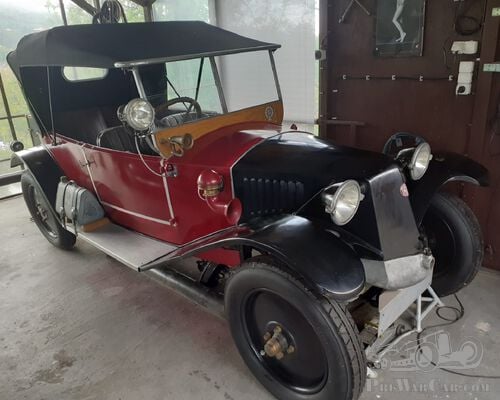
1924 Tatra 11 Roadster – Authentic Survivor with Running Boxer Engine | Rare Opportunity for Discerning Pre-War Collectors
An Exceptional Piece of Automotive HistoryOffered for sale is a remarkably rare 1924 Tatra 11 Roadster, one of the most import..
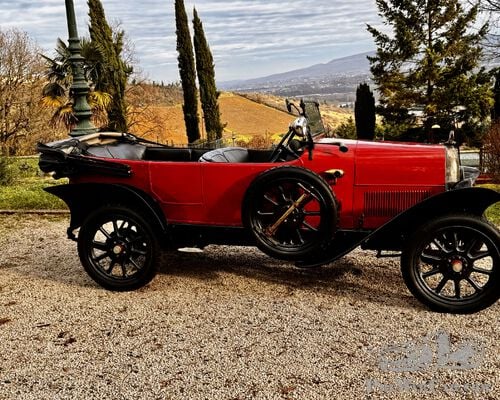
Torpedo sport de 1923 complete et fonctionnelle, conforme a sa sortie d'usine ,d'une authenticité totale, agréer à participer aux MILLE MIGLIA
Voiture référencée pour son authenticité au BOOK FIAT historique de ThurinBelle présentatio, peinture ancienne d'environ 20 ans ,Mot..
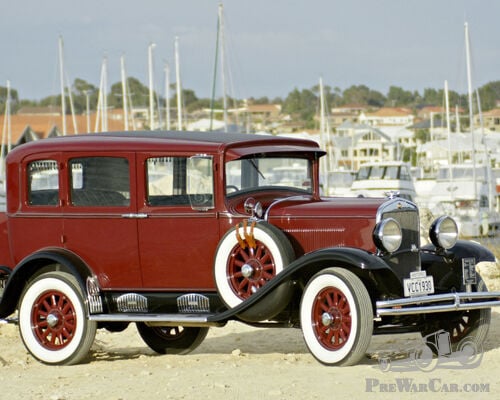
1930 Chrysler 66 Six-Wheel Equipped Royal Sedan
An exceptionally well restored and highly awarded Chrysler 66 Royal Sedan, with only two owners in nearly 97 years.The present owner ..