The global magazine and marketplace for classic car enthusiasts, by enthusiasts.


Filter
Classic Frazer Nash, Rauch & Lang for sale - Frazer Nash, Rauch & Lang cars for sale
-

1918 Rauch & Lang Model B26 Brougham | RM Sotheby's | The Hershey Auction
To Be OFFERED AT AUCTION at RM Sothebys' The Hershey Auction event, 7 - 8 October 2026. $150,000 - $175,000 USD One of the finest surviving examples of the Rauch & Lang electric carBeautiful show-quality, AACA First Junior-winning restorationKnown history, with only three long-term caretakers since the 1950s -
1938 Frazer-Nash BMW 320 Coupe
1938 Frazer-Nash BMW 320 Coupe Chassis Number: 92210Rgstration Number: FGC706 BMW’s 320 is quite a rarity among between-the-Wars machinery from the Bavarian manufacturer, having been launched in 1937, with some 4,200 examples produced before it was replaced by the 321 in 1938.Based on the preceding 319.. -
Fraser Nash TT Replica
AHX 389 ( chassis no. 2073, engine no. 10367).An important and correct short-chassis TT Replica with known history from new. Ex. H. Porter-Hargreaves, Bunty Richmond & Midge Wilby with extensive period competition history.Purchased at the renowned sale of Midge Wilby's effects in 1986 and subsequently restored by Derek H.. -
Frazernash Kit
Kit of parts to build a frazernash. Original Bevel box, axles etc. New chassis and cross members. Nice original radiator surround, wheels, springs etc. -
1927 Frazer Nash Vitesse (Period Brooklands Race History)
1927 Frazer Nash VitesseRegistration: PH 2042Chassis No. 1120Engine No. 126 (Lea-Francis Twin Cam)Supplied new by the Frazer Nash works in 1927 as a Vitesse fitted with a supercharged Anzani engine, this is a car that has spent much of its life doing exactly what its makers intended — being driven hard, raced enthusia..


Frazer-Nash
GB, 1924 – 1960
(1) Frazer Nash Ltd, Kingston on Thames, Surrey, 1924 – 1925
(2) William G. Thomas & Frazer Nash Ltd, Kingston on Thames, Surrey, 1925 – 1926
(3) A.F.N. Ltd, Isleworth, Middlesex, 1926 – 1960
After Captain A. Frazer Nash left GN Ltd, the company he had helped to found, he at first made orthodox family Frazer Nash cars with shaft drive and water-cooled 4-cylinder engines of Deemster extraction. However, only a handful of light cars were made before Frazer Nash reverted to type. His new Frazer Nash car of 1924 was based largely on the GN, retaining its dog-clutch gear-change, separate chains for each of the three forward speeds, solid rear axle, hard quarter-elliptic suspension and high ratio steering. After the Plus-Power engine, Frazer Nash adopted the sv water-cooled 4-cylinder 1½-litre Anzani unit, giving 40bhp. Thus the GN’s combination of simplicity, strength, modest price, low weight and high powere were combined in a still brisker sporting machine. The Frazer Nash, together with the Aston-Martin, was Britain’s nearest answer to importe sports cars in the Bugatti Brescia class. It was so popular that the Frazer Nash remained in production, basically unchanged for 15 years, even though clutches and chain drive had been outmoded when the Frazer Nash was first introduced.
The principal alternations were to the power unit. A Meadows engine of the same size, but with overhead valves, and giving 50bhp, supplemented and then replaced the Anzani from 1929 and four forward speeds were provided on the Frazer Nash. Alternatively available from 1934 was the 1½-litre single ohc Frazer Nash engine, known as the Gough after its designer. This unit normally delivered 60bhp, but was also available supercharged in the Frazer Nash Shelsley or Frazer Nash TT replica chassis which had cantilever front springs. The Frazer Nash model names applied to the chassis, which could be fitted with any engine. Thus some Frazer Nash Shelsleys were equipped with the twin ohc 1.675cc 6-cylinder Blackburne, which was a smoother, more flexible unit.
It was clear that such a fundamentally primitive design could not last for ever, however efficient. H.J. Aldington, who had gained control of AFN Ltd in 1929, sought an alternative by importing the German BMW from 1934 – the BMW Type 319 engine was used in the chain-driven Frazer Nash chassis. The last Frazer Nash of the old pattern was made in 1939, but the Frazer Nash name re-appeared 8 years later attached to a thoroughly up-to-date car. Its power unit was developed jointly by AFN and Bristol, using the pre-war BMW Type 328 engine modified for higher output. In the Frazer Nash the 2-litre cross-push-rod operated ohv unit developed from 75 to 135bhp, depending on the stage of tune required. It was installed in a tubular chassis with transverse leaf independent front suspension and torsion bar rear suspension. There was a normal synchromesh gearbox and live axle. The Frazer Nash car was light – the chassis weighed 1.176lb – and held the road extremely well. The Frazer Nash High Speed Model of 1948 was developed into the Frazer Nash Le Mans Replica which gained a 3rd place in that race in 1949, as well as being the only British car to win the Targa Florio, in 1951. From 1953 a De Dion-type rear axle was used in some Frazer Nash cars, including the Frazer Nash Competition Model. When BMW began making a 2.6-litre V8 engine, this was put in the Frazer Nash Competition Model and in a new two-seater coupé, the Frazer Nash Continental. This was very expensive at £3.751. Only the BMW unit was available from 1957, increased to 3.2-litres in 1959. This was the last year at which Frazer Nash cars were seen at the Earls Court Motor Show and production of Frazer Nash ceased soon after that.
Source: Georgano, encyclopedia of motorcar; TRN
The information is written with the greatest of care. However, if you have any suggested amendments please contact us at office@prewarcar.com
Rauch & Lang
US, 1905 – 1928
(1) Rauch & Lang Carriage Co, Cleveland, Ohio, 1905 – 1916
(2) Baker, Rauch & Lang Co, Cleveland, Ohio, 1916 – 1922
(3) Rauch & Lang Electric Car Manufacturing Co, Chicopee Falls, Mass., 1922 – 1928
Rauch & Lang were an old-established carriage building firm (founded 1853) when they began to make electric Rauch & Lang cars in 1905. These Rauch & Lang cars followed the usual pattern for such electric vehicles, being mainly closed town cars, although a few open phaeton Rauch & Lang cars were also made. The biggest Rauch & Lang cars were heavier vehicles and included a six-seater limousine with separate outside seat for the chauffeur. Some Rauch & Lang cars had 4-doors, a very unusual feature in electric cars. In 1916 the Rauch & Lang cars became part of the Baker, Rauch & Lane group and production declined. From 1919 onwards the Rauch & Lang cars were sometimes listed as Raulangs, and from 1922 this became the official name of the Rauch & Lang cars.
By this time production of Rauch & Lang cars had been transferred to the Stevens-Duryea factory at Chicopee Falls where the number of private cars made was very small. The factory, which was still turning out a few Stevens-Duryeas, also made petrol and electric taxi-cabs under the name Rauch & Lang cars, and bodies for Stanley Steamers.
Source: Georgano, encyclopedia of motorcar; GNG
The information is written with the greatest of care. However, if you have any suggested amendments please contact us at office@prewarcar.com


Featured
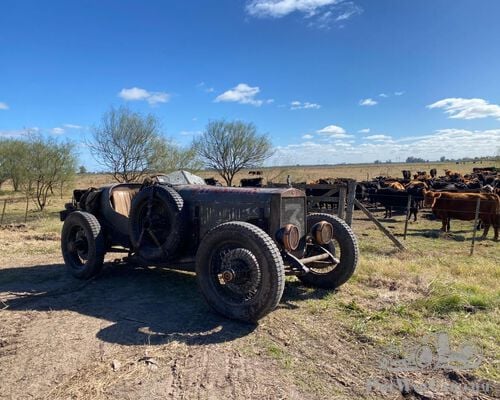
Studebaker 1927 for sale
Authentic race car of the time - Everything is working - All parts of its original mechanics - I have the history of the car - 6 cylinders - Ready ..
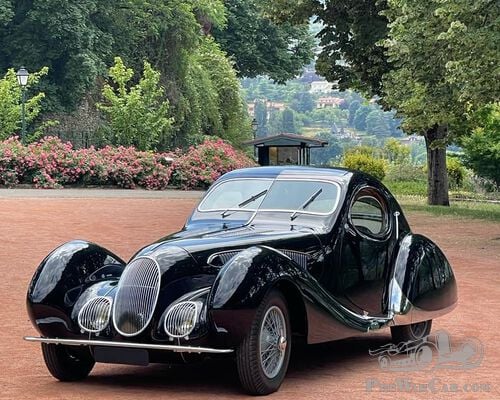
1939 Talbot-Lago T150C “Goutte d’Eau” — Iconic French Coachbuilt Masterpiece
Talbot-Lago T150C ‘Teardrop’ — An Icon of French Automotive Art There are motor cars that define an era. And then there are those tha..
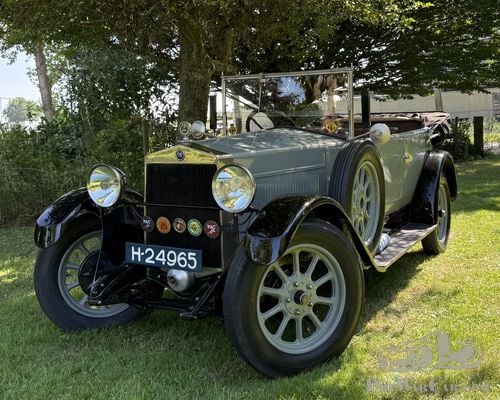
Fiat 509 Torpedo / Spider – Exceptionally Original and Complete
A Rare and Highly Original Example with Long-Term Dutch HistoryOffered for sale is an exceptionally original and remarkably complete Fiat 50..