The global magazine and marketplace for classic car enthusiasts, by enthusiasts.


Filter
Classic Georges Richard, Unic for sale - Georges Richard, Unic cars for sale
-

Lancia Lambda Torpedo 1925
A car designed and bult with features way ahead of its time . Monocoque chassis , with V4 engine and overhead camshaft with roller rockers.Full billet crank shaft ,alloy pistons , 4 speed gearbox and independent front suspension with oil telescopic dampers Full ground up rebuild of body and all mechanicals , Two Pack epoxy enamel p.. -
1931 Cadillac V-8 Five-Passenger Coupe by Fisher | RM Sotheby's | The Hershey Auction
To Be OFFERED AT AUCTION WITHOUT RESERVE at RM Sothebys' The Hershey Auction event, 7 - 8 October 2026. Offered Without Reserve | $65,000 - $85,000 USD Formerly owned by noted Cadillac collector Dan GernattAACA National First Senior and CCCA Premier Awards Very high-quality and well-preserved restoration in original col.. -
1943 Fiat 500 A 'Topolino' Trasformabile | RM Sotheby's | The Hershey Auction
To Be OFFERED AT AUCTION WITHOUT RESERVE at RM Sothebys' The Hershey Auction event, 7 - 8 October 2026. Offered Without Reserve | $15,000 - $20,000 USD Please check back soon as our dedicated cataloguing team is preparing the description for this lot. To view this car and others currently consigned to this auction, please visit the RM website a.. -
1937 Cord 812 Supercharged Phaeton | RM Sotheby's | The Hershey Auction
To Be OFFERED AT AUCTION WITHOUT RESERVE at RM Sothebys' The Hershey Auction event, 7 - 8 October 2026. Offered Without Reserve | $75,000 - $100,000 USD Please check back soon as our dedicated cataloguing team is preparing the description for this lot. To view this car and others currently consigned to this auction, please visit the RM website .. -
1938 Frazer-Nash BMW 320 Coupe
1938 Frazer-Nash BMW 320 Coupe Chassis Number: 92210Rgstration Number: FGC706 BMW’s 320 is quite a rarity among between-the-Wars machinery from the Bavarian manufacturer, having been launched in 1937, with some 4,200 examples produced before it was replaced by the 321 in 1938.Based on the preceding 319.. -
1934 Aston Martin Mk II (short chassis)
Brand new Ecurie Bertelli engine built around a new cylinder block, only test miles completed since. The original cylinder block comes with the car. The Mk II model was introduced in 1934, as Aston-Martin’s replacement for the Le Mans. It sported a new, stronger chassis and an improved engine with counter-balanced crankshaft. Or.. -
Rare Low Chassis Continental Tourer
Please visit our homepage for further information and pictures: www.scuderia-renania.comModel History:The 2-Litre L/C "Continental" was introduced in April 1932 and was the final stage in the development of the successful 2 -litre model. It was built on the desirable low chassis, providing a lower centre of gr.. -
1928 Riley Monaco
Very original car with partly original interior, sound woodwork and nicely re fabric covered. £1000 Dynamo rebuild and electronic cutout.Not used for a couple of years due to health problems but starts and runs well. -
1934 Bentley 3 ½ Park Ward Sports Saloon B26BN
A good, sound car, perhaps needing some cosmetic improvement, but in sound, correct condition, and has been used & enjoyed recently by the last owner. The deep red paintwork is suffering from age, but the structure of the coachwork is fine, the doors closing nicely & fitting well. The interior is grey leather with fresh grey carpets and..


Georges Richard
France, 1897 – 1930
(1) Société des Anciens Etablissements Georged Richard, Ivry-Port, 1897 – 1905
(2) Société des Automobiles Brasier, Ivry-Port, 1905 – 1926
(3) Société Chaigneau-Brasier, Ivry-Port, 1926 – 1930
The first car made by Georges Richard was a frail machine on Benz lines, with belt drive and three forward speeds. By 1900, Richard Richard was offering the Vivinus from Belgium under his own Georgen Richard name – another voiturette, but a quieter, smoother-running one with a fair turn of speed. This Georges Richard was powered by a 6hp 2-cylinder engine, and this Georges Richard too was belt-driven. However, the 7½hp Georges Richard of 1901 had shaft drive, in the approved modern fashion of Darracq and Renault. With the arrival of the designer Brasier at the Georges Richard company, who had worked for Mors, Georges Richard gradually ceased to be associated with voiturettes, but gained little originality. There were four new Georges Richard models in 1902, but all called Richard-Brasiers, rated at between 10 and 40hp but those Richard Georges/ Richard Brasier cars were of Panhard type in most respects. The smaller Georges Richard/ Richard Brasier cars still had tubular chassis and not all Georges Richard/ Richard Brasier models for sale had chain drive, but all types had steel frames by 1904. In that year there were two twins and three fours by Georges Richard/ Richard Brasier, only the biggest of which, the 40hp, was chain-driven. In 1904 and 1905, Georges Richard/ Richard Brasier’s cars won the Gordon Bennett Trophy for France, bringing worldwide fame to the Georges Richard/ Richard Brasier name.
In 1905 Georges Richard left to make the Unic at Puteaux, and Brasier continued to offer his cars, now not as Georges Richard/ Richard Brasier but simply as Brasiers. They remained conservative in design until 1912, with exposed valve gear and cylinders cast in pairs. In that year, a modern light Brasier car was introduced, with a 4-cylinder engine cast en bloc. Ivry-Port went on listing solid, unenterprising, relatively expensive fours until 1927. They were brought up to date in 1923 by means of front wheel brakes and ohv engines, but this had become common practice, Brasier(Georges Richard/ Richard Brasier), in fact, was another famous old make whose popularity slowly declined, like so many in France at this time.
Reorganization in 1926 at first brought no important innovations to Georges Richard/ Richard Brasier/ Brasier, apart from a change of name to Chaigneau-Brasier, and the introduction of a modern orthodox light car in the shape of the 9CV. Then, in 1928, the new Chaigneau-Brasier company revealed the outcome of its rethinking. This had been over- instead of under-enterprising, for the new car as a 3-litre, overhead-camshaft straight-8 with front wheel drive. With this car, and even more with the bigger Chaigneau-Brasier Type DG8 of similar design that followed in 1930, Chaigneau-Brasier committed the double error of plunging into the luxury market at a time of economic depression, and offering an unconventional design to a public that distrusted such things. Chaigneau-Brasier, like Georges Richard/ Richard Brasier/ Brasier paid the price
Source: Georgano, encyclopedia of motorcar; TRN
The information is written with the greatest of care. However, if you have any suggested amendments please contact us at office@prewarcar.com
Unic
France, 1904 – 1939
(1) Sté des Ancien ets Georges Richard, Puteaux, Seine, 1904 – 1914
(2) SA des Automobiles Unic, Puteaux, Seine, 1914 – 1939
When in 1905 Georged Richard left the firm he had founded, he embarked on his second motor manufacturing career with what was intended to be a single-model policy – hence the name of his new car. However, his 10/12hp 2-cylinder UNIC car was joined within a year by two additional fours. After this the UNIC car make remained undistinguished. The most famous of the small fours UNIC cars was not a passenger UNIC car at all, but a taxi. The monobloc 12/14hp UNIC car of 1908 was made for 20 years, and served on London streets for longer still. In 1909 there was a 4.1-litre 6-cylinder model UNIC car. By 1914, three 4-cylinder UNIC cars were listed, of which the 10/12hp UNIC car was best known.
The basic UNIC car of the 1920s was the 10CV Type L, a worthy, long-lived but uninteresting car with an 1.847cc sv engine and the modern feature of unit construction of engine and gearbox. This UNIC car had front-wheel brakes from 1923. The Type L313 Sport UNIC car, an 11CV, with a bigger bore and 2-litres, was added in that year. The UNIC car had overhead valves, and was a good-looking 70mph fast tourer in the French tradition. The UNIC car must have been one of the first cars anywhere to have horizontal bonnet louvres. In 1926, the 11CV UNIC car was also listed in sv touring form; only cars of this rating were made, the UNIC car company having temporarily reverted to tehri original policy. At this time, the UNIC car company employed women road-testers, a rare but not unique practice.
UNIC cars penchant for unusual rear suspension – the 10CV UNIC car had used a combination of cantilevers and quarter-elliptics – was perpetuated on their straight-8 UNIC car of 1928, which had transverse springs located above and below the axle. Engines were push-rod ohv units of 2.494cc or 2.650cc, there were four forward speeds, and brakes of the UNIC cars were servo-assisted; both types persisted until 1934, though the old 11CV UNIC car had gone by 1932, and during the Depression years the UNIC car company concentrated on commercial vehicles. New for 1934 was the U4, a 2-litre sv four with magneto ignition (used on Unic cars almost until the end), articulated-arm independent front suspension and a double reduction back axle. The UNIC car competed with the Berliet 944 and the new small Delage and was joined during the year by the U6, a 3-litre six on similar lines, this UNIC car was available with a 4-speed Cotal electrically selected gearbox. This option was extended to the U4 in 1936, and in 1937, when traditional radiators gave way to fencer’s mask grilles, both 4- and 6-cylinder Unic cars were available in sports cabriolet form with ohv. The U4D of 1938 with 2.150cc ohv engine, and an improved U6 UNIC car survived until the outbreak of World War 2. Private UNIC car production was not resumed in 1946, though Unic are still active in truck manufacture as an associate of Fiat.
Source: Georgano, encyclopedia of motorcar; TRN
The information is written with the greatest of care. However, if you have any suggested amendments please contact us at office@prewarcar.com


Featured
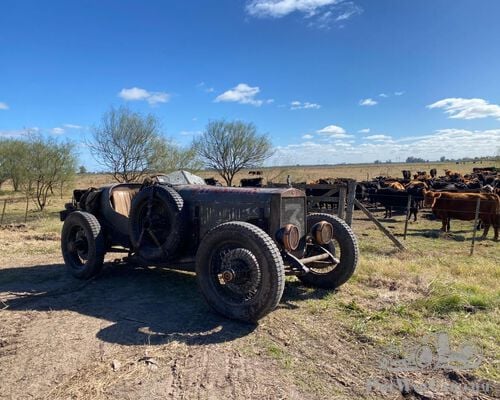
Studebaker 1927 for sale
Authentic race car of the time - Everything is working - All parts of its original mechanics - I have the history of the car - 6 cylinders - Ready ..
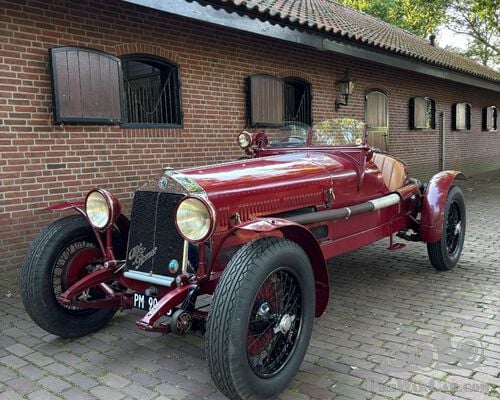
1930 Alfa Romeo 6C 1750 Spider
1930 Alfa Romeo 6C 1750 Spider with complete history from delivery to first owner in 1930 in Firenze till today with copy Libretto/license plate.
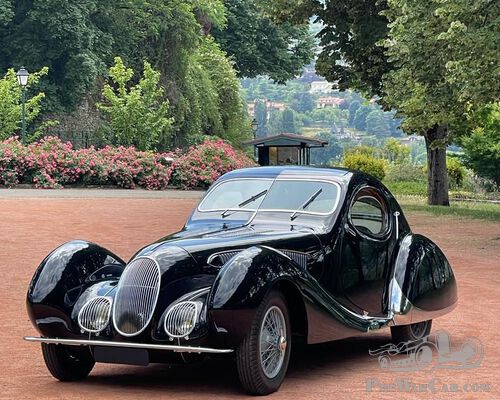
1939 Talbot-Lago T150C “Goutte d’Eau” — Iconic French Coachbuilt Masterpiece
Talbot-Lago T150C ‘Teardrop’ — An Icon of French Automotive Art There are motor cars that define an era. And then there are those tha..