The global magazine and marketplace for classic car enthusiasts, by enthusiasts.


Filter
Classic Georges Roy for sale - Georges Roy cars for sale
-

1930 Standard Avon Alvis 12/50 Supercharged Special
1930 Standard Avon Alvis 12/50 Supercharged Special Chassis Number: 29035 Registration Number: BF9202 The present owner began building the A-A in 1965. He had enjoyed driving his first real car, a 1929 12/50 Alvis Betleback and when he acquired a 1930 Standard Avon, he found tha.. -
1906 FIAT BREVETTI COUPÉ DE VILLE Coachwork by Carrozzeria Italiana Cesare Sala, Milan
1906 FIAT BREVETTI COUPÉ DE VILLE Coachwork by Carrozzeria Italiana Cesare Sala, Milan Chassis No. 788 Coachwork No. 5699 Location: Siena, Tuscany, Italy AN EXCEPTIONALLY ORIGINAL SURVIVING FIAT BREVETTI Offered for sale is this exceptionally rare 1906 FIAT Brevetti, chassis no. 788, featuring distinguished Coupé de Ville coachwork by the renow.. -
1899 Beeston Ladies’ Model Motor Tricycle
A rare opportunity to acquire what is believed to be the only surviving Beeston Ladies’ Model motor tricycle. The New Beeston Cycle Co. was one of the earliest British cycle manufacturers to enter the emerging motor-vehicle industry. After experimenting with prototypes from 1896, the company introduced motor tricycles powere.. -
1924 Bentley 3 4 ½ Litre
•Sold new to Major EG Thomson of Edinburgh, of Ecuire Ecosse fame •Owned for more than 50 years by the Martin family•Upgraded to 4.5 Litre spec using original crankcase•Extensive history file includes factory records and buff logbooks•Fully restored by Paul Grist to his ‘ultimate’ period look and specification .. -
Rosengart LR4N2 1938 – Rare Pre-War French Saloon – Restoration Project
Na sprzedaż: Rosengart LR4N2 z 1938 roku Rzadki francuski samochód przedwojenny, projekt do renowacji. -
1921 Rolls Royce 20hp Experimental tourer
1921 Rolls Royce 20hp Experimental tourer. Chassis number: 4G2 Registration Number: CH2892 Sir Henry Royces' personal car used for development of the 20HP chassis. He is pictured in it both at his French house; La Villa Mimosa in Le Canadel & also near his UK home "Elmsted" .. -
Oldsmobile Curved Dash Model 6C 7hp 1904
We have available for sale this exceptionally original 7hp Curved Dash Oldsmobile. Manufactured in 1904. Continuous ownership/history for many years. This is the larger engined motor car with rear brakes & larger hp. These are exceptionally good strong motor cars and can certainly cover some miles without any issues, well built & very go.. -
BMW 326 Cabriolet
AVAILABLE – NEAR PARISRare two-door Convertible version.EU import duties paid, supplied with its US title.Requires a complete restoration. The car is complete and is sold with an additional complete engine. -
Fiat 509 Torpedo / Spider – Exceptionally Original and Complete
A Rare and Highly Original Example with Long-Term Dutch HistoryOffered for sale is an exceptionally original and remarkably complete Fiat 509 Torpedo / Spider, preserved with many of its original components, fittings and period details still intact.For the serious collector of early Italian motor cars, its principal appeal lies not.. -
1929 Delage DMN (6 Cyl.) Tourer
Delage is a marque synonymous with style and a sporting history. This example is no exception, wearing a stunning body in the style of Vanden Plas. Its most adequately powered by its 3.8 liter overhead valve, straight six engine. The DMN offered the larger valves that would be used in the D8 model, and a lightened fly wheel. The 6 cylinde..


Georges Roy
France, 1906 – 1929
Automobiles Georges Roy, Bordeaux
Georges Roy was a regional French firm with a long record of unspectacular motor cars. In 1906 Georges Roy offered an 1.100cc single, a very large twin of 2.9-litres’ capacity and a 4.6-litre 4-cylinder, all with 3-speed gearboxes. The range of Georges Roy cars was widened in 1907 to include a 10.2-litre 6-cylinder. The twins were still being made in 1908, when there were also 4-cylinder 2.9-litre Georges Roy and 5.9-litre models, and an 8.5-litre 6-cylinder car at 18.500fr for a chassis. Chain drive was optional on the two largest Georges Roy types, but in 1909 only fours were made. Two types of Georges Roy cars, a four and a six, were listed in 1910, sharing the same cylinder dimensions of 80x110mm. By 1912 all Georges Roy cars had four speeds and shaft drive, the 20CV being a 3.6-litre 6-cylinder car. Radiators were round on the Georges Roy and a 1½-litre sv monobloc model on straightforward lines was added to the Georges Roy range in 1913. After World War 1 the Georges Roy appeared as a very conventional 3-litre sv long-stroke model with fixed head, pump cooling, 4-speed unit gearbox, cone clutch, bevel drive, disc wheels and a bull-nose radiator. This was joined a year later by the 1½-litre Georges Roy SBD type with thermo-syphon cooling and separate gearbox. The big Georges Roy OBD had acquired front-wheel brakes by 1923, but by 1926, when it had been discontinued, the smaller Georges Roy car models still had brakes on the rear wheels only. These were not listed with fwb until 1928. Two years later the Georges Roy firm were making light commercials only, still on the same chassis.
Source: Georgano, encyclopedia of motorcar; MCS
The information is written with the greatest of care. However, if you have any suggested amendments please contact us at office@prewarcar.com


Featured
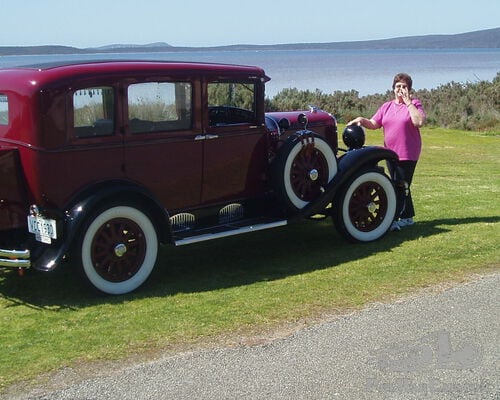
1930 Chrysler 66 Six-Wheel Equipped Royal Sedan
An exceptionally well restored and highly awarded Chrysler 66 Royal Sedan, with only two owners in nearly 97 years.The present owner ..
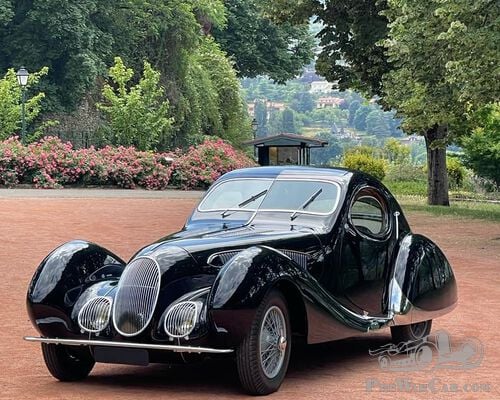
1939 Talbot-Lago T150C “Goutte d’Eau” — Iconic French Coachbuilt Masterpiece
Talbot-Lago T150C ‘Teardrop’ — An Icon of French Automotive Art There are motor cars that define an era. And then there are those tha..
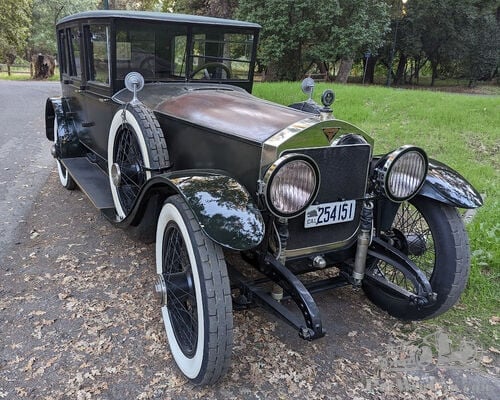
1916 Simplex, Crane model 5
1916 Simplex, Crane MODEL 5CUSTOM MADE HISTORIC PRESERVATION VEHICLE – READY TO TOUR!This Simplex recently completed th..