The global magazine and marketplace for classic car enthusiasts, by enthusiasts.


Filter
Classic Gray, G.N. for sale - Gray, G.N. cars for sale
-

1925 Gray open tourer
1925 Gray open tourer , mechanically complete but comes with spare engine and rearaxle. Panelwork to be done to the body and guards. Is in our Dutch storage. Rare Canadian built righthanddrive car. This is the last year of Gray motorcars € 9500.

Gray
US, 1920
Gray Light Car Corp, Longmont, and Denver, Colo.
The Gray concern with a splendid-sounding title in fact only built two Gray cars, both of them cyclecars of what sounds like a particularly spidery kind. One Gray car for sale was powered by a single-cylinder motor-cycle engine and the other Gray car for sale by a twin, both made by Harley-Davidson. Motor-cycle wheels were fitted.
US, 1922 – 1926
Gray Motor Corp, Detroit, Mich.
During the 1920s, two new makes, Star and Gray, tried to win a share of the mass market dominated by the Model T Ford. The Gray car for sale was in fact made by former employees of Ford, who included the head of the Gray Corporation, F.L. Klingensmith, and this Gray car was similar to the Ford in several features of engine and chassis. A side-valve, 4-cylinder, 2.7-litre engine was used. Unlike the Ford, the Gray cars springing was by conventional quarter-elliptics at front and rear. Front-wheel brakes were offered in 1926 on the Gray car, but that year was its last. The Gray company’s grandiose plans, which included making nearly a quarter of a million cars in the first full year of production, at $490 for the touring car and $760 for the coach, were never fully realized.
Source: Georgano, encyclopedia of motorcar; TRN
The information is written with the greatest of care. However, if you have any suggested amendments please contact us at office@prewarcar.com
G.N.
GB, 1910 – 1925
(1) G.N. Ltd, Hendon, Middlesex, 1910 – 1920
(2) G.N. Motors Ltd, Wandsworth, London S.W., 1920 – 1923
(3) G.N. Ltd, Wandsworth, London S.W., 1923 – 1925
The GN car was the best-known and longest-lived of the British cyclecars; the vehicles that provided the earliest form of motoring for the masses. H.R. Godfrey and A. Frazer-Nash installed air-cooled 1.100 V-twin engines of JAP and Antoine manufacture in the GN prototypes. By 1911 GN were manufacturing their own 90 degrees V-twin using in that year Peugeot cylinder barrels and in 1912 their own GN ioe design cylinder heads. The pre-World War 1 GN cars for sale used a variety of transmissions incorporating belts and chains. Production at Hendon of GN cars was low, not exceeding two cars a week. After the war the British Grégoire works at Wandsworth were taken over, and the GN car was redesigned. A steel chassis replaced the original ash, a conventional steering box replaced the wire and bobbin, and the final drive on the GN cars was by chains rather than by belts. Though high-geared, the steering was extremely light, road-holding was excellent, and the complete GN car weighed very little – 6½cwt for the basic 2-seater GN Popular of 1920. In conjunction with reasonable power and good low-speed torque, this recipe gave a sporting performance, simplicity and economy, and attracted many sportsmen. These GN cars were catered for by the GN Légère, a tuned model, and the GN Vitesse, a still faster car with chain-driven ohc.
Some 50 GN cars were being made per week in 1920 and 1921. Further developed, the GN Vitesse became a really powerful little racing car, with shaft-driven overhead camshafts operating very large inclined valves. In 1922 Godfrey and Frazer-Nash left the GN firm. By 1923 the family motorist had abandoned the cyclecar in favour of the comforts of the light car, so GN ltd began to build this type alongside the old. Shaft-driven chassis were made on these GN cars, powered either by the twin, in smoother, quieter and less potent form, or by water-cooled 4-cylinder units; DFP, Chapuis-Dornier and Anzani were used. Very few GN cars were in fact produced. The cyclecar and the GN name disappeared, but GN carried on in theory until 1929; in 1926 the GN firm re-issued an instruction book. GN Ltd still survives as a Vauxhall agent in Balham.
GN’s were made and sold in France by the Salmson aero engine company between 1919 and 1922.
Source: Georgano, encyclopedia of motorcar; TRN
The information is written with the greatest of care. However, if you have any suggested amendments please contact us at office@prewarcar.com


Featured
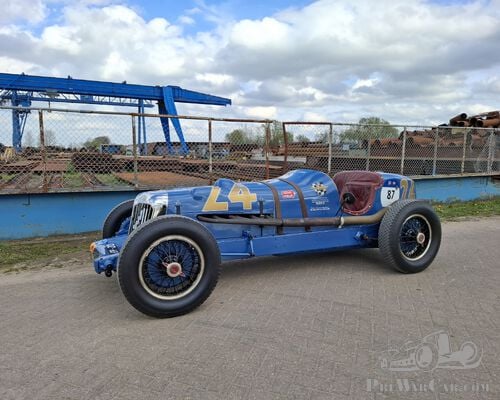
1932 - Graham " Lucenti " Indianapolis
Original participant of the 1932, 1934 and 1935 Indy 500. Best result: finishing 10th overall in the 1934 Indy 500 with driver “Herb” Ardinger...
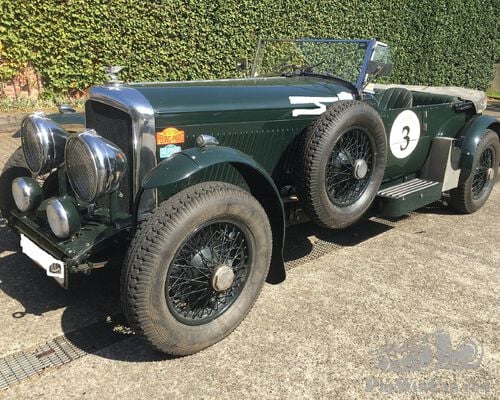
Bentley Derby Special Open Rally Car
This Bentley Derby, manufactured in 1935, has been rebuilt into a short and long-distance rally car. Full rebuilt engine in 2021, Since 2021 low mi..
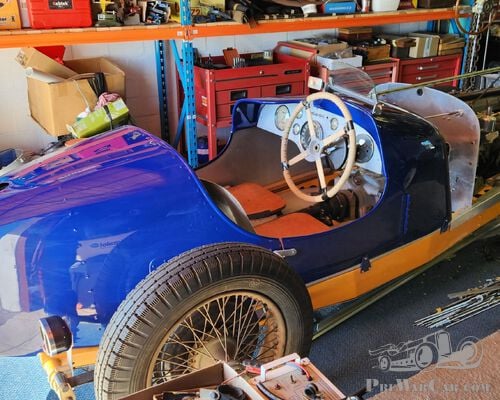
Riley TT Sprite
1935 6-cylinder TT Sprite replica. Chassis # 46A2722. Engine # 6A2722. Original Ulster Imp body. Restoration nearing completion. Engine, G..