The global magazine and marketplace for classic car enthusiasts, by enthusiasts.


Filter
Classic Goliath for sale - Goliath cars for sale
-

DALEY 1898 - Motorcar
This is build by M.H. Daley of Charles city , Iowa , USA . He did build 6 of these cars , but ended this production , and continued his work with farm maschinery and equipments instead. This is the only known to exist . Found and bought by famous Henry Austin Clark ( Long Island automotive museum ,USA ) in 1962 . -
1926 Talbot 18/55 2-Seater with Double Dickey
Thank you for your interest in my wonderful Talbot 18/55 which I’ve owned for 50 years. Other Talbots have come and gone but this has stayed my favourite; the most practical, reliable, elegant and luxurious. Its 2.54 litre, 6 cylinder engine gives it the power and torque to cruise happily up hills and down dales and it has been in regular use, t.. -
The famous white Riley 12/4 from 1936 with Race History ex New Zealand
The famous white Riley of racing driver Mrs. Ivy Stephenson , Riley 12/4 Kestrel Special from 1936A car which was built as a race car and still can be successfully raced today!- A known car with racing history in New Zealand -Restored in excellent state and condition-Comprehensively files and documentation .. -
1933 Rolls Royce 20/25 Sedanca by Thrupp & Maberly
1933 Rolls Royce 20/25 Sedanca by Thrupp & Maberly Chassis Number: GRW27 Registration Number: VTK777 Simply the best we have ever seen. This car won prizes in class at the recent RREC national rally at Burghley house. A massive nut & bolt re.. -
1934 Rolls-Royce 20/25 Gurney Nutting Owen 3 position drop head
1934 Rolls-Royce 20/25 Gurney Nutting Owen 3 position drop headChassis number: GLZ75Registration number: ALW565Chassis number GLZ 75 was off test 10th July 1933 for supply to HR Owen as a ‘stock’ car. The chassis was delivered to Gurney Nutting & Co Ltd. on The Kings Road for Owen Sedanca Coupe Coachwork which the car st.. -
1913 Wolseley 24/30HP Two-Seater
1913 Wolseley 24/30HP Two-Seater Chassis no. 20034Registration no. J1296Engine no. 34/1134 1913 Wolseley 24/30HP Two-Seater for sale: A large and imposing Edwardian two seat tourer, this 24/30hp model sports Wolseleys large 5 litre six cylinder engine giving ample power and easy modern day cruising spe.. -
Bentley 3,5 litre, Park Ward Saloon
1934 Bentley 3½ Litre Saloon – Authentic Pre-War Elegance with Preserved Patina Offered for sale is a truly exceptional 1934 Bentley 3½ Litre Saloon, chassis number B–96–BL – a remarkable example from the iconic “Derby Bentley” era. This vehicle combines genuine originality, mechanical excellence, and fully documented history, making it a rare .. -
Alvis Speed 25 Charlesworth, 1936
Alvis Speed 25 'Charlesworth' DHC, year 1936. Chassis number 13362SB, engine number 15149, body number 14128.12.36 (the original Charlesworth body). The body is finished in blue, combined with a blue leather interior and blue carpeting. Black mohair hood and cover. This beautiful Alvis Speed.. -
1923 Bentley 3 Litre
Bentley 3-Litre, built in 1923. Chassis number 110, engine number 104. License plate KLY 3, nickname “Wilfred”. This Bentley was delivered new on June 4, 1923. The first dated work order reads: “Stripped for racing”. This Bentley 3-Litre won a race at Brooklands in the hands of Captain Cecil Wingfield Tw.. -
FIAT 501 Torpedo fuori serie
Vendo fiat 501 torpedo fuoriserie per il mercato americano(e' leggermente piu' grande,larga) del 1920.Uno dei primi telai di 501, numero 1000 circa.Condizioni come da foto, con il suo raro radiatore della prima serie, con forma a quadratini.Auto senza documenti ma di lecita provenienza, verra' fatta una dichiarazione scritta..


Goliath
D, 1931 – 1963
(1) Hansa-Lloyd & Goliath-Werke; Borgward & Tecklenborg; Bremen, 1931 – 1933
(2) Goliath-Werke GmbH, Bremen, 1950 – 1959
Though a 4-wheeled prototype Goliath cyclecar was built in 1924, the first Goliath motor vehicles were 3- and 4-wheeled vans. In 1931 a 3-wheeled private car, the Goliath Pionier, was introduced. It had two driven rear wheels, a two-seater body and a single-cylinder 2-stroke 198cc Ilo engine. This Goliath was produced until 1933, after which Goliath concentrated on vans again.
In 1950 a new private car appeared, the Goliath GP700 with a 2-cylinder 2-stroke 688cc engine. It was followed by the 886cc Goliath GP900 and both models were available with fuel injection. Two-seater sports coupé versions of these cars were also offered but only built in small number. A 4-stroke flat-4 engine was used from 1957 in the ‘1100’. This Goliath model, like the earlier ‘700’ and ‘900’ had front-wheel drive. After 1958 it was marketed as the Hansa 1100. It was available with a 40bhp power unit and also with a twin-carburettor engine of 55bhp. There were also some 4-wheel drive Goliath Jadgwagen (Jeep-like vehicles) with both 2- and 4-stroke engines. Goliath was affected by the failure in 1961 of the Borgward combine of which it formed part. Production ceased, but cars were assembled in the original Goliath factory until 1963.
Source: Georgano, encyclopedia of motorcar; HON
The information is written with the greatest of care. However, if you have any suggested amendments please contact us at office@prewarcar.com



Featured
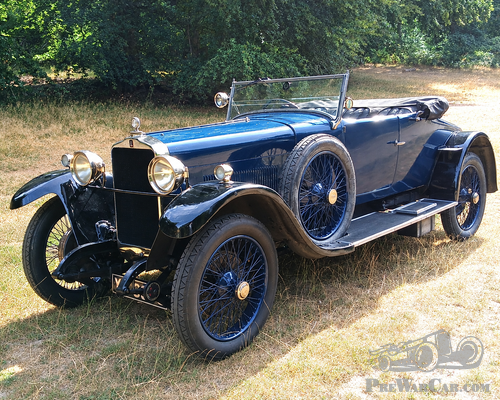
1926 Talbot 18/55 2-Seater with Double Dickey
Thank you for your interest in my wonderful Talbot 18/55 which I’ve owned for 50 years. Other Talbots have come and gone but this has stayed my fav..
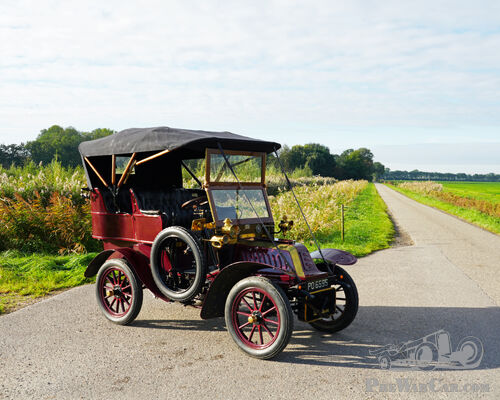
Your ticket to 2026 London to Brighton! 1904 De Dion Bouton Type V 8HP Rear Entrance Tonneau
VCC datedEuropean registrationProven rally historyFour seatsWonderful conditionRoof and window
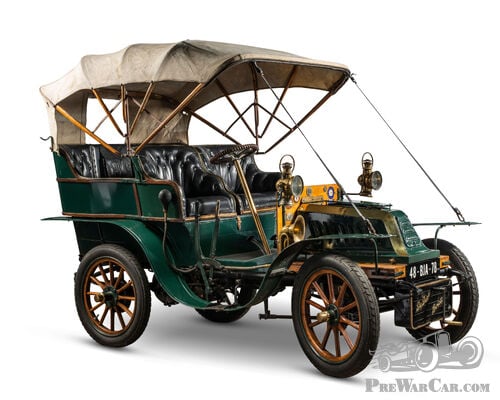
De Dion Bouton Type z in good running condition
De Dion Bouton Type Z from 1905. The car is in good condition, works and runs well. Serie number 36. Engine number 18190. French Carte grise.