The global magazine and marketplace for classic car enthusiasts, by enthusiasts.


Filter
Classic Hampton car for sale - Hampton car cars for sale
-

1934 Mercedes Benz 500 K Spezial Roadster - Rebuild
The most beautiful automobile design of the German pre-war eraHigh-quality, faithful and detailed reconstruction of the Spezial Roadster bodywork on the original rolling chassis of a 500 KCraftsmanship of the highest standard, fully functionalCommission (build) record on the delivery availableComprehensiv.. -
Bugatti Brescia type 23 16 soupapes double allumage
Bugatti roadster Brescia type 23 16 soupapes Proposée à la vente, cette remarquable Bugatti Type 23 “Brescia” représente une opportunité rare d’acquérir un exemplaire à l’historique particulièrement intéressant. Produite à la fin de l’année 1923, cette automobile fait partie des quatre véhicules expédiés neufs en Australie p.. -
REO Model R Speedster 1910
For sale is this nice Reo Model R Speedster. It was built in 1910 and converted to a speedster years ago even before the previous owner bought it. It has the original 4 cylinder engine coupled to a 3 forward 1 reverse gearbox. It spent a good part of its life in sunny Kansas where it was restored by the previous owner who enjoyed it for many yea.. -
1933 Rolls Royce Phantom 2 Tourer.
1933 Rolls Royce Phantom 2 Tourer. Chassis Number: 152MY Registration Number: 825XUT A simply superb car owned for the last couple of decades by an octogenarian lady who now finds access difficult & has decided to relinquish this wonderful car to the next generation. D.. -
1924 Bentley 3 Litre Speed Model 2 Seater By Gurney Nutting
Chassis No:612 Engine No: 628 Current Engine No: U.K. Registration No: NN 8126 Coachwork Sports 2 Seater By Gurney Nutting Chassis No 612 was delivered to A.B.Spencer who specified saloon coachwork by Gurney Nutting. Within two years, however, the car passed to his brother George Spencer who returned the car to Gurney Nutting with instructions to .. -
1929 Lancia Lambda 8th Series Short-Chassis Torpedo
With its monocoque body, four-wheel brakes, independent front suspension and V4 overhead camshaft engine many enthusiasts view the Lancia Lambda as one of the greatest automobiles of all time. With a conventional pedal layout and H-pattern gear selection the Lambda also set the automotive template for years to come. The Lambda was also su.. -
1933 Rolls Royce Phantom 2 Drophead Coupé by Park Ward
1933 Rolls-Royce Phantom II Continental Drophead Coupé Coachwork by Park Ward Registration: BYV 923 Chassis: 55MW Engine: XO25 Vintage & Prestige is proud to offer this spectacular and unusual example of Phantom II DropHead Coupé. Th.. -
Apperson 8-20 mit V8 Motor von 1920
Apperson 8-20 Wir bieten Ihnen diesen Apperson 8-20 mit V8 Motor von 1920 an. Alle wichtigen Teile sind soweit vorhanden. Auch die 2. Motorhaube ist da. Der Motor dreht, das Getriebe schaltet. Melden Sie sich bitte bei Fragen bzw. Interesse. Sie sind herzlich eingeladen.Umsatzsteuer nicht ausweisbar nach § 25A UStG. Z.. -
Packard 120 Sedan 1935
This Packard Sedan is in very good driving condition.Always well maintained, the brakes were overhauled and a new radiator fitted a few years ago.It is an older restoration with some imperfections in the paintwork.The car has enough room for 5 people, and there is room behind the wheel for a tall driver.An impressive .. -
Ford Model A Roadster DeLuxe
Dieser schöne Ford Model A Roadster DeLuxe wurde 2013 von einem Oldtimerliebhaber in den USA gekauft, nach Deutschland verschifft und war seitdem Teil seiner privaten Klassiker-Sammlung.Es handelt sich um das beliebte Modell von 1930 in der eleganten, klassischen Farbkombination in beige-schwarz. Die Zahlreichen Extras verfeinern das toll..


Hampton
GB, 1911 – 1933
(1) Hampton Engineering Co, Hampton-in-Arden, Warwickshire, 1911
(2) Hampton Engineering Co Ltd, King’s Norton, Birmingham, 1912 – 1919
(3) Hampton Engineering Co Ltd, Dudbridge, Stroud, Glos., 1919 – 1920
(4) Hampton Engineering Co (1920) Ltd, Dudbridge, Stroud, Glos., 1920 – 1925
(5) Stroud Motor Manufacturing Co Ltd, Dudbridge, Stroud, Glos., 1926
(6) Hampton Cars (London) Ltd, Dudbridge, Stroud, Glos., 1927 – 1930
(7) Safety Suspension Car Co Ltd, Cainscross, Stroud, Glos., 1931 – 1933
W. Paddon sold other people’s cars before deciding that he could build equally well himself; the Hampton. From 1912, he followed a one-model policy: the Hampton 12/16, a conventional 4-cylinder of 1.726cc, based on imported proprietary parts. A heavier Hampton Colonial version was also listed. In 1914, with light cars fashionable, a 2-cylinder 2-stroke of Hampton’s own manufacture was announced, with pressed-steel frame and bevel drive. This Hampton model was soon withdrawn, and buyers were offered instead, a choice of a true Hampton cyclecar with an 8hp air-cooled Precision twin, 3-speed countershaft gears and belt final drive, or a conventional light car, with a 1.244cc Chapuis-Dornier engine. For the post-war expansion of Hampton, part of a large ironworks was taken over in Gloucestershire. The first Hampton model made there was the Hampton 10/16 of 1919, with a 1.496cc ohv Dorman 4KNO engine. Pre-war type light car chassis were used, with variations in the wheelbase and with vacillation between half and three-quarter elliptic rear suspension. The following year a 1.795cc version was marketed, also powered by Hampton Dorman. The Hampton firm made their own gearboxes, and Lucas or Brolt electrical equipment was available.
Near the beginning of 1920 output was running at six Hampton cars per week; by the end of the year the Hampton company had suffered the first of its reformations. Designs were altered in detail only for 1921 and 1922. This period was marked by various sporting successes of Hamton cars, in addition to the climbs of the notorious 1 in 2½ acclivity of Nailsworth Ladder both before and after the war. J.W. Leno managed a ‘gold’ with a Hampton car in the 1924 Scottish 1.000 miles trial; Brian Marshall lapped Brooklands at over 89mph in 1922. For 1923, the 1.795cc was known as the Hampton 11/35, and the Hampton 9/21 Junior of 1.247cc was introduced, Meadows engines now being used. In 1924 a Hampton 14hp of 2.121cc was added to the range, whilst the Hampton 12hp (formerly 11/35) shrank to 1.496cc and acquired early front wheel brakes. Then the Hampton firm failed again. They were resuscitated by W.F. Milward, the Hampton works manager, aided by Leno and G. Dixon. Marginal improvements to the Hampton 12 were announced in late 1925, including a 3-bearing crank and more wheelbase variatrions. Similarities between Hampton cars of this date and Charron-Laycocks may not have been entirely co-incidental, since both Milward and Dixon had been with that firm. More capital appeared in 1927, when Hampton Cars (London) Ltd was formed. This year’s reorganization retained the Hampton 12hp as the Hampton 12/40, and added the Hampton 15/45, a 6-cylinder of 1.683cc. By 1928, 300 Hampton cars a year were being turned out, including the year’s new model, the Hampton 9hp; mechanically similar to the old Hampton Junior, this was usually made in clumsy fabric or metal saloon bodywork. For 1929 the Hampton 9hp and Hampton 12/40hp were continued, and a 6-cylinder Hampton 20hp was added, with the 2.931cc ohv Meadows engine.
With the trade recession menacing, the Hampton firm started to offer, as variants on the trusty Hampton 12/40, a supercharged sports model and adjustable rear suspension borrowed from the Hodgson. By 1930 they were involved with the Cowburn gearbox, incorporating coned rollers in place of gears, dependent on degrees of friction regulated by little coil springs. When Meadows credit ran out, the Hampton 12/40 was replaced by another 12hp of only 1.196cc, possibly of their own manufacture, whilst 100ohv straight-8 engines of 2.262cc, with 50 matching chassis, were optimistically ordered from Röhr in Germany. This Hampton chassis was based on a sheet-steel tray, with independent suspension by double transverse half-elliptics at the front and long cantilevers at the rear. Hampton models originally listed for 1931 were a revived 12/40, the continued 9hp and 20hp, and the Röhr-engined 18hp, in Röhr or Hampton chassis to choice. All these were later withdrawn, the short-stroke Hampton 12hp (80mm) became available again, and an sv 4-bearing 6-cylinder of 2.414cc was obtainable in either type chassis, at £150 difference in price. The Hampton car firm inevitably expired once more, but the 8-cylinder re-appeared ephemerally in Röhr’s 1931 size of 2½-litres. The receiver, Thomas Godman, formed a new company to offer the Röhr chassis with a choice of the sv 6-cylinder or the 1932 Röhr engine, now of 2.736cc. It is unlikely that any of these were sold, and the last Hampton made was probably Milward’s personal special, a Röhr-type car constructed from parts acquired at the Dudbridge works sale, and used by him up to World War 2.
Source: Georgano, encyclopedia of motorcar; DF
The information is written with the greatest of care. However, if you have any suggested amendments please contact us at office@prewarcar.com


Featured
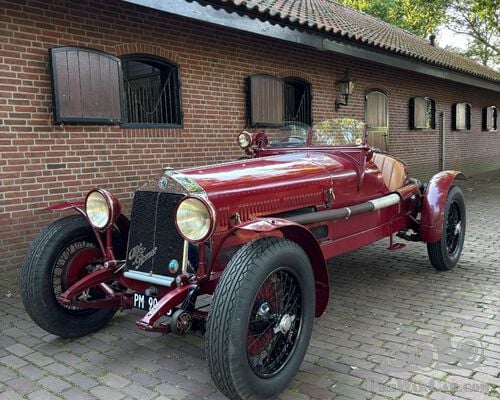
1930 Alfa Romeo 6C 1750 Spider
1930 Alfa Romeo 6C 1750 Spider with complete history from delivery to first owner in 1930 in Firenze till today with copy Libretto/license plate.
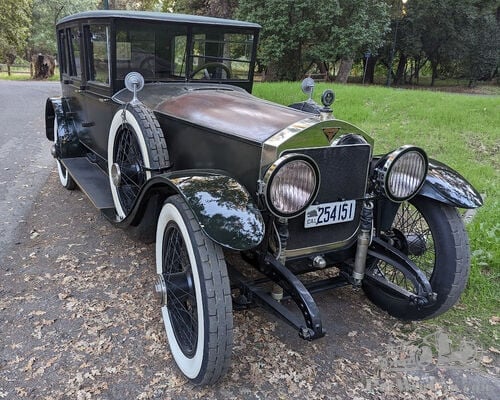
1916 Simplex, Crane model 5
1916 Simplex, Crane MODEL 5CUSTOM MADE HISTORIC PRESERVATION VEHICLE – READY TO TOUR!This Simplex recently completed th..
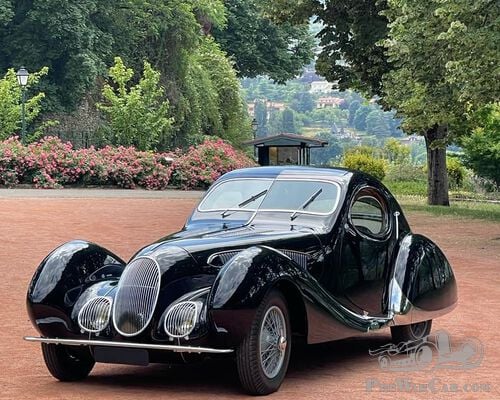
1939 Talbot-Lago T150C “Goutte d’Eau” — Iconic French Coachbuilt Masterpiece
Talbot-Lago T150C ‘Teardrop’ — An Icon of French Automotive Art There are motor cars that define an era. And then there are those tha..