The global magazine and marketplace for classic car enthusiasts, by enthusiasts.


Filter
Classic Haynes, Orient for sale - Haynes, Orient cars for sale
-

HAYNES 1916 touringcar
Starts and run powerfull with the 6 cyl. Engine , 50 hp . Original upholstery , repaint 70 years ago. No rust ever . 4 new tyres and tubes . Old top .Some plaques from Ralley in the fifties mounted on dashboard, American title and import document for eu. Price : Please ask -
1905/6 Orient Buckboard
Build by Waltham , mass. Usa . very original and unrestored , except the engine which is restored and running .Known history back to before ww2 . Last ovner found it in 1950.Eur 25.800


Haynes
US, 1904 – 1925
(1) The Haynex-Apperson Co, Kokomo, Ind., 1904 – 1905
(2) Haynes Automobile Co, Kokomo, Ind., 1905 – 1925
Elwood Haynes built his original single-cylinder Haynes car of buggy type in 1894. In 1898, with the Apperson brothers, he formed the Haynes-Apperson Automobile Co. In 1902, the Appersons and Haynes separated, although both companies remained in Kokomo. From June 1904 the cars were called either Haynes-Apperson or Haynes, while the company name was still Haynes-Apperson. This was officialy changed to Haynes Automobile Company in September 1905.
The first production models of the Haynes car (in 1904) were powered by 2- and 4-cylinder engines, sliding-gear transmissions and shaft drive. Only 4-cylinder engines were used in the years 1905 – 1913. In 1912, three chassis were built, with a total of eight body types. In 1914, Haynes Model 26 was fitted with a 6-cylinder engine, and in 1915 an electric gear change was standard on the larger chassis. For 1916, Haynes car advanced to a 12-cylinder engine of 5.8-litres. This large engine was made by Haynes and continued to be manufactured through 1922, with no changes in bore or stroke. The chassis varied in wheelbase during the post-World War 1 period from 10 to 11ft. The prices for the various Haynes car models dropped from $4.200 for a seven-seater limousine in 1920, to $3.200 in 1925 for a five-seater sedan. Body styles in the Haynes car range were conservative, although one close-couples four-seater coupé with distinctive lines was made in 1923, and a special Haynes Speedster, a two-seater roadster with wire wheels and attractive styling was introduced in 1921.
Source: Georgano, encyclopedia of motorcar; GMN
The information is written with the greatest of care. However, if you have any suggested amendments please contact us at office@prewarcar.com
Orient
US, 1898 – 1908
Waltham Mfg Co, Waltham, Mass.
The Orient car company made an experimental electric runabout in 1898, but did not put this Orient car into production. Their first petrol-engined Orient cars were motor cycles, tricycles and light runabouts powered by De Dion engines. In 1902 they introduced the Orient Buckboard, a very simple Orient car consisting of two seats on a wooden platform, with a 4hp air-cooled engine geared to the rear axle, and, originally, only one speed. There were no springs on this Orient car, as the wooden platform was said to have enough resilience. The weight was 350lb and the price $375.
Although the simple Buckboard was continued, more sophisticated Orient cars were gradually introduced, including a four-seater version Orient car which in turn became a side-entrance tonneau. Wheel steering and small bonnets to cover the driver’s feet appeared in 1904, although the engine of the Orient car was still at the back, and the Buckboard ancestry remained obvious.
In 1905 a completely new Orient car appeared, known as the Waltham Orient. This Orient car had a 4-cylinder air-cooled 18/20hp engine mounted in front in the conventional manner, friction transmission and shaft drive. A slightly smaller 16hp Orient car model was also made. In 1908 Waltham merged with the C.H. Metz Company, and for the following year the cars were known as Metz.
Source: Georgano, encyclopedia of motorcar; GNG
The information is written with the greatest of care. However, if you have any suggested amendments please contact us at office@prewarcar.com


Featured
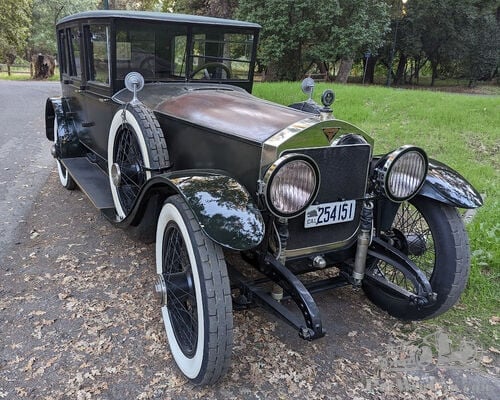
1916 Simplex, Crane model 5
1916 Simplex, Crane MODEL 5CUSTOM MADE HISTORIC PRESERVATION VEHICLE – READY TO TOUR!This Simplex recently completed th..
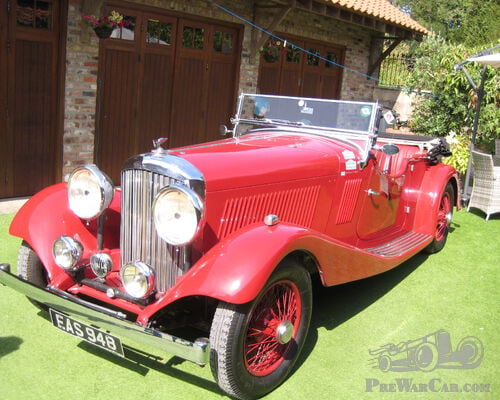
1935 Bentley 3.5 ltr. VDP 4str. Tourer
Chassis B 123 CW was first registered 14th March 1935, and in the late eighties underwent a " body-off" restoration and fitted with VANDEN PLAS
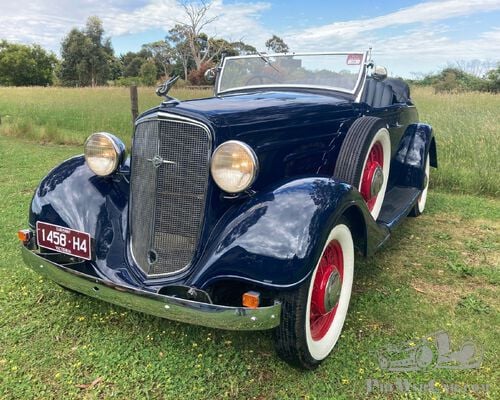
1934 Chevrolet Standard Roadster
1934 Chevrolet Standard Roadster This vehicle was delivered to Australia from Chevrolet and the body was manufactured by Holden Body Works w..