The global magazine and marketplace for classic car enthusiasts, by enthusiasts.


Filter
Classic Hillman, Pierce Arrow for sale - Hillman, Pierce Arrow cars for sale
-

1916 Pierce-Arrow Model 48-B-4 Vestibule Suburban
1916 Pierce-Arrow Model 48-B-4 Vestibule SuburbanPebble Beach Concours d’Elegance “Best in Class” 1977 & 2024An exceptionally grand design; one of the ultimate Pierce-Arrows of its timeOne of just two known survivors on the Model 48-B-4 chassisFormerly of the Delbert Pantel, Imperial Palace collection and Blackhaw..

Hillman
GB, 1907 to date
(1) Hillman – Coatalen Motor Car Co Ltd, Coventry, 1907 – 1909
(2) Hillman Motor Car Co Ltd, Coventry (1910 – 1946); Ruton-on-Dunsmore, Warwickshire (1946 – 1970); Linwood, Glasgow (1963 – 1970
(3) Chrysler United Kingdom Ltd, Ruton-on-Dunsmore, Warwickshire; Linwood Glasgow, 1970 to date
The Hillman car was originally known as the Hillman-Coatalen, the first cars being the work of Louis Coatalen, who designed a 25hp 4-cylinder for the 1907 Tourist Trophy. Pre-1914 production of Hillman cars was on a small scale, and consisted initially of big sv machines with separately cast cylinders (a 6.4-litre four and a 9.7-litre six) and shaft drive. The traditional shape of Hillman car radiator emerged in 1908, and continued on all Hillman car models up to 1930. Neither a little-known 1.8-litre 2-cylinder of 1913 nor a very small six of 2 litres’ capacity in 1914 made much impression, but much more successful was the 9hp Hillman car, a monobloc 1.357cc sv four, selling at £200. This Hillman car was brought up to date with electrics after World War 1, and progressively developed until 1925, by which time it had grown to 1.6-litres. A sports version with a V-radiator, outside exhaust, and polished aluminium bodywork was raced quite extensively in the early 1920s and Raymond Mays served his apprenticeship on one of these. All 1923 – 1925 Hillman cars came with drophead bodywork and winding windows. A conventional sv Hillman Fourteen with a 4-speed gearbox and magneto ignition was the only Hillman car model offered from 1926 to 1928, and production of this was stepped up after Rootes took over in the latter year. In 1929 prices started at £295, and ‘Safety’ versions were fitted with safety glass and servo brakes. Less happy was a companion to the Hillman Fourteen, a 2.6-litre ohv straight-8 with coil ignition. However, Hillman moved into the mass-production class in 1932 with their excellent 1.185cc sv Hillman Minx car at £159. This Hillman car was progressively developed up to the outbreak of World War 2, with 4-speed gearbox and the options of free-wheel and radio in 1934, all-synchromesh boxes in 1935 (these were dropped again in 1939), integral luggage boot in 1936, and unitary construction in 1940. The underslung Hillman Aero-Minx sports model of 1933 formed the basis for the Talbot and Sunbeam-Talbot Tens which resulted from Rootes’ acquisition of the S.T.D group, and there was even a luxury Hillman car Minx-based Humber Ten, though this was marketed only in New Zealand. Alongside these there were also some sv 6-cylinder Hillman cars, 1936 and later versions having transverse independent front suspension, but they gave way to another sv 1.9-litre Hillman Fourteen, sold with hydraulic brakes by 1940; these were not added to the Hillman Minx until the Phase II Hillman car models of late 1947, which also featured steering-column change.
Post-war Hillman Minxes continued the model’s reputation as a style leader of conventional mechanical specification. 1949 Hillman cars had full-width five/six-seater bodywork, there was a more powerful 1¼-litre engine in 1950, and a hardtop coupé version, the Hillman Californian, in 1953. In 1955 the Hillman car range was extended to include the Hillman Husky short-wheelbase station wagon, while de luxe Hillman Minxes acquired 1.395cc short-stroke ohv power units, and licence-production was taken up in Japan by Isuzu. The Hillman car model continued to keep abreast of the times with its cylinder capacity increased to 1½-litres in 1959, to 1.6-litres in 1962, and to 1.7-litres with a 5-bearing crankshaft in 1966. Automatic transmission became optional in 1960 with Hillman cars, hypoid final drive replaced the spiral bevel type in 1961, and later cars had front disc brakes. From 1957 onwards the Rootes-owned Singer company’s Gazelle had a Minx-type hull, and the Minx engine was used after 1959. A bigger Hillman Super Minx car joined the Hillman car range in 1962, and 1963 produced a challenger in the baby-car class, the Hillman Imp car. Made in the Rootes’ Group’s Scottish factory at Linwood, this Hillman car had an inclined, rear-mounted ohc 875cc 4-cylinder engine, 4-speed all-synchromesh gearbox, and all-round independent suspension. In 1966 Hillman Imps did well in the saloon-car racing, and Singer and Sunbeam versions followed, as well as a new Hillman Husky station wagon: the engine was used by a number of specialist manufacturers, notably Bond, Ginetta, TVR and Clan. It was also fitted to one version of the Greek Farmobil cross-country vehicle.
Chrysler acquired a majority interest in Rootes in 1964, the first consequences of the new management being the 1967 Hillman Minx car and Hillman Hunter car that replaced the existing Minx, and Super Minx types. Design was entirely new on these Hillman cars, though the 1.496cc and 1.725cc engines (now inclined in the ‘chassis’) were retained. These were assembled in Iran under the name of Peykan. Vehicles assembled in South-Africa used Peugeot engines. A Hillman Hunter won the 1968 London-Sydney Marathon. An entirely new shape from Hillman cars, the Avenger, appeared in 1970. Its suspension, by McPherson struts at the front and by rigid axle and coils at the rear, was similar to that of French Chryslers, there was a choice of 1.248cc or 1.496cc ohv 4-cylinder engines, disc brakes were fitted at the front, and automatic transmission was optional. Prices of these Hillman cars started at £765.
At the end of the 1970 season the Hillman Minx was dropped after an unbroken run of 38 years. Its replacement was a 54bhp Hillman Hunter De Luxe with the 1½-litre engine. Hillman Avengers went on sale in the USA as Plymouth Crickets. Two new Hillman Avenger cars were added during 1972: a station wagon and the twin-carburettor high-performance Hillman Tiger, a limited-production saloon with magnesium alloy wheels, capable of 105mph and retailing at £1.328. A 78bhp GLS Hillman car version with power brakes, radial-ply tyres and wide-rim wheels appeared in 1973, when the Hillman Imp was continued, and the Hunter line-up ranged from the basic Hillman De Luxe up to the 93bhp 1.7-litre GLS with twin Weber carburetors and close-ratio gearbox.
Source: Georgano, encyclopedia of motorcar; MCS
The information is written with the greatest of care. However, if you have any suggested amendments please contact us at office@prewarcar.com
Pierce (-Arrow)
US, 1901 – 1938
(1) The George N. Pierce Co, Buffalo, N.Y.
(2) Pierce-Arrow Motor Car Co, Buffalo, N.Y.
Of the many prestige cars built in the United States, probably none enjoyed more favour for a longer period thant the Pierce-Arrow car. This car began humbly enough. The first model, the Pierce Motorette, appeared in 1901. The Pierce Motorette was produced by George N. Pierce, a builder of bicycles and birdcages and this little Pierce car was powered by a 2¾hp De Dion engine. This initial venture proved successful and was followed in 1902 by a similar Pierce car but with the output increased to 3½hp. For 1903, the Arrow name appeared and the Pierce-Arrow car company introduced a 15hp 2-cylinder Pierce Arrow car, with a 6½hp machine as a sideline.
In 1904 the name was changed to Great Arrow and the Pierce Great Arrow cars had power units capable of 28hp. It was such a Pierce-Arrow car which won the Glidden Tour, a reliability test, and from this point onward, the Pierce-Arrow car was one to be reckoned with. Power was gradually increased on the Pierce-Arrow car as was the size of the car through the immediate years and by 1908, the Pierce Great Arrow car boasted 60bhp at 1.000rpm. Up to 1909, steering-column change was used. This was the last year in which the word Great appeared in the Pierce-Arrow car name.
The Pierce-Arrow car was introduced in 1909 and such was the firm’s reputation that production of Pierce-Arrow cars was limited and the supply seldom met the demand of the public. An interesting option on the enclosed-drive limousine Pierce-Arrow car for 1911 and later was a bulge in the roof to allow ladies to enter through the rear doors without crushing the elaborate hats then in fashion against the roof.
In 1913, the first Pierce-Arrow cars appeared with the headlamps attached to the tops of the front mudguards, although this innovation was optional on the Pierce-Arrow car. The greater percentage of Pierce-Arrow cars were to appear with this type of headlamp fitting, but the earlier arrangement was available on the Pierce-Arrow car until the early 1930s.
By 1914, Pierce-Arrow cars were available in three sizes. The Pierce-Arrow 66 (reputedly this Pierce-Arrow car was the largest stock car built in the United States) was powered by a 6-cylinder engine with a 5x7in bore and stroke, giving the Pierce-Arrow car a capacity of 12.7-litres. The wheelbase was 12ft 3½in and the tyres on this Pierce-Arrow car were 37in. A complete line of bodies was offered for the Pierce-Arrow car with prices ranging from $5.850 to $7.300. The 8½-litre Pierce-Arrow 48 was built on a wheelbase of either 11ft 2½in or 11ft 10in with a price rnage of $4.850 to $6.300 and the Pierce-Arrow 38, with a wheelbase and prices of 10ft 7in or 11ft and $4.300 to $5.400, constituted the smallest line Pierce-Arrow car. Transmission of the Pierce-Arrow car was 4-speed with direct drive on top gear.
By 1915, with somewhere between 12.000 and 13.000 Pierce-Arrow cars having been built and of these a good percentage Pierce-Arrow cars still on the road, the Pierce-Arrow car was considered as a top prestige car compared with anything in its price class or even about it. Except for 1928, the name never appeared on the Pierce-Arrow car radiator, as it was felt the Pierce-Arrow cars were easily recognizable without it. In frequent cases, Pierce-Arrow cars of this period were sold with a single chassis and two bodies, one open and one closed, which could be alternated with the seasons. Tyres of the Pierce-Arrow cars were reduced to 35in in size and the Pierce-Arrow car plant was expanded about 1916 to accommodate the increased orders, not only for private Pierce-Arrow cars, but for the commercial vehicles which the Pierce-Arrow car company had been building since 1911. The enormous Pierce-Arrow 66 was discontinued during 1917 and the 38 and 48 were continued at prices ranging from $4.800 for the cheapest Pierce-Arrow 38 to $7.000 for the most expensive Pierce-Arrow car, the 48, exclusive of custom bodies. In 1920, the two cooling vents located above the bonnet of Pierce-Arrow cars were eliminated and the cowl parking lights were removed, all lighting being replaced in the headlamps. The last right-hand-drive Pierce-Arrow cars were built late this year. Pierce-Arrow cars being one of the very last American cars to change over to left-hand steering. A new series Pierce-Arrow cars was introduced for 1921, the line being split in size between the 38 and 48 Pierce-Arrow car models. These retained the 6-cylinder engine. For the first time, bonnet louvres were used on Pierce-Arrow cars.
By 1923, sales of Pierce-Arrow cars were dropping and less than two years later, the Pierce-Arrow car company introduced a smaller companion car, the Pierce-Arrow Model 80. This was the first Pierce-Arrow car to be equipped with 4-wheel brakes. The L-head 6-cylinder engine of this Pierce-Arrow car developed about 70bhp. Prices ranged from $2.895 to about $4.000. The Pierce-Arrow cars sold reasonably well in comparison with the larger Pierce-Arrow 36 but the Pierce-Arrow car company was showing an annual deficit and production of Pierce-Arrow cars was diminishing. In 1928, the stockholders voted to place the Pierce-Arrow car company under the control of the successful Studebaker Corporation because of prevailing business conditions.
A new Pierce-Arrow car was introduced for 1929, the Pierce-Arrow car company adopting a straight-8 engine of over 6 lites in place of the old six. The Pierce-Arrow car was offered on two wheelbases at prices beginning at $2.775, and this was Pierce Arrow’s best year, with 9.700 Pierce-Arrow cars delivered. For 1930, three different 8-cylinder engines were offered the prospective purchaser. Because of the relationship between Pierce-Arrow cars and Studebaker, a number of the Pierce-Arrow cars bore a striking resemblance to the Studebaker President Eight, largest of the Studebaker line. Demand of Pierce-Arrow cars continued to fall, and production with it, in 1931, and for 1932 the Pierce-Arrow car company introduced two 12-cylinder lines in addition to its eight, but even then, only 2.692 Pierce-Arrow cars were built during the year. These twelves came in 140bhp, 5½-litre, and 150bhp 7-litre forms, and these Pierce-Arrow cars were priced from $3.900 up.
For 1933, the Pierce-Arrow carcompany introduced a special show car, the Silver Arrow, of which only five were made but which served as an imitation fof the shape of Pierce-Arrow cars to come. Priced at $10.000, the Silver Arrow Pierce-Arrow car had a 12-cylinder 175bhp engine and no running boards. A tapered back, split rear window and spare wheels concealed in compartments behind the front wheels made this Pierce-Arrow car one of the most talked about cars of the year. The Pierce-Arrow car was displayed at the 1933 Chicago World’s Fair.
In 1933, a group of Buffalo businessmen made the Pierce-Arrow car an entity of its own once more. Ab Jenkins was breaking racing records with Pierce-Arrow cars and although the publicity was excellent, business was not for the Pierce-Arrow car company. After 1934, the basic changes in design were slight. The Pierce-Arrow car company turned out both eights and twelves but by 1935, with less than 1.000 Pierce-Arrow cars produced, it was apparent that the end of the make Pierce-Arrow cars was in sight. Retaining its classic radiator, the Pierce-Arrow car limped through 1936 and 1937, with a handful produced in 1938 when the Pierce-Arrow car company went out of business.
Source: Georgano, encyclopedia of motorcar; KM
The information is written with the greatest of care. However, if you have any suggested amendments please contact us at office@prewarcar.com


Featured
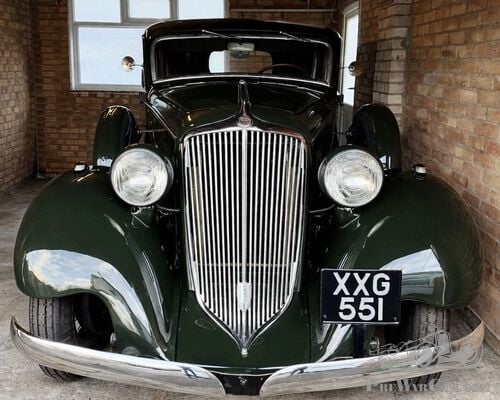
Graham Model 64 Standard Eight 'Blue Streak'
‘The most imitated car on the road’ One of the most significant pre-war American cars ever built. One of 23 known to exist glob..
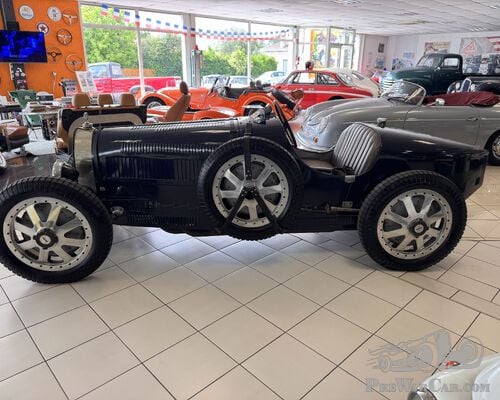
Bugatti 35 B Pur Sang
Bugatti 35 B Pur Sang,importée par un membre délégué de la FFVE il y’a une quinzaine d années.Participation à de nombreux Rallyes Bug..