The global magazine and marketplace for classic car enthusiasts, by enthusiasts.


Filter
Classic Rolland-Pilain, Horch for sale - Rolland-Pilain, Horch cars for sale
-

Rolland Pilain
I am selling a 1913 Rolland Pilain RP 10HP in very good condition. It has a standard registration document in my name, and the MOT will be carried out prior to the sale. -
1938 Horch 853 A Sport Cabriolet
1 of only 342 examples of the 853 AIn last hand for more than 16 yearsBuilt by the Horch factory in Zwickau The Horch 853 A Sport Cabriolet is one of the most sought-after luxury automobiles of its time - a masterpiece of Saxon engineering that embodies style consciousness and technical sophistication a.. -
Horch 854 – A Masterpiece of Automotive Craftsmanship (1939)
This Horch 854 represents one of the finest examples of pre-war German luxury engineering. Built on the shorter and more agile 854 chassis and equipped with the more powerful A-engine, this vehicle combines elegance, rarity, and exceptional craftsmanship. Originally, only 7 chassis of the 854 series we.. -
HORCH 930 V
For SaleHorch 930 VManufacturer: HorchModel and Variant: 930 VBody Type: 4-door sedanChassis Number: 931906Color: Dark bluePower: 93 kWEngine Capacity: 3,796 ccFirst Registration: 01/07/1939Engine Type: Petrol, 8-cylinderMileage: 12,125 km


Rolland-Pilain
France, 1906 – 1931
SA des Etablissements Rolland-Pilain, Tours
Unusual among French marques of its period, Rolland Pilain cars made their greatest impact after World War 1. Their first product was a 20hp 4-cylinder model Rolland Pilain cars with a monobloc engine, though smaller 2.2-litre shaft-driven Rolland Pilain cars were available in 1909 and a 3-speed 1½-litre Rolland Pilain 8/10CV in 1910, in which year the Rolland Pilain car company was also experimenting with ‘valveless’ engines and 4-wheel brakes. Though racing was in the doldrums, the Rolland Pilain car company went to the trouble of building a big chain-driven Rolland Pilain car for the 1911 Grand Prix de France, and a complex 1912 range started with a Rolland Pilain 9CV of 1.7-litres and went up to a chain-driven 4-cylinder 60 Rolland Pilain car of 130x270mm. The 6-cylinder Rolland Pilain 18CV had a ‘valveless’ engine, and even in 1913 chain drive was still optional on the biggest fours of 20CV and 24CV Rolland Pilain cars. Only 1.9-litre and 4-litre 4-cylinder Rolland Pilain cars with sv monobloc engines and unit gearboxes were listed in 1914.
These basic types of Rolland Pilain cars, still with pedal-operated transmission brakes, were available again after World War 1, but far more advanced was the 2.2-litre Rolland Pilain 14/16 of 1921, which boasted not only overhead valves and a detachable head, but also front-wheel brakes (hydraulic at the front and mechanical at the rear). This Rolland Pilain car was still catalogued in 1926. Even more ambitious was the 2-litre twin ohc straight-8 GP Rolland Pilain car of 1922, with desmodromic valves, ball-bearing crankshafts and 4-wheel hydraulic brakes. A victory of a Rolland Pilain car at San Sebastian in 1923 was the limit of the success of Rolland Pilain cars on the circuits, but the type found its way into the catalogue as the Type A22 Rolland Pilain car at 90.000fr, and one of the racers also ran with a 2-litre, 6-cylinder cuff-valve Schmid engine. In 1925 came a 2-litre ohv 4-cylinder Rolland Pilain car with 4-wheel mechanical brakes, selling for £725 in England, while a 1½-litre development, the Rolland Pilain D26, was introduced for 1927. In 1929 Rolland-Pilain car, along with several other French firms, tried a Franco-American theme by introducing a range of big luxury chassis with sv Continental engines. Both the 6-cylinder, 3-litre, and the 4-litre straight-8 Rolland Pilain cars had centralized chassis lubrication, though the elegant bodywork of the Rolland Pilain car was marred by the use of artillery wheels. At the 1930 Paris Salon the Rolland Pilain car company shared a stand with the BNC (also going through a Franco-American phase), but this was the end, though the Rolland Pilain car firm’s Paris depot was still advertising spare parts for Bignan as well as Rolland Pilain cars in 1934.
Source: Georgano, encyclopedia of motorcar; MCS
The information is written with the greatest of care. However, if you have any suggested amendments please contact us at office@prewarcar.com
Horch
D, 1900 – 1939
(1) A. Horch & Co, Cologne-Ehrenfeld, 1900 – 1902
(2) A. Horch & Co, Reichenbach/ Vogtland, 1902 – 1904
(3) A. Horch & Co, Motorwagenwerke AG, Zwickau, 1904 – 1939
August Horch was among the pioneers of car manufacture in Germany. He was employed as a an engineer with Benz from 1896 to 1899 when he started his own Horch car factory at Cologne. The first Horch car appeared in 1900. This Horch car had a 2-cylinder 5hp front-mounted engine and shaft drive. The next Horch models were a 2-cylinder 10/12hp and a 4-cylinder 16/20hp. After the Zwickau works had been set up in 1904 Horch was able to increase production. The Horch 18/22hp ohv 4-cylinder model of 1904 became very popular and was the basis for several subsequent Horch cars. A victory in the Herkomer Trial of 1906 was gained with this Horch car model, the first such success for a Horch. Horch also pioneered with his Horch Torpedo form aero-dynamic bodies for the Prince Henry Trials, which were built by Kathe of Halle. In 1906 a 6-cylinder 8-litre power unit was designed for Horch cars, developing 60bhp, but it was not a success and this was one cause of differences between Horch and his partners. Horch himself left the firm and started the Audi factory.
Various models with different engine sizes were included in the Horch car range, from the small Horch 6/18PS 1.588cc to the Horch 25/60PS 6.395cc. All Horch cars had 4-cylinder engines. After World War 1 the Horch 33/80PS 8.440cc model appeared, which had actually been designed in 1914. This Horch car started a series of prestige cars for which the make became famous in the following years. Paul Daimler (son of Gottlieb) was engaged as chief engineer in 1923. Ohc 4- and 6-cylinder Horch car models with fwb appeared in 1923/ 1924, but the first new Horch car under his management was the Horch 300 with a straight-8 3.230cc engine with twin overhead camshafts. In 1927 the ‘Horch 305’ and ‘Horch 306’ appeared, which also featured straight-8 engines, with twin overhead camshafts and a capacity of 3.375cc developing 75bhp. These Horch car models differed only in wheelbase. They were followed by the ‘Horch 375’ in 1928 with an 8-cylinder 3.974cc engine capable of 80bhp. After Daimler left Horch two more models (the Horch ‘400’ and ‘405’) were produced showing Daimler influence. The Horch 450 of 1930 was entirely new. This Horch car was straight-8 with only one overhead camshaft. Two different wheelbases and engines of 4, 4½ and 5 litres were available. The last of these stayed in the Horch car range until 1939, later Horch cars having 10-bearing crankshafts and all round independent suspension. Type numbers of Horch cars became a little confusing in the next few years, when some models were available with different wheelbases and engine capacities. A V12 with 5.990cc (Horch car models ‘600’ and ‘670’) appeared in 1931, followed by the V8 3.517cc ‘Horch 830B’ in 1933, available in two wheelbase and engine sizes. By 1939 the range consisted of the ‘Horch 930V’ and ‘Horch 830BL’(3.823cc, 92bhp) and the ‘Horch 951A’, ‘Horch 853A’ and ‘Horch 855’ (4.944cc, 120bhp). These Horch car models were available with different wheelbases and a variety of body styles from a two-seater roadster to a large Pullman saloon. The Horch car company was celebrated for luxurious ‘prestige’cars which were sold at lower prices than other top makes; a V8 cost £615 in England, and straight-8s from £985.
From 1932 Horch was a member of the Auto Union, and the racing cars bearing this name were built in the Horch car works. In 1945 the Horch car factory was nationalized and in 1956 it brought out a new Horch car. This had to be sold as the Sachsenring, as Auto Union, now based on Düsseldorf, hold the sole rights to the brand-names Horch, Audi and Wanderer.
Source: Georgano, encyclopedia of motorcar; HON
The information is written with the greatest of care. However, if you have any suggested amendments please contact us at office@prewarcar.com


Featured
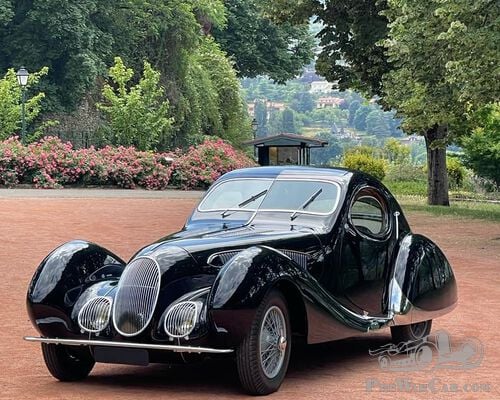
1939 Talbot-Lago T150C “Goutte d’Eau” — Iconic French Coachbuilt Masterpiece
Talbot-Lago T150C ‘Teardrop’ — An Icon of French Automotive Art There are motor cars that define an era. And then there are those tha..
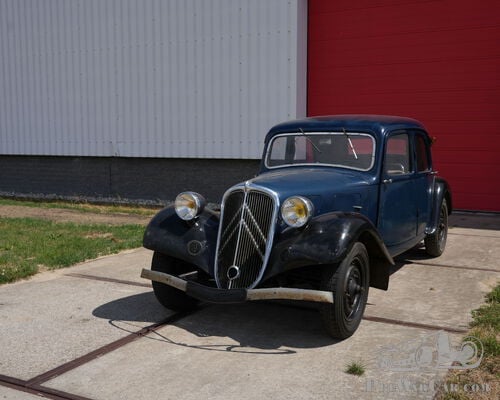
1935 Citroën Traction Avant
Early-production Traction AvantExceptionally original, unrestored conditionRecently part of a major museum collection
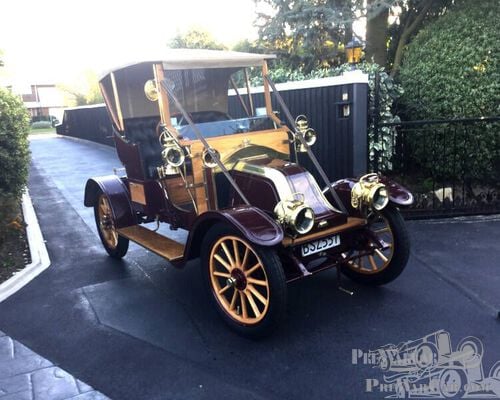
Renault /AX 1913 - named
Purchased fully renovated from New Zealand and imported to the UK. We have owned her for over10 years. Gigi is currently living in France where she..