The global magazine and marketplace for classic car enthusiasts, by enthusiasts.


Filter
Classic Chalmers, Hudson for sale - Chalmers, Hudson cars for sale
-

1920 HUDSON SUPER SIX
FOR SALE :1920 HUDSON SUPER SIX SEVEN SEAT TOURER. 4.7 litre six cylinder sidevalve engine producing 76bhp at 2445rpm. . The car stands on four excellent wooden wheels fitted with new Goodrich 35x5 tyres. The car also has 4 addition rims with tyres as supplied with the car when new. I've reluctantly to part with the car which has a lot of.. -
1922 | Hudson Super Six Special Race Car
Formerly owned by racing driver Antonio Trabucco in Argentina with a great early racing history in South AmericaDiscovered in Argentina in 2014 and imported to EuropePartially overhauled by a specialist workshop in Germany Fully functional and drivableSix-cylinder in-line engine, 4.7 litre displacement wi..


Chalmers / Chalmers-Detroit
US, 1908 – 1924
Chalmers Motor Car Co, Detroit, Mich.
The Chalmers was one of the most popular automobiles made in the United States for more than a decade. The Chalmers was the successor to the Thomas-Detroit which was built by a company which had been founded in 1906 by E.R. Thomas (builder of the Thomas car in Buffalo, N.Y.), Roy D. Chapin and Howard Earle Coffin; the two latter had previously served at Oldsmobile. The Thomas-Detroit of which some 500 were sold during the first year of production, was marketed through the parent firm in Buffalo which manufactured a larger line of cars under the Thomas emblem. The Thomas-Detroit was a medium priced four-cylinder car which had been designed by Coffin. In 1907, Hugh Chalmers, vice president of the National Cash Register Co and a noted salesman, entered the firm. Shortly after, he bought a half of E.R. Thomas’ stock and became president of the company which became the Chalmers-Detroit Motor Company. The Thomas-Detroit became the Chalmers-Detroit in 1908 and in 1910, the Chalmers. Open and closed Chalmers models in two lines comprised the Chalmers four-cylinder cars, with self-starters appearing in 1912. Chalmers (as Chalmers-Detroit) had distinguished itself in road races as early as 1908 when W.R. Burns won the Motor Parkway Sweekstakes at Jericho, N.Y., averaging 48.7mph in the six-lap 140.76 mile run.
In 1913, the Chalmers brought out its first 6-cylinder model, as well as the four and apart from small mechanical and design changes, continued both until 1914. The Chalmers four was dropped from the 1915 line, however, and sixes were to be used exclusively in Chalmers until the ending of manufacture. By 1915, some 20.000 Chalmers cars per year were coming off the Chalmers production line and would even exceed that figure before the advent of World War 1. In 1917, an L-head motor replaced the earlier overhead-valve type and on August 4th, Chalmers again headed racing news when Joe Dawson won the 24-hour stock Car Endurance Run at Sheepshead Bay, N.Y. Sales flagged following the end of the war and Hugh Chalmers, always the salesman, and with the realization that a competitor, Maxwell, wasn’t faring well either, arranged to lease his Chalmers plants to Maxwell, using his salesmanship to promote the two concerns and getting the benefit of Maxwell tooling and manufacturing equipment. By the early 1920s, however, many makes of cars were in financial difficulties due to over-expansion and recession, and Walter P. Chrysler was called in to try and reorganize Maxwell. Chrysler was at this time planning his own corporation and in 1922 Chalmers was taken over by Maxwell which had become a Chrysler subsidiary. The last Chalmer cars for sale were equipped with Lockheed hydraulic brakes but 1923 was the last year of Chalmers production with some 9000 units leaving the factories. The Maxwell survived until 1925 when it became the Chrysler Four.
Source: Georgano, encyclopedia of motorcar; KM
The information is written with the greatest of care. However, if you have any suggested amendments please contact us at office@prewarcar.com
Hudson
US, 1901 – 1902
Beau-Chamberlain Manufacturing Co, Hudson, Mich.
The first car to bear the name Hudson was a light steamer with a vertical 2-cylinder engine, single chain drive and tiller steering. This Hudson car bore no relationship to the later Hudson car.
US, 1909 – 1957
(1) Hudson Motor Car Co., Detroit, Mich., 1909 – 1954
(2) American Motors Corp., Kenosha, Wisc., 1954 – 1957
The Hudson car was created by Roy D. Chapin, and financed by J.L. Hudson, head of Detroit’s famous department store of that name. The first product was a 20hp 4-cylinder Hudson car of conventional design, capable of 50mph, of which 4.000 Hudson cars were sold in its first season. These fours, one of which was entered in the 1914 Tourist Trophy were first supplemented and then supplanted by a 6-cylinder line. The first of these Hudson cars was the heavy (3.696lb) and fairly expensive $2.350) Hudson Model 54 with a 4-speed overdrive gearbox, but the 4½-litre Hudson Super Six of 1916, with its high-compression sv engine, really made the Hudson company’s name, and marked the first of a line of engines of this type which lasted almost to the end of Hudson car production, giving generous outputs while still burning commercial-grade petrol. A Hudson Super Six made the first two-way transcontinental trip – New York to San Fransisco and back – in 1916; Ira Vail took 9th place with a Hudson car in the Indianapolis 500 Mile Race in 1919, and this Hudson car formed the backbone of New Zealand’s ‘service car’ network in the 1920s.
Though Hudson’s booming sales in the 1920s were largely due to the inexpensive companion make the Essex, the Hudson car company also pioneered modestly-priced closed Hudson cars, and in 1922 their ‘coach’ (a 2-door saloon) sold for only $100 more than a tourer. Until 1929, the Hudson Super Six remained the staple Hudson car model, and during its last three years of production the Hudson car was powered by a 4.7-litre ioe unit derived from the original Essex Four of 1918. In 1930 this Hudson car was replaced by a 3½-litre straight-8, later increased to 4.168cc in 1932 – this tough and well-liked unit remained in production until 1952, and powered such Anglo-Americans as the Railton and Brough Superior. These firms also used Hudson’s 3½-litre six.
The 1930s were less facrouable to Hudson cars, except in Britain, where the breed’s popularity warranted the manufacture of a small-bore 2.7-litre ‘export’ six rated at only 16.9hp, which was still being made for Hudson cars in 1940. The regular Hudson Six was a bigger machine of 3.455cc and was offered with independent front suspension in 1934 and 1935; in the latter year Electric Hand gear change became available on Hudson cars. Fencer’s mask radiator grilles followed in 1936, and steering-column change in 1939. The first post-war Hudson cars were a continuation of the 1942 models, but 1948 brought the revolutionary Hudson Step-Down series with the Hudson car company’s high-compression sv in-line engines. These low-built Hudson cars had unitary construction of chassis and body, rear wheels mounted inside the chassis frame, and coil-spring independent front suspension. The 5-litre 145bhp 6-cylinder Hudson Hornet engine introduced for 1951, proved a great success in stock-car events, but before this the Hudson car company had reached its post-war sales peak, with nearly 145.000 Hudson cars delivered in 1950. Competition in the medium-price bracket was too strong, and Hudson’s venture in the compact car market in 1953, with the 3.3-litre 6-cylinder Hudson Jet at $1.833 (this was also the first Hudson to abandon the wet-plate clutch) was not successful.
In 1954 Hudson amalgamated with Nash to form the American Motors Corporation. Though all production was transferred from Detroit to Kenosha, and the Hudson car range now shared its utinized hulls with the bigger Nash models, sales did not prosper. These last Hudson cars had initially the old sv 6-cylinder units or Packard-built V8s, while both Nash’s Rambler and the Austin-built Metropolitan were sold by Hudson agents. The Hudson car name was dropped at the end of the 1957 season.
Source: Georgano, encyclopedia of motorcar; GNG, MCS
The information is written with the greatest of care. However, if you have any suggested amendments please contact us at office@prewarcar.com


Featured
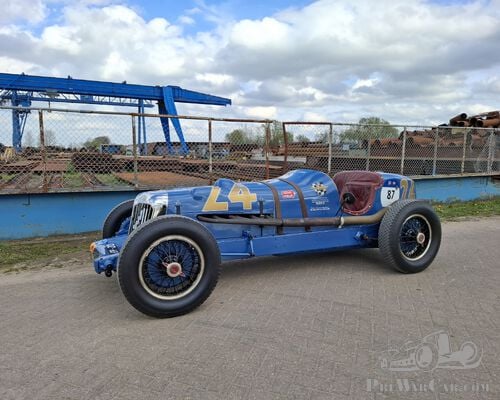
1932 - Graham " Lucenti " Indianapolis
Original participant of the 1932, 1934 and 1935 Indy 500. Best result: finishing 10th overall in the 1934 Indy 500 with driver “Herb” Ardinger...
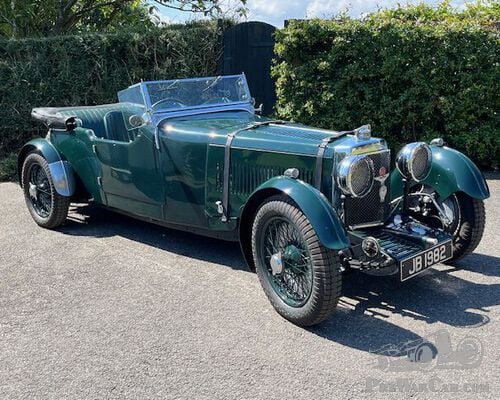
1933 Aston Martin Le Mans
Exceptional 1933 Astron Martin Le MansOriginally bodied as a Standard (Chassis No. L2/222), this unique vehicle was thoughtfully re-bodied i..

Alfa 6C1750 Spider
Alfa 6C1750 Spider with complete history from delivery in 1930 to first owner in Firenze till today with copy Libretto/license plate all the years