The global magazine and marketplace for classic car enthusiasts, by enthusiasts.


Filter
Classic Hudson, DeSoto for sale - Hudson, DeSoto cars for sale
-

1935 Hudson Big Six Suburban Sedan | RM Sotheby's | The Hershey Auction
To Be OFFERED AT AUCTION WITHOUT RESERVE at RM Sothebys' The Hershey Auction event, 7 - 8 October 2026. Offered Without Reserve | $25,000 - $35,000 USD An attractive and capable alternative to the “Big Three” offerings of the era212-cid inline-six; three-speed manual transmissionPreviously restored in green over a tan i.. -
1922 | Hudson Super Six Special Race Car
Formerly owned by racing driver Antonio Trabucco in Argentina with a great early racing history in South AmericaDiscovered in Argentina in 2014 and imported to EuropePartially overhauled by a specialist workshop in Germany Fully functional and drivableSix-cylinder in-line engine, 4.7 litre displacement wi..


Hudson
US, 1901 – 1902
Beau-Chamberlain Manufacturing Co, Hudson, Mich.
The first car to bear the name Hudson was a light steamer with a vertical 2-cylinder engine, single chain drive and tiller steering. This Hudson car bore no relationship to the later Hudson car.
US, 1909 – 1957
(1) Hudson Motor Car Co., Detroit, Mich., 1909 – 1954
(2) American Motors Corp., Kenosha, Wisc., 1954 – 1957
The Hudson car was created by Roy D. Chapin, and financed by J.L. Hudson, head of Detroit’s famous department store of that name. The first product was a 20hp 4-cylinder Hudson car of conventional design, capable of 50mph, of which 4.000 Hudson cars were sold in its first season. These fours, one of which was entered in the 1914 Tourist Trophy were first supplemented and then supplanted by a 6-cylinder line. The first of these Hudson cars was the heavy (3.696lb) and fairly expensive $2.350) Hudson Model 54 with a 4-speed overdrive gearbox, but the 4½-litre Hudson Super Six of 1916, with its high-compression sv engine, really made the Hudson company’s name, and marked the first of a line of engines of this type which lasted almost to the end of Hudson car production, giving generous outputs while still burning commercial-grade petrol. A Hudson Super Six made the first two-way transcontinental trip – New York to San Fransisco and back – in 1916; Ira Vail took 9th place with a Hudson car in the Indianapolis 500 Mile Race in 1919, and this Hudson car formed the backbone of New Zealand’s ‘service car’ network in the 1920s.
Though Hudson’s booming sales in the 1920s were largely due to the inexpensive companion make the Essex, the Hudson car company also pioneered modestly-priced closed Hudson cars, and in 1922 their ‘coach’ (a 2-door saloon) sold for only $100 more than a tourer. Until 1929, the Hudson Super Six remained the staple Hudson car model, and during its last three years of production the Hudson car was powered by a 4.7-litre ioe unit derived from the original Essex Four of 1918. In 1930 this Hudson car was replaced by a 3½-litre straight-8, later increased to 4.168cc in 1932 – this tough and well-liked unit remained in production until 1952, and powered such Anglo-Americans as the Railton and Brough Superior. These firms also used Hudson’s 3½-litre six.
The 1930s were less facrouable to Hudson cars, except in Britain, where the breed’s popularity warranted the manufacture of a small-bore 2.7-litre ‘export’ six rated at only 16.9hp, which was still being made for Hudson cars in 1940. The regular Hudson Six was a bigger machine of 3.455cc and was offered with independent front suspension in 1934 and 1935; in the latter year Electric Hand gear change became available on Hudson cars. Fencer’s mask radiator grilles followed in 1936, and steering-column change in 1939. The first post-war Hudson cars were a continuation of the 1942 models, but 1948 brought the revolutionary Hudson Step-Down series with the Hudson car company’s high-compression sv in-line engines. These low-built Hudson cars had unitary construction of chassis and body, rear wheels mounted inside the chassis frame, and coil-spring independent front suspension. The 5-litre 145bhp 6-cylinder Hudson Hornet engine introduced for 1951, proved a great success in stock-car events, but before this the Hudson car company had reached its post-war sales peak, with nearly 145.000 Hudson cars delivered in 1950. Competition in the medium-price bracket was too strong, and Hudson’s venture in the compact car market in 1953, with the 3.3-litre 6-cylinder Hudson Jet at $1.833 (this was also the first Hudson to abandon the wet-plate clutch) was not successful.
In 1954 Hudson amalgamated with Nash to form the American Motors Corporation. Though all production was transferred from Detroit to Kenosha, and the Hudson car range now shared its utinized hulls with the bigger Nash models, sales did not prosper. These last Hudson cars had initially the old sv 6-cylinder units or Packard-built V8s, while both Nash’s Rambler and the Austin-built Metropolitan were sold by Hudson agents. The Hudson car name was dropped at the end of the 1957 season.
Source: Georgano, encyclopedia of motorcar; GNG, MCS
The information is written with the greatest of care. However, if you have any suggested amendments please contact us at office@prewarcar.com
DeSoto
US, 1913 – 1916
DeSoto Motro Car Co, Auburn, Ind.
The DeSoto appears to have succeeded the Zimmerman. This was a large car with a 55hp, 6-cylinder engine, which was furnished with a compressed-air starter. The DeSoto model Six-55 five-seater touring car sold for $2185.
US, 1928 – 1960
Chrysler Motors Corp, Detroit, Mich.
The DeSoto was launched in 1928 as a 3.2-litre side valve six to compete with Oldsmobile, Pontiac and the cheaper Nashes. Styling and general design of the DeSoto were in line with the 1929 Chryslers, and at $885 for a DeSoto sedan 90.000 were sold in the first twelve months. A 3.4-litre straight-8 DeSoto on a 9ft 6in wheelbase was announced for 1930 as the world’s cheapest 8-cylinder car. However, DeSoto suffered badly in the Depression, and in 1932, when flexible rubber engine mountings and free wheels were made available, sales dropped to 26.000 DeSoto cars.
The DeSoto disappeared from the British market about this time, though certain ‘Chrysler’ models listed in England (the Mortlake, Croydon, and some of the Richmonds) were in fact DeSoto cars in all but name. A 6-cylinder version of Chrysler’s advanced unitary-construction Airflow, the SE-type with a 4-litre engine, was brought out in 1934, but was an unsuccessful as its bigger sister. Later DeSotos followed regular Chrysler lines closely though in later years there was a tendency for DeSoto to move into a higher price class than Dodge; by 1952 DeSotos started $300 higher than the companion make.
By 1939 the DeSoto cars for sale were being made with independent front suspension, hypoid back axles and column change. There was a choice at DeSoto of two 6-cylinder engines and three wheelbase lengths, the longest of these being reserved for seven-seater bodywork – DeSoto continued to offer a really roomy family car right up to 1954. A 4-speed semi-automatic Vacumatic transmission became an option in 1941, but DeSoto’s big post-war change of models did not take place until 1952, when the division followed Chrysler’s lead in adopting the oversquare ohv V8; the DeSoto version was of 4½-litre capcity and developed 16-bhp. With the advent of Chrysler’s ‘flight sweep’ styling in 1955, the side-valve sixes were dropped and the standard engine in a DeSoto was now a 4.8-litre eight, giving 185bhp in Firedome guise, and 200bhp in Fireflite form. Though this redesigning saved Chrysler sales generally, the slump in the medium-price class had an adverse effect on DeSoto and in 1959 the DeSoto division was merged with Plymouth. Last of the DeSotos were the 1961 models, unitary-construction cars with a choice of three engines: Plymouth’s 145bhp ohv ‘slant six’ as used in the Valiant, and V8s of 230 and 265bhp, the two former only in Canadian DeSotos. Production of DeSoto cars ceased in November 1960 after only a few had been delivered.
Source: Georgano, encyclopedia of motorcar; MCS
The information is written with the greatest of care. However, if you have any suggested amendments please contact us at office@prewarcar.com


Featured
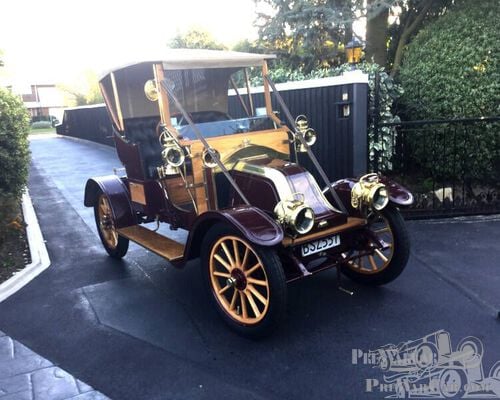
Renault /AX 1913 - named Gigi
Purchased fully renovated from New Zealand and imported to the UK. We have owned her for over10 years. Gigi is currently living in France where she..
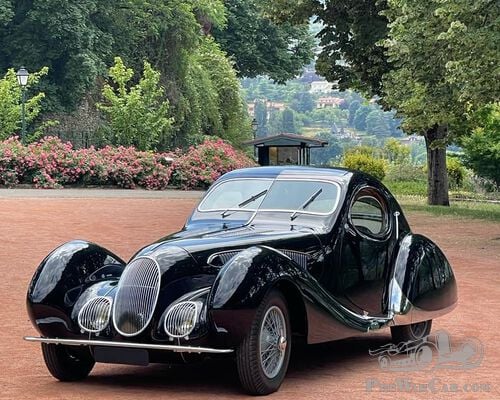
1939 Talbot-Lago T150C “Goutte d’Eau” — Iconic French Coachbuilt Masterpiece
Talbot-Lago T150C ‘Teardrop’ — An Icon of French Automotive Art There are motor cars that define an era. And then there are those tha..
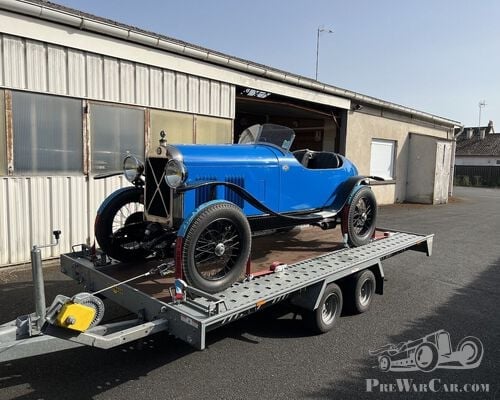
Salmson VAL 3 Séries 7
1927 Salmson VAL3 Series 7. Completely restored a few years ago, in very good overall condition, both bodywork and mechanics. Bordino-style bodywor..