The global magazine and marketplace for classic car enthusiasts, by enthusiasts.


Filter
Classic Hudson, Stanley for sale - Hudson, Stanley cars for sale
-

Stanley Steamer 1919 touring
Very original . Runs good and has new boiler , with pressure test.Use it from day one. Has Danish registration document .Price : please ask ! -
1920 HUDSON SUPER SIX
FOR SALE :1920 HUDSON SUPER SIX SEVEN SEAT TOURER. 4.7 litre six cylinder sidevalve engine producing 76bhp at 2445rpm. . The car stands on four excellent wooden wheels fitted with new Goodrich 35x5 tyres. The car also has 4 addition rims with tyres as supplied with the car when new. I've reluctantly to part with the car which has a lot of.. -
1922 | Hudson Super Six Special Race Car
Formerly owned by racing driver Antonio Trabucco in Argentina with a great early racing history in South AmericaDiscovered in Argentina in 2014 and imported to EuropePartially overhauled by a specialist workshop in Germany Fully functional and drivableSix-cylinder in-line engine, 4.7 litre displacement wi.. -
1910 Hudson model 20 Touring car
Brass lovers!! 1910 Hudson touring car. This car is a GREAT "driver"...I'll detail that in a moment but it has tons of power and is easy to drive. Aesthetically, it's an 8. Recent paint on the body, frame, wheels, under carriage, fenders. Top is new and in excellent shape. Leather is older, but totally livable. Carpet in back is in good shape, f.. -
Stanley steamcar Mountainwagon 820
1915 Stanley Mountain Wagon steamcar Stanley steam cars were made from 1897 to 1927. The "Mountain Wagons" were developed to take guests 35 miles uphill from the train station in Loveland, Colorado into the heart of the Colorado Rockies to the Stanley Hotel. This was a climb with gradients that few cars with combustion engines coul..


Hudson
US, 1901 – 1902
Beau-Chamberlain Manufacturing Co, Hudson, Mich.
The first car to bear the name Hudson was a light steamer with a vertical 2-cylinder engine, single chain drive and tiller steering. This Hudson car bore no relationship to the later Hudson car.
US, 1909 – 1957
(1) Hudson Motor Car Co., Detroit, Mich., 1909 – 1954
(2) American Motors Corp., Kenosha, Wisc., 1954 – 1957
The Hudson car was created by Roy D. Chapin, and financed by J.L. Hudson, head of Detroit’s famous department store of that name. The first product was a 20hp 4-cylinder Hudson car of conventional design, capable of 50mph, of which 4.000 Hudson cars were sold in its first season. These fours, one of which was entered in the 1914 Tourist Trophy were first supplemented and then supplanted by a 6-cylinder line. The first of these Hudson cars was the heavy (3.696lb) and fairly expensive $2.350) Hudson Model 54 with a 4-speed overdrive gearbox, but the 4½-litre Hudson Super Six of 1916, with its high-compression sv engine, really made the Hudson company’s name, and marked the first of a line of engines of this type which lasted almost to the end of Hudson car production, giving generous outputs while still burning commercial-grade petrol. A Hudson Super Six made the first two-way transcontinental trip – New York to San Fransisco and back – in 1916; Ira Vail took 9th place with a Hudson car in the Indianapolis 500 Mile Race in 1919, and this Hudson car formed the backbone of New Zealand’s ‘service car’ network in the 1920s.
Though Hudson’s booming sales in the 1920s were largely due to the inexpensive companion make the Essex, the Hudson car company also pioneered modestly-priced closed Hudson cars, and in 1922 their ‘coach’ (a 2-door saloon) sold for only $100 more than a tourer. Until 1929, the Hudson Super Six remained the staple Hudson car model, and during its last three years of production the Hudson car was powered by a 4.7-litre ioe unit derived from the original Essex Four of 1918. In 1930 this Hudson car was replaced by a 3½-litre straight-8, later increased to 4.168cc in 1932 – this tough and well-liked unit remained in production until 1952, and powered such Anglo-Americans as the Railton and Brough Superior. These firms also used Hudson’s 3½-litre six.
The 1930s were less facrouable to Hudson cars, except in Britain, where the breed’s popularity warranted the manufacture of a small-bore 2.7-litre ‘export’ six rated at only 16.9hp, which was still being made for Hudson cars in 1940. The regular Hudson Six was a bigger machine of 3.455cc and was offered with independent front suspension in 1934 and 1935; in the latter year Electric Hand gear change became available on Hudson cars. Fencer’s mask radiator grilles followed in 1936, and steering-column change in 1939. The first post-war Hudson cars were a continuation of the 1942 models, but 1948 brought the revolutionary Hudson Step-Down series with the Hudson car company’s high-compression sv in-line engines. These low-built Hudson cars had unitary construction of chassis and body, rear wheels mounted inside the chassis frame, and coil-spring independent front suspension. The 5-litre 145bhp 6-cylinder Hudson Hornet engine introduced for 1951, proved a great success in stock-car events, but before this the Hudson car company had reached its post-war sales peak, with nearly 145.000 Hudson cars delivered in 1950. Competition in the medium-price bracket was too strong, and Hudson’s venture in the compact car market in 1953, with the 3.3-litre 6-cylinder Hudson Jet at $1.833 (this was also the first Hudson to abandon the wet-plate clutch) was not successful.
In 1954 Hudson amalgamated with Nash to form the American Motors Corporation. Though all production was transferred from Detroit to Kenosha, and the Hudson car range now shared its utinized hulls with the bigger Nash models, sales did not prosper. These last Hudson cars had initially the old sv 6-cylinder units or Packard-built V8s, while both Nash’s Rambler and the Austin-built Metropolitan were sold by Hudson agents. The Hudson car name was dropped at the end of the 1957 season.
Source: Georgano, encyclopedia of motorcar; GNG, MCS
The information is written with the greatest of care. However, if you have any suggested amendments please contact us at office@prewarcar.com
Stanley
US, 1897 – 1927
(1) Stanley Dry Plate Co, Newton, Mass., 1897 – 1899
(2) Stanley Manufacturing Co, Lawrence, Mass., 1899 – 1901
(3) Stanley Motor Carriage Co, Newton, Mass., 1901 – 1924
(4) Steam Vehicle Corporation of America, Newton, Mass., 1924 – 1927
The Stanley twins, F.E. and F.O., were partners in a photographic dry plate business in Newton, where they produced their first light steam Stanley car in 1897. This Stanley car proved a great success, over 200 Stanley cars being sold in the first year of production. In 1898 a Stanley car was timed over a mile at Charles River Park at 27.40mph. Among the customers of the Stanley cars were A.L. Barber and J.B. Walker, who purchased the manufacturing rights of the Stanley car, and produced it as the Locomobile and Mobile respectively. In 1899 some Stanley cars were advertised by the Locomobile Co of America under the name Stanley-Locomobile. The Stanley cars proceeded to evolve an entirely new design, which appeared in 1902 with a simple non-condensing engine, driving directly on the rear axle. The boiler was mounted at the front of these Stanley cars, frames were of wood, and steering was by tiller. Locomobile went over to Petrol cars at the end of 1903, but the Stanley cars prospered, listing an 8hp Stanley car at $750, and selling their Stanley cars to police and fire departments. More powerful versions Stanley cars rated at 10 and 20hp were available by 1904, and by 1906 the Stanley car had assumed its characteristic appearance, with coffin-like bonnet concealing the boiler, and wheel steering. The Stanley car could out-accelerate petrol cars, and that year Frank Marriott was timed at 127.66mph on Daytona Beach with the streamlined Woggle-Bug. Marriott tried again the following year, but a spectacular crash at about 150mph destroyed the car. Stanley cars 1908 Gentleman’s Speedy Roadster was capable of 60mph, and would run over 50 miles on a filling of water. 1913 Stanley cars were electrically-lighted, and 1915 brought the introduction of steel framed and V-shaped frontal condensers on the Stanley cars on a 10ft 10in wheelbase chassis which lent itself to seven-seater coachwork. However, the advent of Cadillac’s electric self-starter in 1912 had signaled the end of the steamer , with its need for a long warm-up from dead cold. The 1920 Model 735 Stanley car resembled a conventional petrol car in outward appearance with a flat radiator of typically American aspect, but the boiler of the Stanley car was still under the bonnet, and the double-acting 2-cylinder engine still drove direct on the back axle. Acceleration was well above par for the standards of the day, and the Stanley car would cruise at 45mph, with more available. But at around the $2.600 mark sales were low (about 600 Stanley cars per annum), and the Stanley cars had retired from the company during World War 1. The Stanley car firm was reorganized in 1925, and the last Stanley cars had hydraulic front-wheel brakes and balloon tyres.
US, 1907 – 1910
(1) Stanley Automobile Manufacturing Co, Mooreland, Ind., 1907
(2) Troy Automobile & Buggy Co, Troy, Ohio, 1908 – 1910
This Stanley car was a five-seater touring car weighing 1.550lb. The Stanley car was powered by a 2-cylinder, water-cooled engine of 3.6-litres. A friction transmission was used, with a single-chain to drive the rear axle.
Source: Georgano, encyclopedia of motorcar; MCS, GMN
The information is written with the greatest of care. However, if you have any suggested amendments please contact us at office@prewarcar.com


Featured

Lagonda LC Tourer 1934
The Lagonda story began in 1901 in Staines, a small town in the UK. The company enjoyed its greatest successes around 1935. During this period, the..
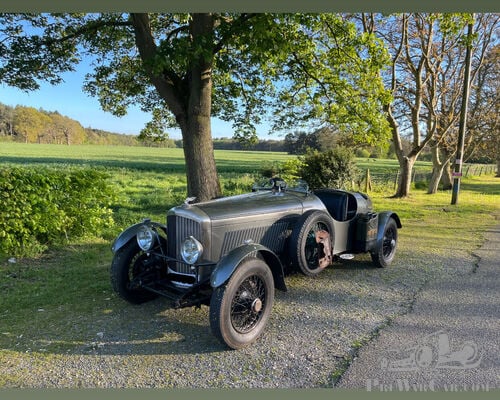
Derby Bentley Special 4-1/4
Sadly i am having to sell on my Bentley special ( Icarus). It is currently a work in progress and still needs finalising/ refining. A great o..
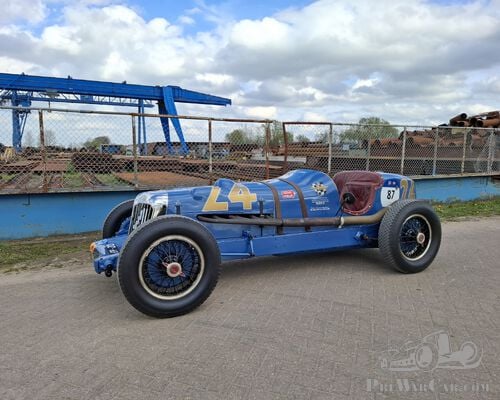
1932 - Graham " Lucenti " Indianapolis
Original participant of the 1932, 1934 and 1935 Indy 500. Best result: finishing 10th overall in the 1934 Indy 500 with driver “Herb” Ardinger...