The global magazine and marketplace for classic car enthusiasts, by enthusiasts.


Filter
Classic Humber, Léon Bollee for sale - Humber, Léon Bollee cars for sale
-

1932 Humber | Brightwells | Auction Ends: Wed 24th Jun
Barn find project, decorative garden ornament or effective shed filler; still fully UK registered as EV 5960; recovered by our vendor from a family who owned it since the 1960s Contact - toby.service@brightwells.com -
Humber 1931 Pullman Limousine
Humber Pullman Limousine with 6 cylinder engine 3500 cc and 25 HP with manual gearbox with four speed transmission. Runs and drives great. Frank Kennis Phone: 00.31.622.420.766 or mail me: info@KennisCars.NL www.KennisCars.NL Classic Car Dealer for Europe Cadillac ; Mercedes ; Rolls-Royce ; Delage ; Bugatti ; Bentley ; Dodge ; Opel ; Corvette .. -
1900 Humber De Dion Engined Quadricycle - VCC Dated
1900 Humber De Dion Engined Quadricycle 2.75HPRegistration No. BS8088Engine No. 9078Frame No. M1041CVCC Dating Cert No. 2177 Humber & Co Ltd was a British manufacturer with its headquarters based in Coventry, incorporated as early as 1887 where the company’s primary source of income was the ‘Bicycle ..


Humber
GB, 1898 to date
(1) Humber Ltd, Beeston, Notts., 1898 – 1908
(2) Humber Ltd, Coventry, 1898 – 1946
(3) Humber Ltd, Ryton-on-Dunsmore, Warwickshire, 1946 – 1970
(4) Chrysler United Kingdom Ltd, Ryton-on-Dunsmore, Warwickshire, 1970 to date
Thomas Humber’s bicycle firm, established in 1868, became a part of H.J. Lawson’s intended automobile empire empire and as such was responsible for production of the abortive Pennington tricars. Humber car manufacture started with an experimental front wheel drive design, while motor tricycles and quadricycles were also produced. These led to a line of 3-wheeled forecars which persisted up to 1905. Little came of Humber cars M.D. voiturette with 2-speed gear, but their more conventional 1901 offering had a 4½hp De Dion engine, De Dion-type transmission and shaft drive, as well a a single-spoke steering wheelwhich remained one of the Humber car company’s trademarks in the early years and anticipated Citroën practice by more than half a century. A 12hp 2½-litre 4-cylinder Humber car followed in 1902, but in 1903 two more ambitious vehicles appeared, a big Humber 20hp four and a 3-cylinder version with mechanically-operated inlet valves, as well a Britain’s first successful effort at a popular light car. This Humber car was the 5hp Humberette with a De Dion-type engine of 613cc and a 2-speed gearbox with two steering-column levers. All these Humber cars had shaft drive – Humbers eschewed the chain. In 1904 the Humberette was made in a more powerful form and up to 1908 two separate lines of Humber car were produced in the factories at Beeston and Coventry, the Beeston cars being the more expensive. 1905 saw a miniature Humber car, a four rated at 8/10hp, but with a capacity of 2 litres, which was developed the following year into a 10/12hp Coventry-Humber car selling at £315; Beeston’s offering that season was a 3½-litre T-head four selling for £472 10s. The 1907 versions of the Beeston-Humber car had a capacity of 6.3-litres and pressure lubrication.
The 1908 Humber car range was quite extensive, ranging from a bid for the lightcar market with a 1½-litre 8hp vertical twin, pressure-lubricated and with Humber’s own design of detachable wheels, at £195, up to a big 5½-litre six Humber car, also Coventry-made, at a modest £450.
Financial difficulties led to the closure of the Beeston factory in 1908, but Coventry went on making the T-headed Humber cars, all of which had 4-speed gearboxes by 1911. In 1912 new L-head models came out, the 11hp having a 1.7-litre monobloc engine, three forward speeds and splash lubcrication; there was also a new Humber car, a cyclecar named the Humberette, with a 998cc air-cooled engine but otherwise on full-scale car lines, which was made up to the outbreak of World War 1. 1913/1914 models cost £120, with £15 extra if watercooling was specified. Though Humber cars had supported the first Tourist Trophies, an unusual departure for 1914 was the preparation of a Humber car team of 3.3-litre twin ohc 4-cylinder machines inspired by the Henry-designed Peugeots for that year’s event.
After the war the Humber car company concentrated on solid family cars, noted for their excellent workmanship and all-weather equipment, as well as their conservatism. Side-valve engines were used up to 1922 in Humber cars, but inlet over exhaust layouts appeared in 1923, in which year there was also a new small Humber car model, the ‘Humber 8/18’ with 12-volt coil ignition at £275. Front wheel brakes had arrived by 1925, although Humber cars adhered to the foot-operated transmission brake for several more seasons. The company sold over 4.000 Humber cars in 1927, thanks to the 1.056cc ‘Humber 9/20’, an excellent 2-litre 4-cylinder ‘Humber 14/40’ and a new 20/55hp Humber car, the first six in a Humber car for many years.
The Humber cars were restyled in 1929, and the following year the effect of the Rootes takeover was seen in the new line of sixes, the 2.1-litre ‘Humber 16/50’ and the 3½-litre Humber Snipe and its long-chassis stablemate, the Humber Pullman. 1930 was also the last year for the 9hp Humber cars and thereafter the Humber car company’s staple products were upper-middle-class family cars of over two litres’ capacity, although a 1.7-litre ‘Humber 12’ appeared in 1933 and formed the basis for the long-stroke 4-cylinder Rootes engines still being manufactured in 1966 as a Humber car. Also at the end of 1932 overhead inlet valves were dropped. In 1936 the 6-cylinder Humber cars acquired transverse independent front suspension, while the biggest sixes were now of 4.1-litres’ capacity. Only 6-cylinder Humber cars were offered in 1938, and hydraulic brakes appeared on 16hp and 21hp Humber car models in 1939, and were also found on the first Humber Super Snipe – a ‘compact’ evolved by mounting the 4.1-litre engine in the smaller chassis, which was excellent value at £398.
Snipe-based Humber cars served the Allied Forces with distinction in World War 2 and the new models introduced in 1945 were really hold-overs of Humber car parts from 1940, with hydraulics now standardized, together with a new four in the shape of a 1.9-litre side-valve Humber Hawk based on Hillman’s Fourteen of 1938/1940. In 1950 a Humber car (the Super Snipe) took second place in the Monte Carlo Rally. The Super Snipe and Pullman acquired overhead valves in 1953, and the Hawk a year later, while 1956 Super Snipes could be had with automatic transmission. Unitary construction was used on a redesigned Hawk in 1957, and two years later the Super Snipe (after a short period in abeyance) re-emerged as an altogether smaller 2.650cc Humber car, also with unitary construction. This was soon replaced by a 3-litre development with disc front brakes. 1962 Humber car models had the four-headlamp pioneered in America in 1957. A small luxury Humber car came out in 1964 in the shape of the Humber Spectre, based on Hillman’s Super Minx, but with overdrive standard equipment. During 1967 all the big Humber cars were dropped, to be replaced on the British market by the Australian-built Plymouth Valiant. Since 1968 the only Humber car offering has been the 1.7-litre Humber Sceptre, a prestige version of the Hillman Hunter. The 1973 Humber cars had twin-carburettor 79bhp engine, and there was a choice of a 4-speed all-synchromesh gearbox with overdrive on the two upper ratios of automatic transmission.
Source: Georgano, encyclopedia of motorcar; MCS
The information is written with the greatest of care. However, if you have any suggested amendments please contact us at office@prewarcar.com
Léon Bollee
France, 1895 – 1933
(1) Automobiles Léon Bollée, Le Mans, 1895 – 1924
(2) Morris Motors Ltd, Usines Léon Bollée, Le Mans, 1925 – 1931
(3) Sté Nouvelle Léon Bollée, Le Mans, 1931 – 1933
Leon Bollee was a son of Amédée Bolllée père, the most important pioneer of steam road vehicles in France. Leon Bollee, however, turned to really small petrol Leon Bollee cars. He was the first to do so, and therefore had to invent a new name for his Leon Bollee car of 1895 – he called it a Leon Bollee voiturette. This Leon Bollee car was a tandem two-seater 3-wheeler that was faster than any other petrol-engined vehicle on the road when the Leon Bollee car was working, thanks to a powerful 3hp engine and light weight, but the power unit was unreliable on the Leon Bollee car. The Leon Bollee car had a single air-cooled cylinder of 650cc and used hot-tube ignition. There were 3 forward speeds on the Leon Bollee car, with belt final drive. The frame was tubular. Four years after the Leon Bollee voiturette appeared, Leon Bollee superseded it with a 4-wheeler with independent front suspension by double transverse leaf springs. This Leon Bollee car had a single-cylinder, water-cooled engine. Unlike the Leon Bollee voiturette, this Leon Bollee car made no mark. The design rights were sold to Darracq, and around 1901 the name of Leon Bollee cars vanished. Meanwhile, the term voiturette had been taken up by the trade and public in general as the name for a small light car.
The Leon Bollee car reappeared in 1903 as an entirely normal, full-sized car in the more expensive class, backed by Vanderbilt money and designed for the American market. This Leon Bollee car was made in 28hp (4.6-litres) and 45hp (8-litres) versions, with four cylinders and chain drive, and led on to a 11.9-litre six Leon Bollee car in 1907, in which year the first shaft driven Leon Bollee car appeared. From 1909 there was also a small modern four, the Leon Bollee 10/14hp. The 1910 range embraced 9 Leon Bollee cars, including 2 of over 10-litres capacity. Electric lighting became available on Leon Bollee cars in 1913, but the Leon Bollee grew increasingly old-fashioned after World War 1 despite the introduction of ohv in 1922 on Leon Bollee cars and front wheel brakes in 1923. Late in 1924 Sir William Morris bought the Le Mans Leon Bollee car factory. From making a wide range of conservative French Leon Bollee fours, it turned to thinly-disguised products of Cowley, Oxford, the idea being to breach the French tariff walls from the inside. The first Morris- Leon Bollee had a 12CV 2½-litre 4-cylinder unit-construction engine made by Hotchkiss, the engine manufacturers controlled by Morris, but it had push-rod overhead valves and bore little evidence of its parentage. Not so the 18CV Morris- Leon Bollee car of 1928. This was a 3-litre straight-8 with single overhead camshaft that reflected Morris’ takeover of Wolseley two years earlier. Morris’ own new six of 1928 was mirrored in the 15CV 2.6-litre Le Mans product of 1929. The bodies for the Morris- Leon Bollee car were all made in France and were usually considerably more dashing and attractive than their British counterparts. Chassis of this Morris- Leon Bollee car were made in France, and all cars had a 4-speed gearbox. At one time, 50 12CV Morris- Leon Bollee cars were being turned out each week. However, Morris’ enterprise was not a success, and he discontinued it in the hard times of the Depression. A new syndicate was formed in September 1931 to sell the same range of cars under the name of Leon Bollee cars. This lasted for less than two years and few Leon Bollee cars were made.
Source: Georgano, encyclopedia of motorcar; TRN
The information is written with the greatest of care. However, if you have any suggested amendments please contact us at office@prewarcar.com


Featured
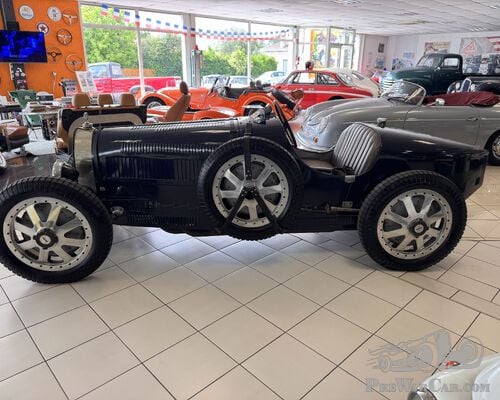
Bugatti 35 B Pur Sang
Bugatti 35 B Pur Sang,importée par un membre délégué de la FFVE il y’a une quinzaine d années.Participation à de nombreux Rallyes Bug..

Alfa 6C1750 Spider
Alfa 6C1750 Spider with complete history from delivery in 1930 to first owner in Firenze till today with copy Libretto/license plate all the years