The global magazine and marketplace for classic car enthusiasts, by enthusiasts.


Filter
Classic Humber, Morgan for sale - Humber, Morgan cars for sale
-

Te koop Morgan Aero 1927
De Morgan Aero is geproduceerd van 1920 tot rond 1933. Dit voertuig met chassisnummer B718 is van 1927. De driewieler is in goed rijdbare en in originele staat, video’s hierover zijn het bewijs. De aandrijving (koppeling & bak) en dynamo zijn op kwalitatief gezien technisch verantwoorde wijze enigszins aangepast, waarmee de technische betrou.. -
1920 Humber 10.5hp two-seat tourer | The Ernie Warren Collection Auction | 13th June 2026
A 1920 Humber 10.5hp two-seat tourer.Reg No. AH 3975.Car No. K3829.Engine No. 3865.Blue with black interior.Humber virtually stopped production of civilian cars during WWI and the ‘Ten’ emerged after the cessation of hostilities with electric lighting and dynamo starting. Along with the ‘F.. -
1914 14hp Humber tourer | The Ernie Warren Collection Auction | 13th June 2026
A 1914 14hp Humber tourer. Reg No. NA 2161.Car No. H325.Engine No. H345.Mole with brown upholstery.From an interest in motor vehicles beginning in 1896, the motor division of Humber Ltd became much more important than the cycle and motorcycle divisions, and by 1913 were second only to Wolseley as.. -
A 1927 Humber 14/40 All-Weather Tourer | The Ernie Warren Collection Auction | 13th June 2026
Reg No. HU 9485. Car No. 14373.Engine No. 14373.Blue and black with black interior.For the 1927 season, the replacement for the Humber 12/25 was the 14/40, four-cylinder IOE engine with a capacity of 2020cc.The 14/40 was to become one of the most popular and therefore most successful vintage products. T.. -
Humber 1931 Pullman Limousine
Humber Pullman Limousine with 6 cylinder engine 3500 cc and 25 HP with manual gearbox with four speed transmission. Runs and drives great. Frank Kennis Phone: 00.31.622.420.766 or mail me: info@KennisCars.NL www.KennisCars.NL Classic Car Dealer for Europe Cadillac ; Mercedes ; Rolls-Royce ; Delage ; Bugatti ; Bentley ; Dodge ; Opel ; Corvette .. -
1926 Humber 9/20 2 seat Tourer + Dickey | The Ernie Warren Collection Auction | 13th June 2026
A 1926 Humber 9/20 two-seat tourer with dickey.Reg No. FL5377.Car No. 3711L.Engine No. 3711L.Brown with red interior.A charming example of the Vintage light car. A scaled down version of the larger touring cars, the quality and solidity of their construction ensured longevity and reliability. A 1056cc I.. -
1913 11hp Humber four-seat tourer | The Ernie Warren Collection Auction | 13th June 2026
A 1913 11hp Humber four-seat tourer.Reg No. BH 607.Car No. 723.Engine No. 731.Mole with brown upholstery.From an interest in motor vehicles beginning in 1896, the motor division of Humber Ltd became much more important than the cycle and motorcycle divisions, and by 1913 were second only to Wolseley as .. -
1900 Humber De Dion Engined Quadricycle - VCC Dated
1900 Humber De Dion Engined Quadricycle 2.75HPRegistration No. BS8088Engine No. 9078Frame No. M1041CVCC Dating Cert No. 2177 Humber & Co Ltd was a British manufacturer with its headquarters based in Coventry, incorporated as early as 1887 where the company’s primary source of income was the ‘Bicycle ..


Humber
GB, 1898 to date
(1) Humber Ltd, Beeston, Notts., 1898 – 1908
(2) Humber Ltd, Coventry, 1898 – 1946
(3) Humber Ltd, Ryton-on-Dunsmore, Warwickshire, 1946 – 1970
(4) Chrysler United Kingdom Ltd, Ryton-on-Dunsmore, Warwickshire, 1970 to date
Thomas Humber’s bicycle firm, established in 1868, became a part of H.J. Lawson’s intended automobile empire empire and as such was responsible for production of the abortive Pennington tricars. Humber car manufacture started with an experimental front wheel drive design, while motor tricycles and quadricycles were also produced. These led to a line of 3-wheeled forecars which persisted up to 1905. Little came of Humber cars M.D. voiturette with 2-speed gear, but their more conventional 1901 offering had a 4½hp De Dion engine, De Dion-type transmission and shaft drive, as well a a single-spoke steering wheelwhich remained one of the Humber car company’s trademarks in the early years and anticipated Citroën practice by more than half a century. A 12hp 2½-litre 4-cylinder Humber car followed in 1902, but in 1903 two more ambitious vehicles appeared, a big Humber 20hp four and a 3-cylinder version with mechanically-operated inlet valves, as well a Britain’s first successful effort at a popular light car. This Humber car was the 5hp Humberette with a De Dion-type engine of 613cc and a 2-speed gearbox with two steering-column levers. All these Humber cars had shaft drive – Humbers eschewed the chain. In 1904 the Humberette was made in a more powerful form and up to 1908 two separate lines of Humber car were produced in the factories at Beeston and Coventry, the Beeston cars being the more expensive. 1905 saw a miniature Humber car, a four rated at 8/10hp, but with a capacity of 2 litres, which was developed the following year into a 10/12hp Coventry-Humber car selling at £315; Beeston’s offering that season was a 3½-litre T-head four selling for £472 10s. The 1907 versions of the Beeston-Humber car had a capacity of 6.3-litres and pressure lubrication.
The 1908 Humber car range was quite extensive, ranging from a bid for the lightcar market with a 1½-litre 8hp vertical twin, pressure-lubricated and with Humber’s own design of detachable wheels, at £195, up to a big 5½-litre six Humber car, also Coventry-made, at a modest £450.
Financial difficulties led to the closure of the Beeston factory in 1908, but Coventry went on making the T-headed Humber cars, all of which had 4-speed gearboxes by 1911. In 1912 new L-head models came out, the 11hp having a 1.7-litre monobloc engine, three forward speeds and splash lubcrication; there was also a new Humber car, a cyclecar named the Humberette, with a 998cc air-cooled engine but otherwise on full-scale car lines, which was made up to the outbreak of World War 1. 1913/1914 models cost £120, with £15 extra if watercooling was specified. Though Humber cars had supported the first Tourist Trophies, an unusual departure for 1914 was the preparation of a Humber car team of 3.3-litre twin ohc 4-cylinder machines inspired by the Henry-designed Peugeots for that year’s event.
After the war the Humber car company concentrated on solid family cars, noted for their excellent workmanship and all-weather equipment, as well as their conservatism. Side-valve engines were used up to 1922 in Humber cars, but inlet over exhaust layouts appeared in 1923, in which year there was also a new small Humber car model, the ‘Humber 8/18’ with 12-volt coil ignition at £275. Front wheel brakes had arrived by 1925, although Humber cars adhered to the foot-operated transmission brake for several more seasons. The company sold over 4.000 Humber cars in 1927, thanks to the 1.056cc ‘Humber 9/20’, an excellent 2-litre 4-cylinder ‘Humber 14/40’ and a new 20/55hp Humber car, the first six in a Humber car for many years.
The Humber cars were restyled in 1929, and the following year the effect of the Rootes takeover was seen in the new line of sixes, the 2.1-litre ‘Humber 16/50’ and the 3½-litre Humber Snipe and its long-chassis stablemate, the Humber Pullman. 1930 was also the last year for the 9hp Humber cars and thereafter the Humber car company’s staple products were upper-middle-class family cars of over two litres’ capacity, although a 1.7-litre ‘Humber 12’ appeared in 1933 and formed the basis for the long-stroke 4-cylinder Rootes engines still being manufactured in 1966 as a Humber car. Also at the end of 1932 overhead inlet valves were dropped. In 1936 the 6-cylinder Humber cars acquired transverse independent front suspension, while the biggest sixes were now of 4.1-litres’ capacity. Only 6-cylinder Humber cars were offered in 1938, and hydraulic brakes appeared on 16hp and 21hp Humber car models in 1939, and were also found on the first Humber Super Snipe – a ‘compact’ evolved by mounting the 4.1-litre engine in the smaller chassis, which was excellent value at £398.
Snipe-based Humber cars served the Allied Forces with distinction in World War 2 and the new models introduced in 1945 were really hold-overs of Humber car parts from 1940, with hydraulics now standardized, together with a new four in the shape of a 1.9-litre side-valve Humber Hawk based on Hillman’s Fourteen of 1938/1940. In 1950 a Humber car (the Super Snipe) took second place in the Monte Carlo Rally. The Super Snipe and Pullman acquired overhead valves in 1953, and the Hawk a year later, while 1956 Super Snipes could be had with automatic transmission. Unitary construction was used on a redesigned Hawk in 1957, and two years later the Super Snipe (after a short period in abeyance) re-emerged as an altogether smaller 2.650cc Humber car, also with unitary construction. This was soon replaced by a 3-litre development with disc front brakes. 1962 Humber car models had the four-headlamp pioneered in America in 1957. A small luxury Humber car came out in 1964 in the shape of the Humber Spectre, based on Hillman’s Super Minx, but with overdrive standard equipment. During 1967 all the big Humber cars were dropped, to be replaced on the British market by the Australian-built Plymouth Valiant. Since 1968 the only Humber car offering has been the 1.7-litre Humber Sceptre, a prestige version of the Hillman Hunter. The 1973 Humber cars had twin-carburettor 79bhp engine, and there was a choice of a 4-speed all-synchromesh gearbox with overdrive on the two upper ratios of automatic transmission.
Source: Georgano, encyclopedia of motorcar; MCS
The information is written with the greatest of care. However, if you have any suggested amendments please contact us at office@prewarcar.com
Morgan
GB, 1905 – 1906
Morgan and Co Ltd, Leighton Buzzard, Beds.
Made by a well-known firm of coachbuilders, the Morgan car was a conventional shaft-driven car with 5.8-litre T-head 4-cylinder Mutel engine, distinguished only by the Sparks-Boothby hydraulic clutch on the Morgan car, soon abandoned in favour of an ordinary leather cone. Only about five Morgan cars were made and their lack of success resulted in Morgan cars becoming Adler concessionaires in 1907, and abandoning motor manufacture.
GB, 1910 to date
Morgan Motor Co Ltd, Malvern Link, Worcs.
This Morgan car was the best-known, and best, of the British 3-wheelers that were popular while the horsepower tax gave the Morgan cars an advantage. H.F.S. Morgan’s tricycle was also the first of its type, this Morgan car going into production in 1910. At the front of a tubular chassis frame was an sv, air-cooled V-twin motor-cycle engine of 1.100cc by JAP, transversely mounted. Transmission of the Morgan car was by dog clutches and chains, providing two forward speeds. The steering was direct. The front wheels of the Morgan car, had independent front suspension, by sliding pillars and coil springs. There were two seats. A reasonable amount of power plus light weight meant an excellent performance of the Morgan cars. The Morgan car was safer than most 3-wheelers because its road-holding was above average. This recipe made the Morgan car popular with sportsmen, for whom the Morgan Grand Prix model was produced in 1914: the first catalogued competition Morgan car. Soon afterwards, an exiguous four-seater Morgan car, the forerunner of the Morgan Family model of the 1920s, was listed.
After World War 1, Morgan carscontinued to cater for all markets. Names changed, but the Morgan Sports or Morgan Standard model was the normal two-seater, also available in De Luxe form; the Morgan Family model was the more capacious type Morgan car, and the long-tailed Morgan Aero, later the Morgan Super Sports, was the Morgan car intended for serious speed work. Engines of Morgan cars were water- or air-cooled to choice, most being supplied by JAP, or by Blackburne in the case of the competition Morgan cars. From 1925 all the latter’s power units had overhead valves. By 1927 the Super Sports Morgan car could attain 80mph in standard trim, while the less sporting Morgan cars now had internal expanding front wheel brakes and electric starting. Geared-down steering and (if required) three forward speeds followed on Morgan cars in 1929. Even so, Morgan cars were losing customers to new, cheap sports cars such as the M-type MG. Three speeds and reverse in a normal gearbox (though still with chain final drive) were available from 1931 and standard on the Morgan car after 1932, and a modified 8hp Ford 4-cylinder engine could later be had in the Morgan car instead of the twin. Four years later the first 4-wheeled Morgan car was introduced, the excellent little Morgan 4/4. This Morgan car used an 1.122cc 4-cylinder Coventry-Climax engine with overhead inlet valves, developing 34bhp. The Morgan car was still light in weight, and retained the Morgan independent front suspension, so the performance and handling qualities of Morgan cars were well up to form. The Morgan car could attain 75mph. The twins were last catalogued in 1939.
Just before World War 2, a 1.267cc Standard 10hp engine with ohv head was substituted in the Morgan 4/4. When this was no longer available, from 1950, Morgan fitted a tuned Standard Vanguard unit in the Morgan car giving 70bhp. In this Morgan Plus Four, as the Morgan car was renamed, performance became still more lively, and when the 90bhp Triumph TR2 engine became available in 1954, maximum speed of the Morgan car rose to 100mph for the first time. With the advent of the Morgan Plus Four, there was no longer a small Morgan car, but this gap was made good in 1955, when the Morgan Series 2 4/4 arrived. This Morgan car used the very hard-wearing 1.172cc sv Ford Ten engine which had powered F4 Morgan. (The latter was the last 3-wheeler Morgan car, which had been made until 1950.) The result was a cheap, pleasant and reliable sports Morgan car of the old school. Later, the ohv Ford 105E engine was substituted. The latest version Morgan car had a 1.599cc 98bhp engine, a 4-speed all-synchromesh gearbox, front disc brakes, and the traditional Morgan suspension. The Morgan Plus Four kept pace with Triumph’s TR engine development, also acquiring disc brakes and, eventually, the 2.138cc 105bhp TR4 unit. A streamlined coupé, the Morgan Plus Four Plus of 1964, was a brief deviation from the classical Morgan car line which met with little approval and was discontinued after only 50 of these Morgan cars had been sold. When Triumph changed to a six during 1968, Morgan cars adopted a new engine for their bigger Morgan cars, and the Morgan Plus Four became the Morgan Plus Eight, powered by Rover’s 3 ½-litre 160bhp V8 and capable of 125mph. The 1973 versions of the Morgan car use the 4-speed all-synchromesh Rover gearbox in place of the Moss box previously fitted.
Source: Georgano, encyclopedia of motorcar; MCS, TRN
The information is written with the greatest of care. However, if you have any suggested amendments please contact us at office@prewarcar.com


Featured

K3 Replica on KN Chassis
"The K3 Magnette must rank in the history books as the most famous and successful of all the record breaking MGs. With only 33 examples produced durin..
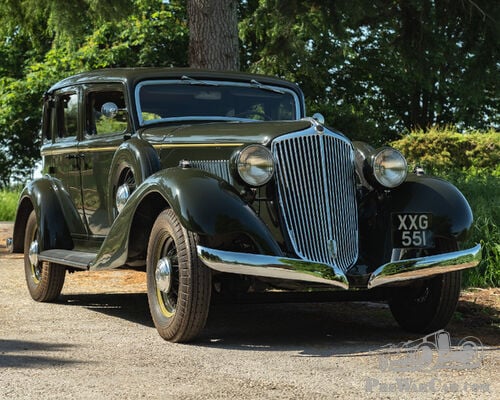
Graham Model 64 Standard Eight 'Blue Streak'
UK Registration No: XXG 551Chassis No: 1801069MOT: ExemptH&H ClassicsKelham Hall | Newark, Nottinghamshire
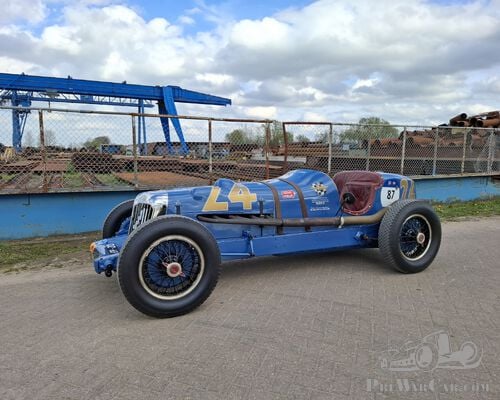
1932 - Graham " Lucenti " Indianapolis
Original participant of the 1932, 1934 and 1935 Indy 500. Best result: finishing 10th overall in the 1934 Indy 500 with driver “Herb” Ardinger...