The global magazine and marketplace for classic car enthusiasts, by enthusiasts.


Filter
Classic Hupmobile, DeSoto for sale - Hupmobile, DeSoto cars for sale
-

1912 Hupmobile Model 32 Torpedo Touring | RM Sotheby's | The Hershey Auction
To Be OFFERED AT AUCTION WITHOUT RESERVE at RM Sothebys' The Hershey Auction event, 7 - 8 October 2026. Offered Without Reserve | $15,000 - $25,000 USD Rare Canadian-delivery example delivered through The Automobile & Supply Co. Ltd. of TorontoOwnership believed to span just four families A showcase of advanced engi.. -
Mid 1920s Hupmobile R series open tourer project car
Mid 1920s Hupmobile R series open tourer project car. Chassis N° R 179775, castingnumber on engine 52900. Very good condition older restored chassis. Also work done on both engine and rearaxle. Radiator shell is straight but needs to be renickeled. A number of smaller parts are in boxes and not shown. Suitable inexpensive project car fo..


Hupmobile
US, 1908 – 1940
Hupp Motor Car Corp., Detroit, Mich.; Cleveland, Ohio
Robert and Louis Hupp, the founders of the Hupmobile company, started with a 2.8-litre 4-cylinder light runabout, with two bucket seats and a bolster tank, distinguished by a 2-speed sliding-type gearbox. This Hupmobile car sold for $750 and was joined in 1911 by a Hupmobile touring car with 3 forward speeds and a longer wheelbase of 9ft 2in, listed at only $900. Hupmobile, like Dodge and Chevrolet, adhered to the 4-cylinder sv unit for many years and made nothing else until 1924, though the Hupmobile cars acquired electric lighting and starting in 1914. A Hupmobile car with a 10ft 6in wheelbase was made available for seven-seater bodywork in 1916. Sales were good: 12.000 Hupmobile cars in 1913, and climbing up to 38.000 by 1923. By 1918 a rounded cowl and bonnet line had replaced the original angular configuration and fuel feed was by vacuum from a tank at the rear. Open Hupmobile car models were listed at $1.250. Aluminium pistons were featured in 1924 and balloon tyres on the Hupmobile car in 1925, the last year of the four. Interestingly enough, Hupmobile’s 4-litre straight-8 appeared in 1925, a year before the first six. This Hupmobile car was a conventional machine with contracting Lockheed hydraulic brakes, mechanical actuation being used on the 6-cylinder Hupmobile cars. The Hupmobile car company stayed in the medium-price field, sixes selling at $1.295 in 1929, while prices of the Hupmobile M-series sv eight started at $1.825. In 1929 Chandler’s plant in Cleveland was acquired and was used for the manufacture of the less expensive Huppmobile Hupps. Like most of America’s independent makes, the Hupmobile car company was hit hard by the Depression, sales of Hupmobile cars dropping from 50.374 in 1929 to 17.450 in 1931, although in the next two years, in 1932 and 1933 some very handsome Hupmobile cars were made.
In 1934 the Hupmobile Aerodynamic range with three-piece wrap-around windscreens and headlamps faired into the bonnet sides appeared. An experimental front wheel drive version was not proceeded with. The aerodynamic Hupmobile cars were made in 4-litre, 6-cylinder and 5-litre straight-8 forms, but sales were poor and the Hupmobile car factory closed down halfway through the 1936 season. It was reopened, but the 1937 and 1938 Hupmobile cars were of little interest apart from the standardization of automatic overdrive on the eights. Like Graham, Hupmobile tried to stay in business by adapting the body dies on the discontinued 810/812 Cord series to their conventional running gear. These Hupmobile Skylarks were built in the Graham factory; the last Hupmobile cars were completed in July 1940, but were sold as 1941 models.
Source: Georgano, encyclopedia of motorcar; MCS
The information is written with the greatest of care. However, if you have any suggested amendments please contact us at office@prewarcar.com
DeSoto
US, 1913 – 1916
DeSoto Motro Car Co, Auburn, Ind.
The DeSoto appears to have succeeded the Zimmerman. This was a large car with a 55hp, 6-cylinder engine, which was furnished with a compressed-air starter. The DeSoto model Six-55 five-seater touring car sold for $2185.
US, 1928 – 1960
Chrysler Motors Corp, Detroit, Mich.
The DeSoto was launched in 1928 as a 3.2-litre side valve six to compete with Oldsmobile, Pontiac and the cheaper Nashes. Styling and general design of the DeSoto were in line with the 1929 Chryslers, and at $885 for a DeSoto sedan 90.000 were sold in the first twelve months. A 3.4-litre straight-8 DeSoto on a 9ft 6in wheelbase was announced for 1930 as the world’s cheapest 8-cylinder car. However, DeSoto suffered badly in the Depression, and in 1932, when flexible rubber engine mountings and free wheels were made available, sales dropped to 26.000 DeSoto cars.
The DeSoto disappeared from the British market about this time, though certain ‘Chrysler’ models listed in England (the Mortlake, Croydon, and some of the Richmonds) were in fact DeSoto cars in all but name. A 6-cylinder version of Chrysler’s advanced unitary-construction Airflow, the SE-type with a 4-litre engine, was brought out in 1934, but was an unsuccessful as its bigger sister. Later DeSotos followed regular Chrysler lines closely though in later years there was a tendency for DeSoto to move into a higher price class than Dodge; by 1952 DeSotos started $300 higher than the companion make.
By 1939 the DeSoto cars for sale were being made with independent front suspension, hypoid back axles and column change. There was a choice at DeSoto of two 6-cylinder engines and three wheelbase lengths, the longest of these being reserved for seven-seater bodywork – DeSoto continued to offer a really roomy family car right up to 1954. A 4-speed semi-automatic Vacumatic transmission became an option in 1941, but DeSoto’s big post-war change of models did not take place until 1952, when the division followed Chrysler’s lead in adopting the oversquare ohv V8; the DeSoto version was of 4½-litre capcity and developed 16-bhp. With the advent of Chrysler’s ‘flight sweep’ styling in 1955, the side-valve sixes were dropped and the standard engine in a DeSoto was now a 4.8-litre eight, giving 185bhp in Firedome guise, and 200bhp in Fireflite form. Though this redesigning saved Chrysler sales generally, the slump in the medium-price class had an adverse effect on DeSoto and in 1959 the DeSoto division was merged with Plymouth. Last of the DeSotos were the 1961 models, unitary-construction cars with a choice of three engines: Plymouth’s 145bhp ohv ‘slant six’ as used in the Valiant, and V8s of 230 and 265bhp, the two former only in Canadian DeSotos. Production of DeSoto cars ceased in November 1960 after only a few had been delivered.
Source: Georgano, encyclopedia of motorcar; MCS
The information is written with the greatest of care. However, if you have any suggested amendments please contact us at office@prewarcar.com


Featured
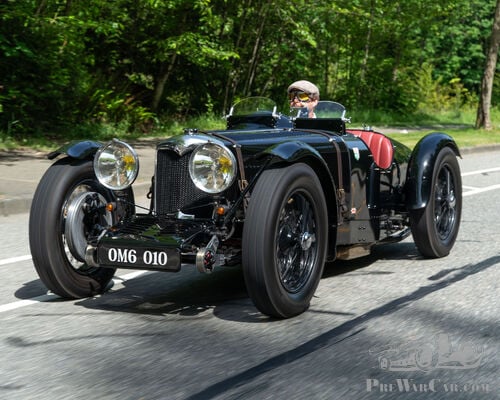
Riley 14/6 Special 1933
The ExperienceStep into the golden age of British motoring. This 1933 Riley 14/6 Special is a masterclass in pre-w..
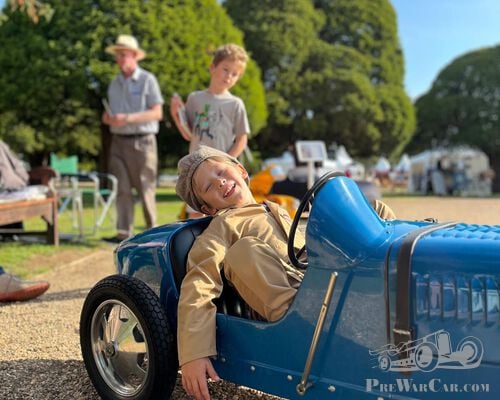
Bugatti type 52 Crosthwaite and Gardener
Bugatti Type 52 tool room copyThis is a Tool Room Copy of the junior electric cars modelled on Type 35s created for Bugattis clients I from..
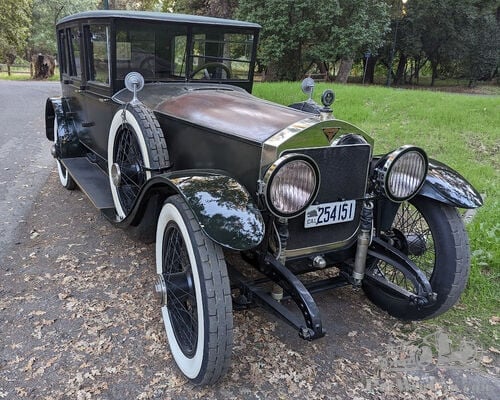
1916 Simplex, Crane model 5
1916 Simplex, Crane MODEL 5CUSTOM MADE HISTORIC PRESERVATION VEHICLE – READY TO TOUR!This Simplex recently completed th..