The global magazine and marketplace for classic car enthusiasts, by enthusiasts.


Filter
Classic Du Pont, Hupmobile for sale - Du Pont, Hupmobile cars for sale
-

1929 Du Pont Model G Two-Passenger Speedster by Merrimac | RM Sotheby's | The Monterey Auction
To Be OFFERED AT AUCTION at RM Sothebys' The Monterey Auction event, 13 - 15 August 2026. $800,000 - $1,200,000 USD One of the most beautiful American automobiles of its generationThe 1929 New York International Automobile Show display carOne of three two-passenger “taper tail” models with an external spareOne .. -
Mid 1920s Hupmobile R series open tourer project car
Mid 1920s Hupmobile R series open tourer project car. Chassis N° R 179775, castingnumber on engine 52900. Very good condition older restored chassis. Also work done on both engine and rearaxle. Radiator shell is straight but needs to be renickeled. A number of smaller parts are in boxes and not shown. Suitable inexpensive project car fo..


Du Pont
US, 1920 – 1932
(1) Du Pont Motors Inc, Wilmington, Del., 1920 – 1923
(2) Du Pont Motors Inc, Moore, Pa., 1923 – 1932
E. Paul du Pont’s company built quality cars in limited numbers, total production being 537 vehicles of all Du Pont types. First of the line was a Du Pont 4.1-litre sv four with their own engine, selling for $2.600, but this gave way to proprietary-engined sixes, initially powered by Herschell-Spillman. The 1925 Du Pont Model D had a 6-cylinder 5-litre Wisconsin engine with overhead valves that developed 75bhp, a constant-mesh gearbox, and Lockheed hydraulic brakes to all four wheels. Its successor, the Du Pont Model E, could be had with a supercharger, but the best-known, and best, Du Pont was the Du Pont Model G speedster introduced in 1928. With its narrow straight wings copied from the Amilcar, Woodlite headlamps and grille concealing the radiator, the last a pioneering feature, the Du Pont Model G was not a good-looking car, but it was a very effective one. Like all the DuPont speedsters it had four forward speeds. The 5.3-litre, sv straight-8 engine, by Continental, gave 114bhp at 3600rpm with catalogued modifications. With the latter, 100mph was guaranteed. In the 1929 Le Mans 24 Hours race the Du Pont Model G proved itself faster than the other American entries, Stutz and Chrysler. Touring bodywork was, of course, available on the Du Pont car, and in 1931 came the long wheelbase (12ft 2 in) Du Pont Model H, built in a Stearns Knight frame. The later Du Pont cars were assembled in the Indian motorcycle factory at Springfield, after E. Paul du Pont had acquired this concern.
Source: Georgano, encyclopedia of motorcar; TRN
The information is written with the greatest of care. However, if you have any suggested amendments please contact us at office@prewarcar.com
Hupmobile
US, 1908 – 1940
Hupp Motor Car Corp., Detroit, Mich.; Cleveland, Ohio
Robert and Louis Hupp, the founders of the Hupmobile company, started with a 2.8-litre 4-cylinder light runabout, with two bucket seats and a bolster tank, distinguished by a 2-speed sliding-type gearbox. This Hupmobile car sold for $750 and was joined in 1911 by a Hupmobile touring car with 3 forward speeds and a longer wheelbase of 9ft 2in, listed at only $900. Hupmobile, like Dodge and Chevrolet, adhered to the 4-cylinder sv unit for many years and made nothing else until 1924, though the Hupmobile cars acquired electric lighting and starting in 1914. A Hupmobile car with a 10ft 6in wheelbase was made available for seven-seater bodywork in 1916. Sales were good: 12.000 Hupmobile cars in 1913, and climbing up to 38.000 by 1923. By 1918 a rounded cowl and bonnet line had replaced the original angular configuration and fuel feed was by vacuum from a tank at the rear. Open Hupmobile car models were listed at $1.250. Aluminium pistons were featured in 1924 and balloon tyres on the Hupmobile car in 1925, the last year of the four. Interestingly enough, Hupmobile’s 4-litre straight-8 appeared in 1925, a year before the first six. This Hupmobile car was a conventional machine with contracting Lockheed hydraulic brakes, mechanical actuation being used on the 6-cylinder Hupmobile cars. The Hupmobile car company stayed in the medium-price field, sixes selling at $1.295 in 1929, while prices of the Hupmobile M-series sv eight started at $1.825. In 1929 Chandler’s plant in Cleveland was acquired and was used for the manufacture of the less expensive Huppmobile Hupps. Like most of America’s independent makes, the Hupmobile car company was hit hard by the Depression, sales of Hupmobile cars dropping from 50.374 in 1929 to 17.450 in 1931, although in the next two years, in 1932 and 1933 some very handsome Hupmobile cars were made.
In 1934 the Hupmobile Aerodynamic range with three-piece wrap-around windscreens and headlamps faired into the bonnet sides appeared. An experimental front wheel drive version was not proceeded with. The aerodynamic Hupmobile cars were made in 4-litre, 6-cylinder and 5-litre straight-8 forms, but sales were poor and the Hupmobile car factory closed down halfway through the 1936 season. It was reopened, but the 1937 and 1938 Hupmobile cars were of little interest apart from the standardization of automatic overdrive on the eights. Like Graham, Hupmobile tried to stay in business by adapting the body dies on the discontinued 810/812 Cord series to their conventional running gear. These Hupmobile Skylarks were built in the Graham factory; the last Hupmobile cars were completed in July 1940, but were sold as 1941 models.
Source: Georgano, encyclopedia of motorcar; MCS
The information is written with the greatest of care. However, if you have any suggested amendments please contact us at office@prewarcar.com


Featured
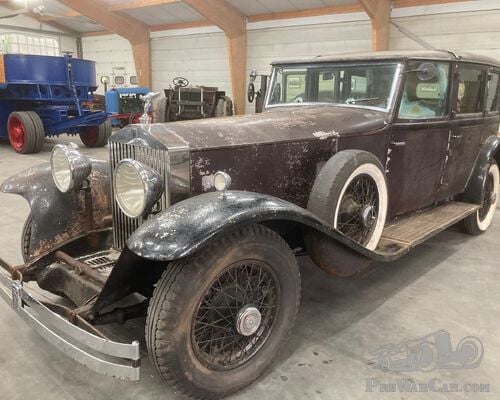
Rolls-Royce
Rolls-Royce Phantom ll chassisnummer 287 AJS. bouwjaar 1932, Links gestuurd, Brewster Keswick Sedance Towncar

Daimler Flat six 15 Saloon - Fluid Flywheel / pre-selector
The E20 was manufactured between 1935 and 1939. It offered the choice of a coachbuilt saloon, Sports Saloon, Fixedhead Coupé and Drophead Coupé bod..

Alfa 6C1750 Spider
Alfa 6C1750 Spider with complete history from delivery in 1930 to first owner in Firenze till today with copy Libretto/license plate all the years