The global magazine and marketplace for classic car enthusiasts, by enthusiasts.


Filter
Classic International, Hampton car for sale - International, Hampton car cars for sale
-

1901 International Charette 6HP - VCC Dated
1901 International Charette 6HP Double Phaeton Engine No. 62 Engine Displacement. 823VCC Dated 8 time London to Brighton finisher The International Motor Car Company, of London, England, was not related in any way to the more famous International Harvester Company of the United..

International
GB, 1898 – 1904
(1) International Motor Car Co, London, 1898 – 1900
(2) International Motor Car Co Ltd, London, 1900 – 1904
Oscar Seyd’s firm never built a car, though some International car offerings were assembled in their Great Portland Street Showrooms and a certain amount of work was also undertaken at the service depot in Kilburn, where International cars had been operating since 1896. The original International-Benz was in fact a French-built Roger, a car which had become hard to sell in France; International added their own improvements to the International car, among them a reverse, a British-built version of the ‘Crypto’ gear and bodywork made to their order. Single- and twin-cylinder variations on the Benz theme were offered until 1901, later International car being German-built after the demise of M. Roger’s company. In 1899 International presented a ‘light two-seater racing car’ with wheel steering, a Benz-based 12hp with wheel steering, pneumatic tyres and double phaeton coachwork on the International car at £800, and a 9hp ‘vibrationless’ flat-twin (not on Benz lines) in addition to their regular range of International car. International cars became a limited liability company in 1900, when two Coventry firms, Payne and Bates (Godiva) and Allard, were approached to make a new design for the International car. The Payne and Bates-built International car(possibly the twin-cylinder Royal with steel frame and wheel steering, offered for £367 10s) proved unsatisfactory, but Allard’s effort, the International Charette, introduced in November 1900, sold in some numbers. This International Charette car was a belt-driven light car with front vertical 823cc engine of De Dion type (designed to run at only 1.000rpm), a coal-shovel shaped bonnet and rack-and-pinion steering. It sold for £165. Early International cars were rated at 5hp (later increased to 6hp) and there were 2-speed and 3-speed variants. All International Charette chassis were delivered to London under their own power. This type International car was not offered after 1903 and apart form the Mountaineer motorcycle, the later cars of the International company were of French origin. The International Armstrong (1902) was a single-cylinder 1.100cc machine with shaft drive on Renault lines and this gave way in 1903 to the Aster-engined Portlands, also shaft-driven and offered in a variety of sizes from a 6hp single at £205 up to a big 24hp 4-cylinder car with a 4-speed gearbox.
The smallest International car, the Portland was still available in 1904, but by this time the International car company was mainly concerned with importing the Diamant car. International were defunct by 1905.
US, 1900
International Motor Carriage Co, Stamford, Conn.
This International car company showed a light car with a 2-stroke engine designed to run on paraffin at the Madison Square Garden show in 1900, but this International car did not go into production.
Source: Georgano, encyclopedia of motorcar; MCS, GNG
The information is written with the greatest of care. However, if you have any suggested amendments please contact us at office@prewarcar.com
Hampton
GB, 1911 – 1933
(1) Hampton Engineering Co, Hampton-in-Arden, Warwickshire, 1911
(2) Hampton Engineering Co Ltd, King’s Norton, Birmingham, 1912 – 1919
(3) Hampton Engineering Co Ltd, Dudbridge, Stroud, Glos., 1919 – 1920
(4) Hampton Engineering Co (1920) Ltd, Dudbridge, Stroud, Glos., 1920 – 1925
(5) Stroud Motor Manufacturing Co Ltd, Dudbridge, Stroud, Glos., 1926
(6) Hampton Cars (London) Ltd, Dudbridge, Stroud, Glos., 1927 – 1930
(7) Safety Suspension Car Co Ltd, Cainscross, Stroud, Glos., 1931 – 1933
W. Paddon sold other people’s cars before deciding that he could build equally well himself; the Hampton. From 1912, he followed a one-model policy: the Hampton 12/16, a conventional 4-cylinder of 1.726cc, based on imported proprietary parts. A heavier Hampton Colonial version was also listed. In 1914, with light cars fashionable, a 2-cylinder 2-stroke of Hampton’s own manufacture was announced, with pressed-steel frame and bevel drive. This Hampton model was soon withdrawn, and buyers were offered instead, a choice of a true Hampton cyclecar with an 8hp air-cooled Precision twin, 3-speed countershaft gears and belt final drive, or a conventional light car, with a 1.244cc Chapuis-Dornier engine. For the post-war expansion of Hampton, part of a large ironworks was taken over in Gloucestershire. The first Hampton model made there was the Hampton 10/16 of 1919, with a 1.496cc ohv Dorman 4KNO engine. Pre-war type light car chassis were used, with variations in the wheelbase and with vacillation between half and three-quarter elliptic rear suspension. The following year a 1.795cc version was marketed, also powered by Hampton Dorman. The Hampton firm made their own gearboxes, and Lucas or Brolt electrical equipment was available.
Near the beginning of 1920 output was running at six Hampton cars per week; by the end of the year the Hampton company had suffered the first of its reformations. Designs were altered in detail only for 1921 and 1922. This period was marked by various sporting successes of Hamton cars, in addition to the climbs of the notorious 1 in 2½ acclivity of Nailsworth Ladder both before and after the war. J.W. Leno managed a ‘gold’ with a Hampton car in the 1924 Scottish 1.000 miles trial; Brian Marshall lapped Brooklands at over 89mph in 1922. For 1923, the 1.795cc was known as the Hampton 11/35, and the Hampton 9/21 Junior of 1.247cc was introduced, Meadows engines now being used. In 1924 a Hampton 14hp of 2.121cc was added to the range, whilst the Hampton 12hp (formerly 11/35) shrank to 1.496cc and acquired early front wheel brakes. Then the Hampton firm failed again. They were resuscitated by W.F. Milward, the Hampton works manager, aided by Leno and G. Dixon. Marginal improvements to the Hampton 12 were announced in late 1925, including a 3-bearing crank and more wheelbase variatrions. Similarities between Hampton cars of this date and Charron-Laycocks may not have been entirely co-incidental, since both Milward and Dixon had been with that firm. More capital appeared in 1927, when Hampton Cars (London) Ltd was formed. This year’s reorganization retained the Hampton 12hp as the Hampton 12/40, and added the Hampton 15/45, a 6-cylinder of 1.683cc. By 1928, 300 Hampton cars a year were being turned out, including the year’s new model, the Hampton 9hp; mechanically similar to the old Hampton Junior, this was usually made in clumsy fabric or metal saloon bodywork. For 1929 the Hampton 9hp and Hampton 12/40hp were continued, and a 6-cylinder Hampton 20hp was added, with the 2.931cc ohv Meadows engine.
With the trade recession menacing, the Hampton firm started to offer, as variants on the trusty Hampton 12/40, a supercharged sports model and adjustable rear suspension borrowed from the Hodgson. By 1930 they were involved with the Cowburn gearbox, incorporating coned rollers in place of gears, dependent on degrees of friction regulated by little coil springs. When Meadows credit ran out, the Hampton 12/40 was replaced by another 12hp of only 1.196cc, possibly of their own manufacture, whilst 100ohv straight-8 engines of 2.262cc, with 50 matching chassis, were optimistically ordered from Röhr in Germany. This Hampton chassis was based on a sheet-steel tray, with independent suspension by double transverse half-elliptics at the front and long cantilevers at the rear. Hampton models originally listed for 1931 were a revived 12/40, the continued 9hp and 20hp, and the Röhr-engined 18hp, in Röhr or Hampton chassis to choice. All these were later withdrawn, the short-stroke Hampton 12hp (80mm) became available again, and an sv 4-bearing 6-cylinder of 2.414cc was obtainable in either type chassis, at £150 difference in price. The Hampton car firm inevitably expired once more, but the 8-cylinder re-appeared ephemerally in Röhr’s 1931 size of 2½-litres. The receiver, Thomas Godman, formed a new company to offer the Röhr chassis with a choice of the sv 6-cylinder or the 1932 Röhr engine, now of 2.736cc. It is unlikely that any of these were sold, and the last Hampton made was probably Milward’s personal special, a Röhr-type car constructed from parts acquired at the Dudbridge works sale, and used by him up to World War 2.
Source: Georgano, encyclopedia of motorcar; DF
The information is written with the greatest of care. However, if you have any suggested amendments please contact us at office@prewarcar.com


Featured
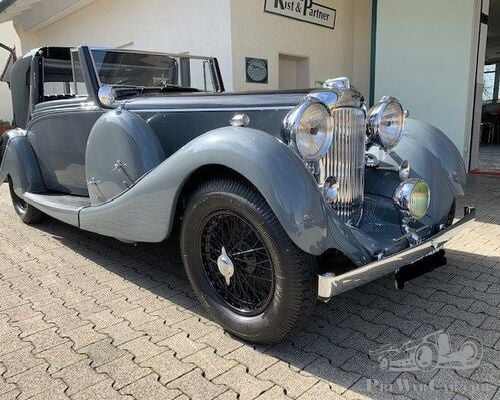
Lagonda LG 45 Coupe de Ville Sedanca by Mayfair
The successor to the M45, the LG45 was built around the same highly capable, competition-proven 4.5-litre Meadows inline-six engine, but featured r..
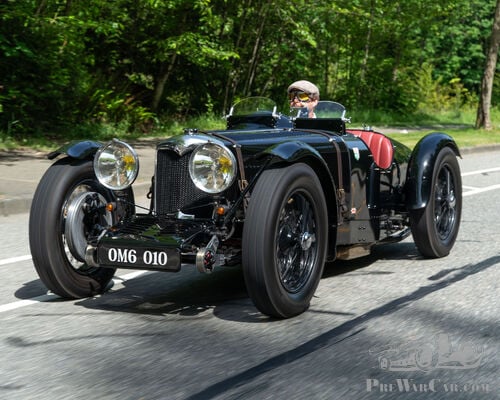
Riley 14/6 Special 1933
The ExperienceStep into the golden age of British motoring. This 1933 Riley 14/6 Special is a masterclass in pre-w..

1915 Rolls-Royce Silver Ghost Barker Tourer
⁃ An exceptionally rare original bodied pre-war Silver Ghost⁃ Desirable Barker tourer in exciting barn find condition⁃ ..