The global magazine and marketplace for classic car enthusiasts, by enthusiasts.


Filter
Classic H.R.G., International for sale - H.R.G., International cars for sale
-

1901 International Charette 6HP - VCC Dated
1901 International Charette 6HP Double Phaeton Engine No. 62 Engine Displacement. 823VCC Dated 8 time London to Brighton finisher The International Motor Car Company, of London, England, was not related in any way to the more famous International Harvester Company of the United..

H.R.G.
GB, 1936 – 1956
HRG Engineering Co Ltd, Tolworth, Surrey
The initials of the HRG car stand for E.A. Halford, G.H. Robins, and H.R. Godfrey (the ‘G’ of GN. Their HRG car was intended to carry on the Frazer Nash tradition of a vintage-style sporting machine without frills, though the HRG used bevel drive and not chains. The engine of the HRG car was the well-tried 1.496cc ohv 4-cylinder Meadows 4ED, ignition was by magneto, suspension was quarter-elliptic at the front and semi-elliptic at the rear, and the body a straight forward slab-tank two-seater. The HRG car sold for £395 and with a weight of about 1.570lb it was capable of some 90mph. In 1938 an HRG car was the highest-placed British car at LeMans, and the following year HRG won the 1½-litre class there. For 1939 pump-cooled ohc Singer engines were adopted on HRG car models, an ‘1100’ using that firm’s 9hp unit joining the 1½-litre. Synchromesh gearboxes and coil ignition were introduced, but magnetos were still optional until the demise of the traditional HRG cars at the end of 1955. A solitary HRG coupé used a Triumph engine.
There were few changes when the HRG cars reappeared on the market in 1946, though there was a short-lived HRG Aerodynamic 1500 with full-width bodywork. A distinguished competition record with HRG cars included Coupes des Alpes in 1948 and 1951 Alpine Rallies (a little-known HRG innovation was the provision of a works van to support drivers of the HRG cars in the 1949 event, forerunners of today’s rally ‘circuses’), class wins in the 1949 and 1950 Production Car Races at Silverstone, and a clean sweep of the 1½-litre class in the 1949 Belgian 24-Hour Race. Curiously enough, the zenith of the HRG cars competition career coincided with a drop in sales: approximately 40 HRG cars were delivered in 1948, 25 in 1949 and only 11 in 1950. The traditional HRG car, however, survived until 1955; a twin-cam head announced in 1953 was never actually offered on this model, but the last 12 HRG WS-types (all of which were exported) had the short-stroke Singer engine and hydraulic brakes in place of the cable-operated type used since 1936. An altogether more modern 1½-litre HRG car prototype (the ‘1100’ had been dropped around 1950) with all-round independent suspension, disc brakes, twin ohc engine and aerodynamic body work, made its appearance in 1955, but this was not produced in series and HRG concentrated on general engineering until the HRG company closed down in 1966. A few months before the end a last HRG car prototype had appeared, using the Vauxhall VX 4/90 engine. Not more than 240 HRG cars of all types were made.
Source: Georgano, encyclopedia of motorcar; MCS
The information is written with the greatest of care. However, if you have any suggested amendments please contact us at office@prewarcar.com
International
GB, 1898 – 1904
(1) International Motor Car Co, London, 1898 – 1900
(2) International Motor Car Co Ltd, London, 1900 – 1904
Oscar Seyd’s firm never built a car, though some International car offerings were assembled in their Great Portland Street Showrooms and a certain amount of work was also undertaken at the service depot in Kilburn, where International cars had been operating since 1896. The original International-Benz was in fact a French-built Roger, a car which had become hard to sell in France; International added their own improvements to the International car, among them a reverse, a British-built version of the ‘Crypto’ gear and bodywork made to their order. Single- and twin-cylinder variations on the Benz theme were offered until 1901, later International car being German-built after the demise of M. Roger’s company. In 1899 International presented a ‘light two-seater racing car’ with wheel steering, a Benz-based 12hp with wheel steering, pneumatic tyres and double phaeton coachwork on the International car at £800, and a 9hp ‘vibrationless’ flat-twin (not on Benz lines) in addition to their regular range of International car. International cars became a limited liability company in 1900, when two Coventry firms, Payne and Bates (Godiva) and Allard, were approached to make a new design for the International car. The Payne and Bates-built International car(possibly the twin-cylinder Royal with steel frame and wheel steering, offered for £367 10s) proved unsatisfactory, but Allard’s effort, the International Charette, introduced in November 1900, sold in some numbers. This International Charette car was a belt-driven light car with front vertical 823cc engine of De Dion type (designed to run at only 1.000rpm), a coal-shovel shaped bonnet and rack-and-pinion steering. It sold for £165. Early International cars were rated at 5hp (later increased to 6hp) and there were 2-speed and 3-speed variants. All International Charette chassis were delivered to London under their own power. This type International car was not offered after 1903 and apart form the Mountaineer motorcycle, the later cars of the International company were of French origin. The International Armstrong (1902) was a single-cylinder 1.100cc machine with shaft drive on Renault lines and this gave way in 1903 to the Aster-engined Portlands, also shaft-driven and offered in a variety of sizes from a 6hp single at £205 up to a big 24hp 4-cylinder car with a 4-speed gearbox.
The smallest International car, the Portland was still available in 1904, but by this time the International car company was mainly concerned with importing the Diamant car. International were defunct by 1905.
US, 1900
International Motor Carriage Co, Stamford, Conn.
This International car company showed a light car with a 2-stroke engine designed to run on paraffin at the Madison Square Garden show in 1900, but this International car did not go into production.
Source: Georgano, encyclopedia of motorcar; MCS, GNG
The information is written with the greatest of care. However, if you have any suggested amendments please contact us at office@prewarcar.com


Featured
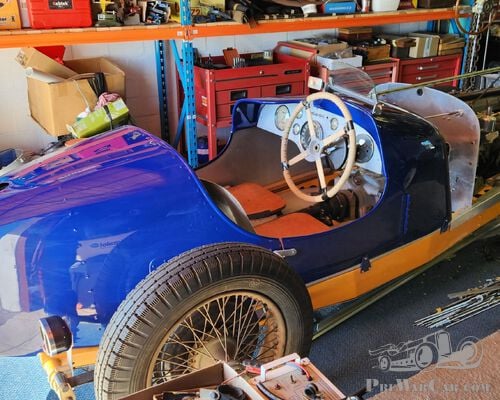
Riley TT Sprite
1935 6-cylinder TT Sprite replica. Chassis # 46A2722. Engine # 6A2722. Original Ulster Imp body. Restoration nearing completion. Engine, Ge..
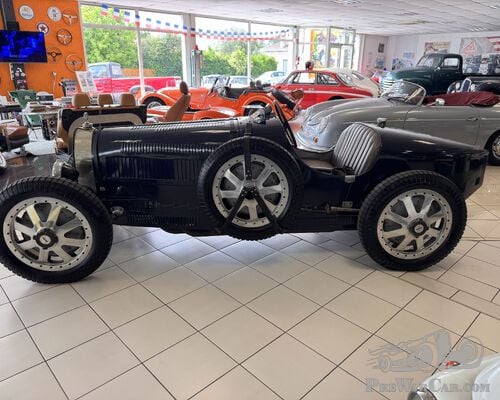
Bugatti 35 B Pur Sang
Bugatti 35 B Pur Sang,importée par un membre délégué de la FFVE il y’a une quinzaine d années.Participation à de nombreux Rallyes Bug..