The global magazine and marketplace for classic car enthusiasts, by enthusiasts.


Filter
Classic Isotta Fraschini, Stoewer for sale - Isotta Fraschini, Stoewer cars for sale
-

Isotta Fraschini 8A Cesare Sala
This 1927 Tipo 8A was delivered from the factory to coachbuilder Cesare Sala in Milan. One of Italy’s most prestigious and skilled coachbuilders, Sala was a popular choice for Isotta’s customers, together with fellow Milan concern Castagna. Sala had made its name in the pre-automobile era, supplying fine horse-drawn carriages to European royalty.. -
Short wheelbase 1930 Isotta Fraschini tipo 8A project
Short wheelbase 1930 Isotta Fraschini tipo 8A project. Enginenumber 1420 Chassisnumber unknown. Wheelbase 3400mm. Rare and ideal opportunity to complete this exciting project of the famous Isotta. The engine is in good condition and turns over freely with a healthy compression. The car has the big hubs with matching wheels as used on some 8A and 8A.. -
1924 Stoewer type D3 roadster
Rare opportunity to buy a vintage 1924 Stoewer type D3 roadster in fully restored condition. More than € 50K were spent in 2018 and 2019 on its restoration . Detailed work invoices come with the car. A video can be sent on request . Price € 64000 ex Eibergen Netherlands imported EEC.


Isotta-Fraschini
Italy, 1900 – 1949
(1) Società Milanese d’Automobili Isotta, Fraschini & Cia, Milan, 1900 – 1904
(2) Fabbrica Automobili Isotta-Fraschini, Milan, 1904 – 1949
Cesare Isotta and Vincenzo Fraschini went into partnership in 1899, importing French cars (Mors, Renault) and proprietary engines (Aster); when their company was floated a year later the first Isotta Fraschini cars to bear their names were thinly disguised Renaults with shaft drive and 5hp single-cylinder Aster power units. A 12hp twin Isotta Fraschini car appeared in 1902, but the first wholly Italian designed Isotta Fraschini cars were not seen until 1903. These new Isotta Fraschini cars followed the fashionable Mercédès idiom with pair-cast 4-cylinder engines, side valves in a T-head, low tension magneto ignition, 4-speed gearboxes and side-chain drive. Initially three Isotta Fraschini carmodels were listed – a 4.180cc Isotta Fraschini 12, a 5.426cc Isotta Fraschini 16 and a 7.433cc Isotta Fraschini 24 – and there were few major changes until 1908, though foot accelerators and high tension ignition came in 1906 on Isotta Fraschini cars, and compressed-air starters were offered briefly in 1907, when the largest Isotta Fraschini carcar in the catalogue was the 11.3-litre Isotta Fraschini Tipo C.
Like FIAT and Itala, theIsotta Fraschini carfirm was quick to recognize the prestige value of racing: in 1905 they built an unsuccessful 17.2-litre machine with gear-driven ohc; in 1907 Minoia won the Coppa Florio with a Isotta Fraschini car; and in 1908 Trucco won the Targa Florio. The last year brought numerous successes in the USA, where 40 Isotta Fraschini cars were sold. By 1906 Isotta Fraschini were Italy’s second-ranking manufacturers, after FIAT, but they were hard hit by the Agadir Crisis, and in 1907 there was a successful takeover bid by Lorraine-Dietrich of France, whose intention it was to integrate the Milan Isotta Fraschini car-factory into their organization. By 1909, however, Isotta Fraschini were independent again and had sold a manufacturing licence to Praga in Prague.
A novelty in 1908 was a 1.327cc racing voiturette with ohc 4-cylinder monobloc engine said to run up to 3.500rpm; this Isotta Fraschini car went into limited production as the FENC type. More important, a successful uncoupled 4-wheel braking system was evolved by Oreste Fraschini and Giustino Cattaneo (who had joined theIsotta Fraschini car firm in 1905 and was to be responsible for all Isotta Fraschini cars up to 1935). This was available on production Isotta Fraschini cars by 1911, and three years later was standardized on the larger Isotta Fraschini cars. The 1909 range included a modern sv monobloc four, the ENC, available in 2.1-litre and 2.2-litre forms, though the old combination of T-head engine and chain drive persisted until 1913. The smaller Isotta Fraschini cars of 1914 closely paralleled the offerings of FIAT and Itala, coming in 2.3-litre, 3-litre and 4.4-litre sizes, with monobloc engines, 4-speed gearboxes, and optional electrics. However, for the enthusiast the Isotta Fraschini car company offered some 16-valve ohc sports cars with 4-wheel brakes and chain drive – the 6.2-litre Isotta Fraschini TM and the 10.6-litre Isotta Fraschini KM. The latter boasted dual magneto ignition, could be had with pear-shaped or V-radiator, and this Isotta Fraschini car was capable of 85-90mph on 140bhp. A Isotta Fraschini car with 130bhp 7.2-litre engine was raced unsuccessfully at Indianapolis in 1913, and there was also a shaft-driven variant of the TM, designated the Isotta Fraschini TC.
After World War 1 Cattaneo switched to a one-model Isotta Fraschini car programme with the Isotta Fraschini Tipo 8, a 5.880cc 9-bearing pushrod ohv straight-8 with alloy block, magneto ignition, 3-speed unit gearbox, central ball change, multi-plate clutch, semi-elliptic springing, and coupled 4-wheel brakes. Output was 80bhp at a low 2.200rpm, and the Isotta Fraschini car was conceived from the start as a chauffeur-driven carriage – hence the ponderous handling that attracted unfavourable comparisons with the contemporary 32CV Hispano-Suiza. Most straight-8s were exported: of 1.370 delivered Isotta Fraschini cars between 1919 and 1935 about 450 went to the United States and there were agencies in eight foreign capitals. In 1925 the Isotta Fraschini Tipo 8 gave way to the 7.4-litre Isotta Fraschini 8A with servo brakes, higher gear ratios, and an output of 110 – 120bhp; the 135 bhp Isotta Fraschini 8ASS sports version was said to do 104mph. By 1929 a Isotta Fraschini carlimousine cost £2.900 in London or $22.750 in New York. Two years later came the last of Isotta Fraschini car with a straight-8, the Isotta Fraschini 8B. This had a redesigned engine capable of 3.000rpm, coil ignition, and a stiffer and deeper frame; from 1932 Isotta Fraschini car was available with a 4-speed preselective gearbox, a conversion initiated by Antione Lago, then the Isotta Fraschini company London agent. In 1934 a 4-speed synchromesh box was offered, but by now sales were down to a trickle (only 25-30 8Bs were made all told, as against 950 8As) and the Isotta Fraschini car company, after unsuccessful negotiations for a merger with Henry Ford, elected to concentrate on aero engines. In 1936 Isotta Fraschini joined the Caproni organization, and their only roadgoing products were diesel trucks made under MAN-licence.
There was a final comeback of Isotta Fraschini cars in 1947 with the Rapi-designed 8C Monterosa – Isotta Fraschini never marketed a six. This Isotta Fraschini car had a 90 degrees ohc V8 engine mounted at the rear of a platform chassis, with independent front suspension by rubber in compression and swing-axle rear suspension. The 5-speed all-synchromesh gearbox incorporated an overdrive top, brakes were hydraulic, and a curious feature was an ignition warning light that went out in the event of trouble. Various cylinder capacities were tried: the 1947 Paris Salon Isotta Fraschini car had a 3.4-litre unit, but production models were to have had 2.544cc engines. Prototype Isotta Fraschini cars wore aerodynamic convertible and closed coachwork by Touring of Milan, but less than 20 Isotta Fraschini 8Cs had been built when the factory was shut down by order of the Italian government. The name Isotta Fraschini was acquired by the Breda armaments firm, who attempted a revival of the diesel commercial vehicle range as late as 1958
Source: Georgano, encyclopedia of motorcar; MCS
The information is written with the greatest of care. However, if you have any suggested amendments please contact us at office@prewarcar.com
Stoewer
D, 1899 – 1939
(1) Gebrüder Stoewer, Fabrik für Motorfahrzeuge, Stettin, 1899 – 1916
(2) Stoewer-Werke AG vorm. Gebr. Stoewer, Stettin, 1916 – 1939
The Stoewer car factory developed out of the Stoewer ironworks and was among the pioneers of the German car industry. After manufacturing motor cycles, tricycles and quadricycles for two years, Stoewer turned to cars in 1899. The first Stoewer car had a rear-mounted 2-cylinder engine. 4-cylinder Stoewer cars followed in 1901, and electric Stoewer cars were also produced. Best known were the 2-cylinder Type T Stoewer car (2.280cc and 3/12PS), the 4-cylinder Stoewer P4 (3.052cc and 11/22PS), the Stoewer G4 (1.500cc and 6/12PS) and the 6-cylinder Stoewer P6 (8.820cc and 34/60PS), evolved in the 1905-1907 period all Stoewer cars with shaft-drive. The Stoewer B1 of 6/16PS and the Stoewer B6 of 9/22PS which appeared in 1910 were also built by Mathis under licence. The G4 Stoewer car was the basis for the Stoewer B5, which Stoewer car in 1912 became famous by setting up a record at Brooklands with 67.7mph. The new range of Stoewer cars which appeared in 1913 was also based on successful earlier cars. They were the Stoewer C1 (6/18PS), Stoewer C2 (10/28PS) and C3 Stoewer car (6-cylinder and 19/45PS). Shortly before the outbreak of World War 1 the Stoewer car range was headed by the F4 Stoewer car with a 4-cylinder, 8.8-litre 33/100PS ohc engine. After the war an enormous Stoewer car appeared, the Stoewer D7, using a 6-cylinder 11.2-litre 42/120PS aero engine, as well as some conservative sv 4- and 6-cylinder Stoewer cars with rear wheel and transmission brakes. Front wheel brakes appeared on Stoewer cars in 1925. Stoewer introduced 8-cylinder Stoewer cars in 1928. These were the Stoewer Superior, Stoewer Marschall, Stoewer Gigant and Stoewer Repräsentant with engines ranging from 2-litres and 45bhp to 4.9-litres and 100bhp. The Stoewer car firm re-entered the economy class in 1931 with the V5, a front-driven Stoewer car with a V4 1.188cc engine, followed by the front-drive models R140 (1.369cc), R150 (1.488cc) and R180 (1.769cc). Another 8-cylinder was the front wheel drive Greif V8 with a 2.488cc engine, which was replaced by the conventional 6-cylinder 3.609cc Arcona Stoewer car in 1938. In 1934 the 1½-litre 4-cylinder Stoewer car and 2½-litre V8 Stoewer car were shown at the Brussels Salon by Monsieur Dewaet under the name D.S. (Dewaet-Stoewer). The Greif Junior was built under Tatra licence with an opposed 4-cylinder 1.474cc engine. It succeeded the Röhr Junior. In the middle of the range was the Stoewer Sedina with a 4-cylinder engine of 2.4-litres.
Production of private Stoewer cars was given up at the outbreak of World War 2 in 1939. The Stoewer car factory was destroyed during the war and production of Stoewer cars was not resumed.
Source: Georgano, encyclopedia of motorcar; HON
The information is written with the greatest of care. However, if you have any suggested amendments please contact us at office@prewarcar.com


Featured

K3 Replica on KN Chassis
"The K3 Magnette must rank in the history books as the most famous and successful of all the record breaking MGs. With only 33 examples produced durin..
Rolls-Royce
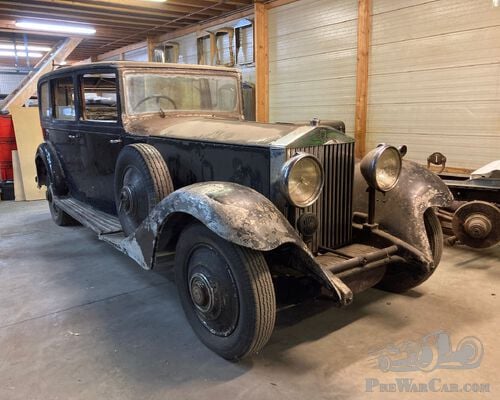
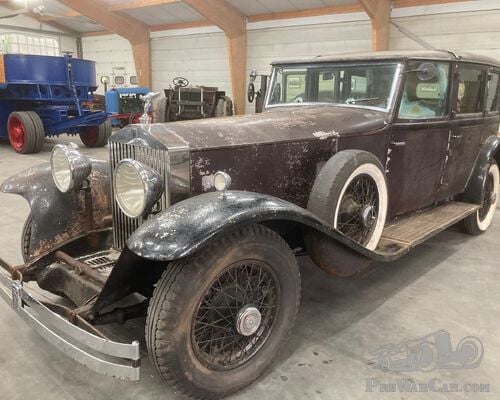
Rolls-Royce Phantom ll chassisnummer 287 AJS. bouwjaar 1932, Links gestuurd, Brewster Keswick Sedance Towncar