The global magazine and marketplace for classic car enthusiasts, by enthusiasts.


Filter
Classic Donnet/ Donnet-Zédel, Jaguar SS for sale - Donnet/ Donnet-Zédel, Jaguar SS cars for sale
-

1939 SS Jaguar 1.5 litre Drophead Coupe | Reeman Dansie Auction | 20th Jun, 2026
Reg. no. FXE 374Chassis no. 56493. Believed one of only eighteen survivors worldwide and owned since 1963. A beautiful multi-prize-winning, well-cared for example with extensive history and benefiting from a unique long-term ownership and very rare.This very special SS Jaguar was bought by Peter Pearson f.. -
1935 JAGUAR SS100 2.5 LITRE
1935 Jaguar SS100 2.5 Litre Chassis number: 18010Registration Number: AD-48-86 (Portugal) In the current ownership since 1998; this Jaguar was purchased new by a Mr Luxton & exported to Australia where it gained an extensive racing history though the 1940's up to 1950. It was purchased to form part of a pr.. -
1937 SS Jaguar 100
•One of only 198 2½-litre cars to be built•Wonderful original condition and driving extremely well•History file includes period brochures, magazines and photographs•A well-travelled car having enjoyed ownerships in both England and America•Arguably one of the most beautiful cars of its time With its low, underslung chassis .. -
1935 SS1 20hp Tourer
Technical Specification:Mark & Model: SS1 20hp TourerYear: 1935Registration plate: Jersey registeredChassis Number: 248809Engine Capacity: 2663 ccTransmissions: 4 speed manualMileage: 45,227 (recorded)Body style: TourerInterior color: Green leatherExterior color: re.. -
1939 SS100 Jaguar 3½ Litre Open Sports
A fabulous example of 1 of just 116 of the 3½ Litre versions built & with a remarkable ownership record spanning 70 years with one person! The car was bought by the last owner in 1955 & has been cherished since then. The car was raced in the early post-war years, 1948 to 1952, at which time it had cycle wings fitted. Then, and since, the ca.. -
1939 Jaguar SS100
This car is one of the last SS100's produced, being registered in April 1939 by Birmingham dealer P.J. Evans to first owner Denis Patterson. Within a month of taking delivery Patterson was competing in the RSAC Scottish Rally in the car. The original buff continuation logbook contained in the history file, issued some time prior to 1954, records.. -
SS 2 12 HP Fixed Head Coupe - part restored
Technical SpecificationMark & Model: SS 2 12 HP Fixed Head Coupe Year: 1935 Registration plate: UK registeredChassis Number: 300917 Engine Number: 300964 Engine Capacity: 1479cc Transmission: Manual Mileage : Body style: 2-door coupe Interior .. -
1936 Jaguar SS100 2.5 / 3.5 Litre
1936 Jaguar SS100 2.5 / 3.5 Litre Chassis number: 18003 Registration Number: Austrian Plates. Formerly BOX878 UK plate. European Taxes paid. The third example ever produced. This car comes with extensive USA race history & in 1961 was upgraded to 3.5 Litre spec with a correc..


Donnet / Donnet-Zédel
France, 1924 – 1934
SA des Automobiles Donnet, Nanterre, Seine; Neuilly, Seine, Pontarlier, Doubs.
After Zédel and Vinot et Deguingand ceased production, Donnet, a new company constituted from them in 1924, offered two new cars called Donnet-Zédel. A light car was made, the 7CV Donnet-Zedel Type G, which had a side-valve 4-cylinder engine of 1100cc and (unusual for so small a vehicle) a 4-speed gearbox. It was a solidly-built machine, and a Donnet-Zedel sports model was listed. There was, in addition, a medium-sized four of about 2¼-litres. From 1926, the Donnet-Zedel firm came to concentrate upon a 2½-litre six, also with side valves, which proved a popular car. Another, smaller six with 1.3-litres (later 1.8-litre) Sainturat-designed engine was also offered by Donnet-Zedel. In the 1932 range however, was a new small Donnet-Zedel car in the shape of a 750cc 2-stroke. This, a violet design, had been sold as the Dequingand until 1930. A fwd 2-litre 6-cylinder Donnet-Zedel, shown at the 1931 Paris Salon came to nothing. With the demise of Donnet, Simca took over the Donnet-Zedel factory.
Source: Georgano, encyclopedia of motorcar; TRN
The information is written with the greatest of care. However, if you have any suggested amendments please contact us at office@prewarcar.com
Jaguar SS
GB, 1931 to date
(1) Swallow Coachbuilding Co Ltd, Coventry, Warwickshire, 1931 – 1934
(2) S.S. Cars Ltd, Coventry, Warwickshire, 1934 – 1945
(3) Jaguars Cars Ltd, Coventry, Warwickshire, 1945 to date
William Lyons and William Walmsley started the manufacture of sidecars in Blackpool in 1922, following this up in 1927 with a line of handsome open and closed sporting bodies on popular chassis such as Austin, Morris, Fiat, Swift and Standard. The company moved to Coventry in 1928, and from the Swallow saloon version of the 16hp Standard came the first SS I of 1931. This used Standard mechanical components throughout, but a special underslung frame was made for the Swallow through the 2.054cc 6-cylinder sv engine was left untuned. The long bonnet, diminutive coupé body and helmet-type front wings gave it a distinctive look, which suggested a price in the region of £1.000 – the SS I car, in fact, cost £310. A 2½-litre 20hp engine was available, and there was a companion SS II car based on the 1.052cc Standard Little Nine. A sale of 776 SS machines the first season was remarkable for a new make at the depths of the Depression. The 1933 6-cylinder SS car models with full-flow wings were better proportioned, and a sports tourer by SS was available for the first time. 1934 SS cars had X-braced frames, synchromesh gearboxes, and larger and more powerful engines – the 2.7-litre SS Twenty gave 68bhp. Twin carburetors and a higher-lift camshaft featured on SS cars in 1935, in which year the SS car company’s first sports car made its appearance: this SS 90 was sold only with the 20hp engine, and had a short chassis and slab-tank two-seater bodywork.
The Jaguar name first appeared in 1936, on a handsome 4-door Jaguar sports saloon, with a 2.7-litre ohv 104bhp engine, still made by Standard, but redesigned by Harry Welake and W.M. Heynes. These Jaguar cars were good for 85 – 90mph and the Jaguar car sold for only £385. The sv SS I and SS II models were continued for one more season with Standard engines, a Standard unit also being used in the 1.6-litre version of the Jaguar car, but much more exciting was the short-chassis ohv Jaguar SS 100 two-seater. Its handling was tricky, but it proved hard to beat in British rallies of the later 1930s. In 1938 the 2½-litre was continued, but the small sv four had given way to a 1.8-litre unit, used after the war by Standard in their versions of the Triumph. A new 125bhp 3½-litre was listed not only in saloon and drophead coupé forms, but also as a SS 100 two-seater, offering a genuine 100mph for only £445. Over 5.000 SS cars were sold in a year interrupted by war. The 1940 SS models were available with heaters.
In 1945 the SS name of the company was changed to Jaguar Cars Ltd, and the sidecar interests were sold. Under idderent ownership the Swallow company was responsible for the Swallow Doretti in 1954.
Source: Georgano, encyclopedia of motorcar; MCS
The information is written with the greatest of care. However, if you have any suggested amendments please contact us at office@prewarcar.com



Featured

Lagonda LC Tourer 1934
The Lagonda story began in 1901 in Staines, a small town in the UK. The company enjoyed its greatest successes around 1935. During this period, the..
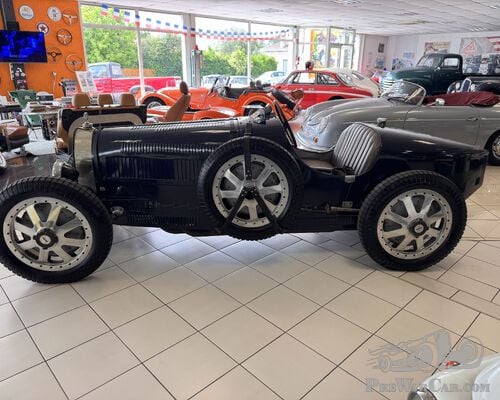
Bugatti 35 B Pur Sang
Bugatti 35 B Pur Sang,importée par un membre délégué de la FFVE il y’a une quinzaine d années.Participation à de nombreux Rallyes Bug..