The global magazine and marketplace for classic car enthusiasts, by enthusiasts.


Filter
Classic Jaguar SS, Vulcan for sale - Jaguar SS, Vulcan cars for sale
-

1939 SS Jaguar 1.5 litre Drophead Coupe | Reeman Dansie Auction | 20th Jun, 2026
Reg. no. FXE 374Chassis no. 56493. Believed one of only eighteen survivors worldwide and owned since 1963. A beautiful multi-prize-winning, well-cared for example with extensive history and benefiting from a unique long-term ownership and very rare.This very special SS Jaguar was bought by Peter Pearson f.. -
1935 JAGUAR SS100 2.5 LITRE
1935 Jaguar SS100 2.5 Litre Chassis number: 18010Registration Number: AD-48-86 (Portugal) In the current ownership since 1998; this Jaguar was purchased new by a Mr Luxton & exported to Australia where it gained an extensive racing history though the 1940's up to 1950. It was purchased to form part of a pr.. -
1937 SS Jaguar 100
•One of only 198 2½-litre cars to be built•Wonderful original condition and driving extremely well•History file includes period brochures, magazines and photographs•A well-travelled car having enjoyed ownerships in both England and America•Arguably one of the most beautiful cars of its time With its low, underslung chassis .. -
1935 SS1 20hp Tourer
Technical Specification:Mark & Model: SS1 20hp TourerYear: 1935Registration plate: Jersey registeredChassis Number: 248809Engine Capacity: 2663 ccTransmissions: 4 speed manualMileage: 45,227 (recorded)Body style: TourerInterior color: Green leatherExterior color: re.. -
1939 SS100 Jaguar 3½ Litre Open Sports
A fabulous example of 1 of just 116 of the 3½ Litre versions built & with a remarkable ownership record spanning 70 years with one person! The car was bought by the last owner in 1955 & has been cherished since then. The car was raced in the early post-war years, 1948 to 1952, at which time it had cycle wings fitted. Then, and since, the ca.. -
1939 Jaguar SS100
This car is one of the last SS100's produced, being registered in April 1939 by Birmingham dealer P.J. Evans to first owner Denis Patterson. Within a month of taking delivery Patterson was competing in the RSAC Scottish Rally in the car. The original buff continuation logbook contained in the history file, issued some time prior to 1954, records.. -
SS 2 12 HP Fixed Head Coupe - part restored
Technical SpecificationMark & Model: SS 2 12 HP Fixed Head Coupe Year: 1935 Registration plate: UK registeredChassis Number: 300917 Engine Number: 300964 Engine Capacity: 1479cc Transmission: Manual Mileage : Body style: 2-door coupe Interior .. -
1936 Jaguar SS100 2.5 / 3.5 Litre
1936 Jaguar SS100 2.5 / 3.5 Litre Chassis number: 18003 Registration Number: Austrian Plates. Formerly BOX878 UK plate. European Taxes paid. The third example ever produced. This car comes with extensive USA race history & in 1961 was upgraded to 3.5 Litre spec with a correc..


Jaguar SS
GB, 1931 to date
(1) Swallow Coachbuilding Co Ltd, Coventry, Warwickshire, 1931 – 1934
(2) S.S. Cars Ltd, Coventry, Warwickshire, 1934 – 1945
(3) Jaguars Cars Ltd, Coventry, Warwickshire, 1945 to date
William Lyons and William Walmsley started the manufacture of sidecars in Blackpool in 1922, following this up in 1927 with a line of handsome open and closed sporting bodies on popular chassis such as Austin, Morris, Fiat, Swift and Standard. The company moved to Coventry in 1928, and from the Swallow saloon version of the 16hp Standard came the first SS I of 1931. This used Standard mechanical components throughout, but a special underslung frame was made for the Swallow through the 2.054cc 6-cylinder sv engine was left untuned. The long bonnet, diminutive coupé body and helmet-type front wings gave it a distinctive look, which suggested a price in the region of £1.000 – the SS I car, in fact, cost £310. A 2½-litre 20hp engine was available, and there was a companion SS II car based on the 1.052cc Standard Little Nine. A sale of 776 SS machines the first season was remarkable for a new make at the depths of the Depression. The 1933 6-cylinder SS car models with full-flow wings were better proportioned, and a sports tourer by SS was available for the first time. 1934 SS cars had X-braced frames, synchromesh gearboxes, and larger and more powerful engines – the 2.7-litre SS Twenty gave 68bhp. Twin carburetors and a higher-lift camshaft featured on SS cars in 1935, in which year the SS car company’s first sports car made its appearance: this SS 90 was sold only with the 20hp engine, and had a short chassis and slab-tank two-seater bodywork.
The Jaguar name first appeared in 1936, on a handsome 4-door Jaguar sports saloon, with a 2.7-litre ohv 104bhp engine, still made by Standard, but redesigned by Harry Welake and W.M. Heynes. These Jaguar cars were good for 85 – 90mph and the Jaguar car sold for only £385. The sv SS I and SS II models were continued for one more season with Standard engines, a Standard unit also being used in the 1.6-litre version of the Jaguar car, but much more exciting was the short-chassis ohv Jaguar SS 100 two-seater. Its handling was tricky, but it proved hard to beat in British rallies of the later 1930s. In 1938 the 2½-litre was continued, but the small sv four had given way to a 1.8-litre unit, used after the war by Standard in their versions of the Triumph. A new 125bhp 3½-litre was listed not only in saloon and drophead coupé forms, but also as a SS 100 two-seater, offering a genuine 100mph for only £445. Over 5.000 SS cars were sold in a year interrupted by war. The 1940 SS models were available with heaters.
In 1945 the SS name of the company was changed to Jaguar Cars Ltd, and the sidecar interests were sold. Under idderent ownership the Swallow company was responsible for the Swallow Doretti in 1954.
Source: Georgano, encyclopedia of motorcar; MCS
The information is written with the greatest of care. However, if you have any suggested amendments please contact us at office@prewarcar.com
Vulcan
GB, 1902 – 1928
(1) Vulcan Motor Manufacturing and Engineering Co Ltd, Southport, Lancs., 1902 – 1906
(2) Vulcan Motor and Engineering Co Ltd, Southport, Lancs., 1906 – 1928
The Vulcan car firm was better known for commercial vehicles. Private Vulcan cars stemmed from experiments conducted in the 1897-1899 period by the brothers Thomas and Joseph Hampson. A belt-driven single-cylinder voiturette Vulcan car with lateral radiators was shown in 1902, being replaced a year later by a 6hp Vulcan car with armoured wood frame, mechanically-operated inlet valves, and shaft drive. This Vulcan car was listed at only £105, and this Vulcan car was soon followed by a 10hp twin, also T-headed but with a steel frame, selling for £200. 4-cylinder Vulcan cars of 12 and 16hp, still modestly priced, were available in 1905, while the biggest 1906 Vulcan cars, with capacities of 3.1- and 5.2-litres, had gate change. No 2-cylinder Vulcan cars were catalogued after 1908, but a year previously Vulcan cars had joined the ranks of 6-cylinder manufacturers with a 4.8-litre T-headed machine featuring dual ignition and cone clutch, at £600 for a Vulcan car chassis. Unlike other makers, Vulcan cars retained their interest in this type, which Vulcan car had acquired a 4-speed box and had grown to 6-litres by 1908, and the 1909 Vulcan car range consisted of four 4-cylinder cars and the six, all shaft-driven and still with T-heads; the smallest Vulcan car, rated at 12hp, had a 3-speed gearbox and worm drive. A new 3.6-litre six Vulcan car with unit gearbox and worm drive followed in 1911, along with an L-head 2.4-litre fifteen. Worm drive was standardized on the 1912 Vulcan cars, when the bigger Vulcan cars had T-heads, and a 1.8-litre, 2-cylinder with an Aster engine was offered. All but the smallest Vulcan car had detachable wheels as standard in 1913, and by the outbreak of World War 1 the Vulcan car company was well established with a range of solidly-built Vulcan cars: a 2.4-litre 10/15, a 2.6-litre 15.9, and a 3-litre monobloc 15/20 Vulcan car at £375. All these Vulcan cars had L-heads and bull-nose radiators, though the similarly styled six retained the older Vulcan car configuration. A 1½-litre Vulcanette with a 3-speed rear-axle gearbox and full electrical equipment was announced for 1915 but the war intervened.
After 1918 the Vulcan car company concentrated increasingly on trucks, and a brief association with the Harper Bean Group (1919-1920) did no good to finances. Some odd experiments by Vulcan cars included a worm-drive 3½-litre V8 tourer Vulcan car intended to sell for £625 (1919), and two Vulcan cars in 1922 with Howard sleeve-valve engines, a big 3.6-litre sports-touring four Vulcan car and a 10hp 1.4-litre flat-twin listed at £315. However, none of these Vulcan cars reached the public, the regular Vulcan car lines being a 1.8-litre ohv 12 and a 2.6-litre sv 16/20, both with Dorman engines. There was also a conservative 20hp Vulcan carmodel with the Vulcan car company’s own 3.3-litre sv fixed-head engine and 4-speed separate gearbox, this Vulcan car was selling for £850 in 1921; by this time flat radiators were again being used on Vulcan cars. The Vulcan 20 was available to military order with full wireless equipment in 1923, in which year C.B. Wardman effected a liaison of Vulcan cars and Lea-Francis. The two companies pooled their dealer network, Vulcan cars became responsible for certain Lea-Francis power units and bodies, and Lea-Francis made gear and steering boxes for Vulcan cars. A 1½-litre sv Dorman-engined Vulcan 12 was listed at £295 in 1925, followed a year later by an ohv worm-driven derivative, also with Dorman engine, and looking very like a Lea-Francis. 4-wheel brakes were available on Vulcan cars in 1925 and standardized in 1926. Last of the line Vulcan cars were the 14/40 and 16/60, with the disastrous twin ohc 6-cylinder engines of their own make. Short-chassis Vulcan cars were worm-driven, but bevel drive was adopted for long-chassis versions. Vulcan cars wore artillery wheels, but were otherwise identical to their Lea-Francis counterparts which Vulcan cars were made alongside them at Southport. Not many of these Vulcan cars were made, and after 1928 only commercial vehicles were produced. The Vulcan car firm subsequently amalgamated with Tilling-Stevens and thus were abrorbed into the Rootes Group after World War 2. Truck production ceased in 1953.
US, 1913 – 1914
(1) Vulcan Motor Car Co, Painesville, Ohio, 1913
(2) Vulcan Manufacturing Co, Painesville, Ohio, 1913 – 1914
This Vulcan car was a cleanly-designed light car with a 27hp 4-cylinder engine. A two-seater speedster Vulcan car on an 8ft 9in wheelbase with electric lights sold for $750. A five-seater version of this Vulcan car with the same engine, but on a longer wheelbase, cost $850.
Source: Georgano, encyclopedia of motorcar; MCS, GMN
The information is written with the greatest of care. However, if you have any suggested amendments please contact us at office@prewarcar.com



Featured

1915 Rolls-Royce Silver Ghost Barker Tourer
⁃ An exceptionally rare original bodied pre-war Silver Ghost⁃ Desirable Barker tourer in exciting barn find condition⁃ ..
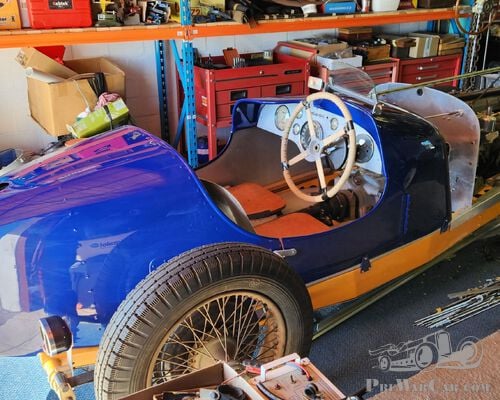
Riley TT Sprite
1935 6-cylinder TT Sprite replica. Chassis # 46A2722. Engine # 6A2722. Original Ulster Imp body. Restoration nearing completion. Engine, G..

K3 Replica on KN Chassis
"The K3 Magnette must rank in the history books as the most famous and successful of all the record breaking MGs. With only 33 examples produced durin..