The global magazine and marketplace for classic car enthusiasts, by enthusiasts.


Filter
Classic Jowett for sale - Jowett cars for sale
-

Ford v8 Club cabriolet 1937
Very nice Ford v8 Club cabriolet. In excellent condition. Runs and drives very well.Top condition.Shipping possible. -
1937 Rolls Royce 25/30 Airline style Saloon by Park Ward
1937 Rolls Royce 25/30 Airline style Saloon by Park Ward Chassis Number: GRP4 Registration Number: ELH113 Under long term ownership for several decades; this 25/30 has one of the most exhaustive & massive history files I have ever seen with some £135,000 pounds having been s.. -
1904 Gladiator 14/20HP Limousine by Leon Molon
1904 Gladiator 14/20 HP Four-Cylinder Demi-LimousineCoachwork by Léon MolonRegistration no. NXI45Chassis no. 2471 Engine no. C569 • ‘Successfully participated in over 35 London-Brighton Runs’ A relatively short-lived French marque, Gladiator produced motor cars from around 1896 to 1920, lat.. -
Chevrolet Master Sedan 1934
A super cool Chevrolet Master from 1934.In very original condition, drives well.With many original accessories such as the covers on the rear fenders, sun visor, and spare wheel protection.Car originally from California, imported to the Netherlands about 10 years ago. Dutch registration. -
Ford Model A Roadster Deluxe 1931
This 1931 Ford Model A Roadster Deluxe is a fine example of one of the most iconic American cars ever built — a car that truly embodies Henry Ford’s original vision: “You can have any color, as long as it's black.”Finished in classic all-black, this Roadster presents a clean, authentic look without excessive chrome or flashy accessories —.. -
Rosengart LR4N2 1938 – Rare Pre-War French Saloon – Restoration Project
Na sprzedaż: Rosengart LR4N2 z 1938 roku Rzadki francuski samochód przedwojenny, projekt do renowacji. -
1932 Ford B Tudor Sedan
1932 Ford "B" Tudor Sedan, 4 cylinders, not restored, original condition, almost completed, ideal for a Hot Rod project, RHD. I can also supply a Ford V8 engine (please ask for pricing!) -
Rolls-Royce 20 HP Van Shooting brake
This Rolls-Royce Twenty (also called Rolls-Royce 20HP) is a very unusual car. To begin with because it is a van. Secondly because of its striking signwriting, that intensifies the classic character of the body.This Twenty has not always carried the van body. In november 1925 a Mrs Foreshew purchased an enclosed limousine at coach builder .. -
Rolls-Royce 25-30 HP Park-Ward Touring Limousine
Rolls-Royce 25/30 HP #GRP24 was sold new to Mrs. Daisie Mignot. She was the widow of the Reverend Peter Thomas Mignot (CBE) who founded the Mignot Memorial Hospital at Alderney (BCI). The chassis was bodied by Park Ward with and "Airline" style Touring Limousine body and was equipped with a large sunroof and a division that winds up under the ro..


Jowett
GB, 1906 – 1954
(1) Jowett Motor Manufacturing Co Ltd, Bradford, Yorks., 1906 – 1919
(2) Jowett Cars Ltd, Bradford, Yorks., 1919 – 1954
The most famous motor car to come out of Yorkshire was the little flat-twin built Jowett car by Benjamin and William Jowett, who had earlier made V-twin engines for cars and stationary work, and also the first Scott 2-stroke motorcycles. The Jowett car was one of the most practical light cars of its period, the 1920s and 1930s. After experiments lasting from 1906 to 1913, a machine(the Jowett car) with an 816cc water-cooled side-valve engine, a 3-speed unit-construction gearbox, worm final drive and side-lever steering was put into production. A two-seater Jowett car was the standard style until 1923.
However, production of the Jowett car was not seriously under way until after World War 1, when the Jowett car make first gained recognition outside its home shire. The engine was enlarged to 907cc, bevel drive was substituted during the war and there was wheel steering in 1914. The Jowett Seven had its drawbacks, such as a fixed-head engine which made owner-maintenance difficult, and the Jowett car needed careful handling because of hard springing, high-geared steering and bad brakes, but its advantages far outweighed them. Because the famous engine exerted the Jowett cars power output at very low engine speeds, flexibility and acceleration were excellent. The power unit was rugged, reliable and very economical. Fuel consumption of the Jowett car could be as good as 55mpg. The whole Jowett car weighed very little. Coil ignition and electric starting were standard fittings from 1923 on the Jowett car, but the most important new convenience of that year was the introduction of the Jowett Long Four, a capacious four-seater, selling for £245, or £20 than the still-current two-seater. The Jowett Long Four and the equally roomy Jowett car saloon of 1926 were bestsellers. In 1929, the engine was given a detachable cylinder head, and, at last, internal expanding 4-wheel brakes were supplied with all Jowett cars except the short-lived 100 guinea ‘Jowett chummy’ model of that year. At the same time, the Jowett Black Prince saloon was introduced to give the make a more modern look; it had a fabric body with a high waistline and shallow windows, dummy hood irons and wire wheels, all in the most fashionable style.
In the 1930s weight went up on Jowett cars and axle ratios went down, but economy and pulling power were still combined, thanks to the virtues of the original engine. A handful of sports Jowett cars had been made in the 1920s and now, in 1934, the Jowett Kestrel sports saloon was offered, followed a year later by the twin carburetor Jowett Weasel sports tourer. In the former year, a four-speed gearbox arrived on the Jowett cars and in 1935 a centrifugal clutch and freewheel device could be had, to help gear-changing. However, the true revolution for Jowett cars came in 1936, for this year was the last of the 907cc twin and the first of the Jowett Ten, with a flat-4 engine of 1.166cc. A saloon Jowett car only was offered. For 1937, the twin was enlarged to 946cc and renamed the Jowett Eight, while all Jowett cars were given Bendix brakes. Very late in the day, a synchromesh gearbox arrived for the 1940 season.
After World War 2, the twin was finally dropped from passenger Jowett cars, but a machine that was to be almost as famous took the place of both the Jowett Eight and the Jowett Ten, once again as the sole Jowett car model. The Jowett Javelin, however, was an utterly different conception. This Jowett car was a small family car, but of the most advanced character. Indeed it was not ‘British’ at all, in the context of 1947, when traditional designs dominated the home market. With its independent torsion-bar suspension front and rear, rigid unitary body-chassis construction, good aerodynamic shape, light weight and high gearing, its fine handling, 80mph maximum speed and combination of excellent acceleration and high cruising speed, the Jowett car was more reminiscent of the pre-war Lancia Aprilia, the Fiat 1100 or the BMW. The engine alone was a reminder of Jowett practice, being a 1½-litre flat 4. For 1950, the Jowett Javalin was joined by an even more advanced Jowett car, the two-seater sports Jowett Jupiter. This Jowett car had a space-frame designed by Eberan von Eberhorst, formerly of Auto-Union, and a 90mph performance. The Jowett Jupiter, in turn, was developed in 1954 into the Jowett R4 Jupiter, a sports-racing car of which only a handful were made. The Jowett car was considerably shorter and lighter, with a fiberglass body, and was a 100mph machine. The competitions record of the Jowett Gavelin and its developments was impressive. It included class wins in the 1949 and 1951 Monte Carlo Rallies, and in the 1950, 1951 and 1952 le Mans 24 hours race by Jowett cars. Sadly, however, the old Jowett name died in 1954 after some 30.000 Javelins and 1.200 Jupiters had been made. At the time of closure a revised twin Jowett car, the ioe Jowett CD-type, was under development.
Source: Georgano, encyclopedia of motorcar; TRN
The information is written with the greatest of care. However, if you have any suggested amendments please contact us at office@prewarcar.com



Featured
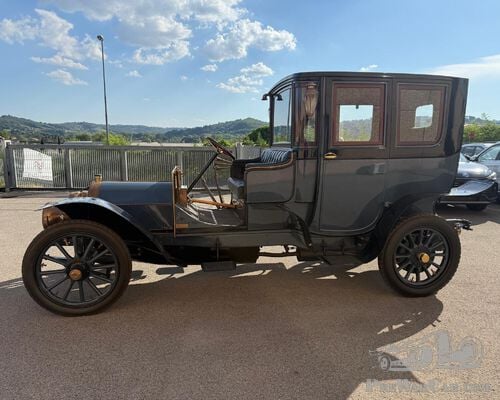
1906 FIAT BREVETTI COUPÉ DE VILLE Coachwork by Carrozzeria Italiana Cesare Sala, Milan
1906 FIAT BREVETTI COUPÉ DE VILLE Coachwork by Carrozzeria Italiana Cesare Sala, Milan Chassis No. 788 Coachwork No. 5699 Location: Siena, Tuscany..
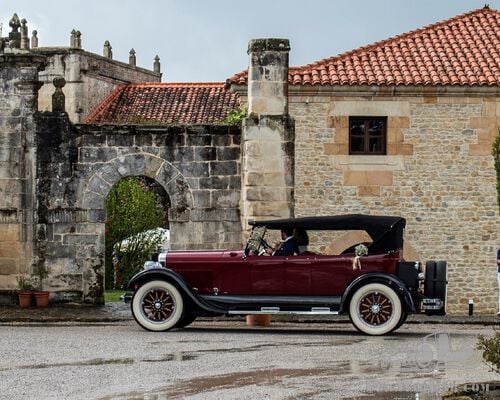
1925 Lincoln Model L Phaeton by Brunn - Excellent provenance
Retaining its original matching-numbers engine and chassis (both numbered 24576), the car benefits from an extensively documented history and..
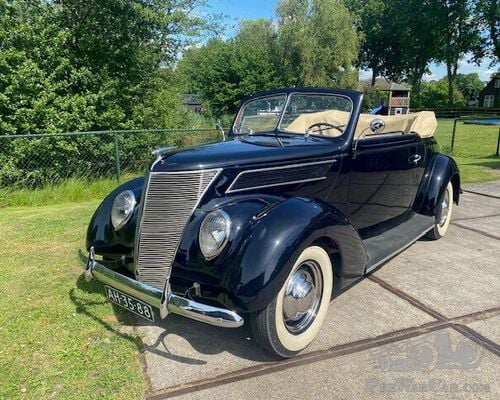
Ford v8 Club cabriolet 1937
Very nice Ford v8 Club cabriolet. In excellent condition. Runs and drives very well.Top condition.Shipping possible.