The global magazine and marketplace for classic car enthusiasts, by enthusiasts.


Filter
Classic La Buire for sale - La Buire cars for sale
-

1911 De Dion Bouton CS2 Tourer
1911 De Dion Bouton Type CS2 Tourer Registration no. DEZ1911Engine no. 6765CGearbox no. 26183 The Type CS2 has a 14hp, four-cylinder engine of 2121cc with mechanical valves, a double sleeve sliding pinion, four-speed gear.. -
1932 Ford B Tudor Sedan
1932 Ford "B" Tudor Sedan, 4 cylinders, not restored, original condition, almost completed, ideal for a Hot Rod project, RHD. I can also supply a Ford V8 engine (please ask for pricing!) -
1909 ROLLS-ROYCE 40/50hp SILVER GHOST 7.4 LITRE 4 SPEED BALLOON CAR
1909 ROLLS-ROYCE 40/50hp SILVER GHOST 7.4 LITRE 4 SPEED H.J. MULLINER STYLE BALLOON CAR Chassis 1009 UK Registration Number: AH834 On 30th March 1907 an advert appeared in The Autocar headed 'The Best Six-Cylinder Car in the World'. The advertiser was Rolls-Royce Ltd. and the pr.. -
1937 Bugatti Type 57C
1937 Bugatti Type 57C Chassis Number TBA Freshly serviced & fully gone though by Marque specialist Ivan Dutton. Call For full details & more pictures: Richard Biddulph 07967260673 -
1934 Rolls-Royce 20/25 James Young Saloon GUB77
A smart, clean and handsome example, very nicely finished in silver, with wings and waistline moulding in a lovely shade of blue. The interior consists of excellent leather to the front, cloth to the rear & the headlining all in deep blue, with light blue carpets & particularly attractive wood veneers – all work together to create a very un.. -
Studebaker Comander
Angefangene Restauration wegen gesundheitlichen/altersgründen abgebrochen.Fahrzeug fertig lackiert, Motor komplett überholt.Das Fahrzeug wird im teilzerlegten Zustand, wie auf den Bildern zu sehen, verkauft. Anfragen gerne telefonisch unter der 08152 1081 oder per E-Mail: m.feyrer@web.de -
1936 Alvis Speed 25 Charlesworth Saloon
Technical SpecificationMark & Model: Alvis Speed 25 Charlesworth SaloonYear: 1936Registration plate: UK registeredTransmissions: Manual 4 speedBody style: 4 door saloonInterior color: Original brown leatherExterior color: BlackSeating capacity: 4/5Whee.. -
Exceptional 8Hp Darracq Type C
This breath-takingly original 1901 Veteran Darracq Motorcar is the later version of the Type C Rear-entrance Tonneau Model. One of about 1200 thought to have been built, it is the most original example of a veteran or vintage car that we have ever encountered.It stands as a true witness to over 125 years of motoring, and is, in our opini.. -
1939 Derby Bentley Overdrive MX series Drophead Coupe by Vanden Plas
1939 Derby Bentley Overdrive MX series Drop Head Coupe by Vanden Plas.Chassis number: B105MXRegistration number: WXW40The best of the best: This ultra desirable Overdrive Derby Bentley was in the long term ownership of Peter Blond, a well known Sothebys director who headed t.. -
Join our Team as a Classic Car Mechanic
Are carburetors more your thing than OBD, and V8s more exciting than electric drives?Then you’ve come to the right place! FM Oldtimer GmbH in Bäretswil specializes in the restoration, maintenance, and servicing of classic vehicles of all makes and eras. To strengthen our team, we are looking for a passionate and experienced:..


La Buire
France, 1904 – 1930
(1) Chantiers de la Buire, Lyons, 1904 – 1905
(2) Société des Automobiles de la Buire, Lyons, 1905 – 1909
(3) Sociéte Nouvelle de la Buire-Automobiles, Lyons, 1910 – 1930
Though the Chantiers de la Buire were engaged on automobile work under contract to Serpollet as early as 1900, their own La Buire car designs did not appear on the market until 1904 – these were sometimes erroneously referred to in England as ‘de la Buire’ cars. The La Buire cars were conventional T-headed 4-cylinder machines with metal-to-metal clutches, 4-speed gearboxes, chain drive and pressed-steel frames, made in 16hp and 30hp sizes. A separate car division was formed in 1905 on the La Buire car and a year later three fours were on the market; the smaller La Buire cars had capacities of 4.9 and 7.5-litres respectively, but the ‘La Buire 80’ was a herculean 13.6-litre affair. All had high-tension magnetos, Rover-type compression brakes and twin transmission footbrakes. The big La Buire car had a long and distinguished career in British sprints and hill-climbs in the hands of J. Higginson, inventor of the Autovax. He started with ftd at Sunrising in 1907 and ended by being the entrant of the biggest car ever to record ftd at Shelsley Walsh in 1912. Otherwise the La Buire car company were not interested in racing, apart from a 2nd place in the Coupe de la Commission Sportive of 1907, which resulted in a catalogued type de course La Buire car model offered from 1908 to 1910. Bevel drive with twin crown wheels – a system favoured up to 1914 – made its appearance on a 2.7-litre 4-cylinder car in 1907. 1908 saw a ‘10/14’ of 2.1-litre capacity and a 4.8-litre 6-cylinder, also shaft-driven. No fewer than nine La Buire car models were on sale in 1909, and these included four sixes, the capacities of these La Buire cars ranging from a modest 3.6-litres up to an above average 9.5-litres. The La Buire car company followed the majority of French makers in 1910 by offering L-head Monobloc engines, initially in 3.2-litre form; these La Buire cars had multi-plate clutches and chain-driven camshafts, the latter being a La Buire innovation which was extended over the range. For the 1910 season the La Buire cars were known as Berthiers, after the technical director, M. Berthier who took over the La Buire car company. In late 1910 the Société Nouvelle was formed, and the cars reverted to the La Buire name. Long strokes were a characteristic of late pre-war La Buire carmodels: the ‘La Buire 15’ measured 80x160mm and the ‘La buire 20’ 90x160mm. By 1912 unit gearboxes and differential-mounted transmission brakes had made their appearance on La Buire cars, as had a round-nosed radiator, which was used throughout the range in 1914. A mechanical starter was fitted on the 1913 15hp La Buire ca. Rather small fours of 1.7 and 2.3 litres were available in 1913, as well as the bigger ‘La Buire 15’ and ‘La Buire 20’, and 6-cylinder La Buire cars of 4.8- and 5.3-litres. The big La Buire cars still had two brake pedals, but the second one was now linked to the drums on the rear wheels.
The story of La Buire cars after World War 1 is typical of so many distinguished French marques. A handsome V-radiator had little behind it save tradition; the 1919 ‘La Buire 14/20’ was a stolid 2.650cc affair with fixed head, side valves, pump and fan cooling, 4-speed unit gearbox, magneto ignition and spiral bevel final drive, selling for £1.075 in England. This La Buire car was available with front-wheel brakes in 1922 and a year later came the optimistically-styled La Buire 14/46hp Speed Model with ohv and front wheel brakes and the same cylinder dimensions (75x150mm). An ohv 1.8-litre ‘La Buire 12/38’ with thermos-syphon cooling and central change offered 53mph for £525, but front-wheel brakes were extra until 1925. Thereafter La Buire had little new to offer and 1.8-litre and 2-litre 4-cylinder La Buire cars on similar lines persisted until 1930.
Source: Georgano, encyclopedia of motorcar; MCS
The information is written with the greatest of care. However, if you have any suggested amendments please contact us at office@prewarcar.com


Featured
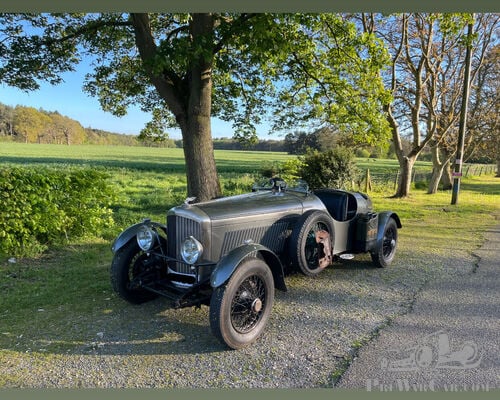
Derby Bentley Special 4-1/4
Sadly i am having to sell on my Bentley special ( Icarus). It is currently a work in progress and still needs finalising/ refining. A great o..

Lagonda LC Tourer 1934
The Lagonda story began in 1901 in Staines, a small town in the UK. The company enjoyed its greatest successes around 1935. During this period, the..

Alfa 6C1750 Spider
Alfa 6C1750 Spider with complete history from delivery in 1930 to first owner in Firenze till today with copy Libretto/license plate all the years