The global magazine and marketplace for classic car enthusiasts, by enthusiasts.


Filter
Classic Chalmers, Lagonda for sale - Chalmers, Lagonda cars for sale
-

1939 Lagonda V-12 Drophead Coupé
1939 Lagonda V-12 Drophead CoupéChassis number: 14062Engine number: 14062Registration number: TBABody Number: 7542According to the Lagonda Club of Great Britain, the V-12 Drophead Coupé offered here was delivered new to James Scott and Son, of Dundee. In recent years it was fully restored in Sweden by world renowned Rolls Royce & Bentley spe.. -
1938 Lagonda LG 45 Rapide Tourer - 1 of 25 original cars
Only 24 original examples still existing out of 25 cars builtCompletely original in all its componentsGreat and fully documented history with all ownersOriginal colour scheme in grey (repainted 2025), dark red leatherMille Miglia participant in 2024, eligible to many top eventsFascinating and uni.. -
Lagonda M45 T7 ready for new adventures
The Lagonda car company was founded in 1906 in Staines, Middlesex by the American Wilbur Gunn (1859-1920) who named it after a river near his home town of Springfield, Ohio. Having established its reputation, Lagonda concentrated mainly on the production of light cars before reverting to sporting and luxury models in the mid-1920s with the introduc.. -
1936 Lagonda LG45 Drop head Coupe
1936 Lagonda LG45 Drop head Coupe Chassis number: 12104 Registration number: HXV183 (Previous) Fully Nut & bolt restored some years ago; this car has seen very sparing dry weather only use ever since & has also been the winner of some Lagonda club awards. Unusually the c.. -
Lagonda LG 45 Coupe de Ville Sedanca by Mayfair
The successor to the M45, the LG45 was built around the same highly capable, competition-proven 4.5-litre Meadows inline-six engine, but featured refinements such as synchromesh gears and a central lubrication system.Introduced in 1936, the public and motoring press alike immediately recognized the model’s merits, with British publication.. -
1937 Lagonda LG45 Drophead Coupe
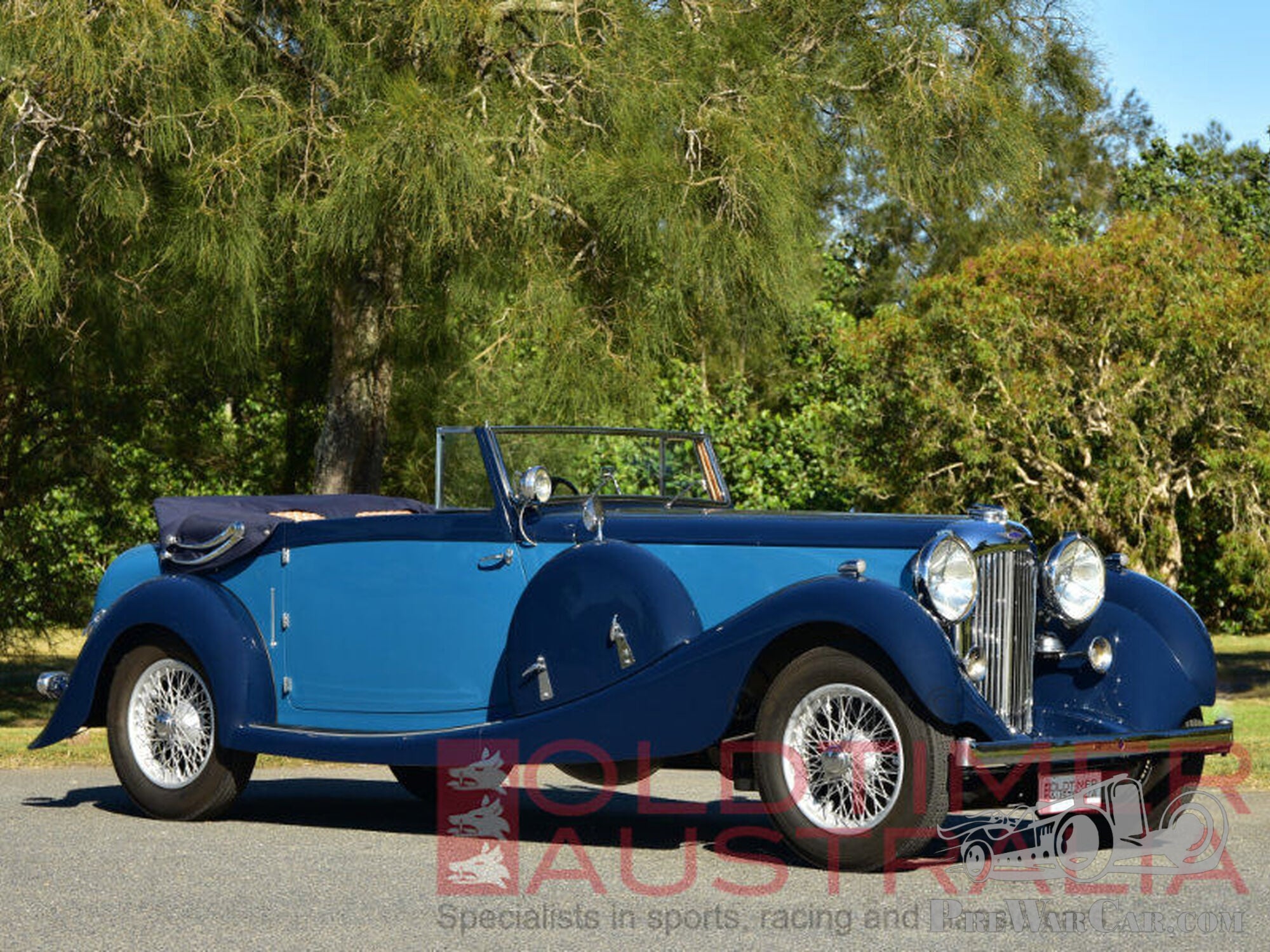
Details:Oldtimer Australia is delighted to offer for sale a beautifully restored 1937 Lagonda LG45 Drophead Coupe.This particular example was first registered in the UK on 22nd February 1937 and it carried the registration number AJB 282. According to documentation in the history file the car was originally black in colour. The Lag.. -
1937 Lagonda LG45 ‘Rapide’ four-seater Tourer
Chassis number 12178, engine number M45/160, steering box number 6087/47.Colour grey metallic combined with a dark red leather interior and a black mohair hood and tonneau cover. The Lagonda LG45 is a very rare automobile, only 278 examples were built in the years 1936 – 1937. The engine shows the directly bolte.. -
Rare Low Chassis Continental Tourer
Please visit our homepage for further information and pictures: www.scuderia-renania.comModel History:The 2-Litre L/C "Continental" was introduced in April 1932 and was the final stage in the development of the successful 2 -litre model. It was built on the desirable low chassis, providing a lower centre of gr.. -
1937 Lagonda LG 45 Special
Lagonda LG 45 Sport Special, year 1937. Chassis number 12158G10, engine number 12153, original UK registration number BKU999. Colours: Dark blue bodywork, silver wire wheels combined with a dark brown leather interior finished with dark blue carpet. Black cloth hood and hood cover. This fantastic Lagonda LG45 .. -
1933 Lagonda 4½-Litre M45 T7 Tourer
"Lagonda cars have always upheld a reputation for effortless fast touring and the pride of ownership which fine detail work and distinguished coachbuilding can give. The 4½-Litre model retains these characteristics, but scores considerably over its forebears by its high power-to-weight ratio. The chassis is no bigger than the three-litre car, and t..




Chalmers / Chalmers-Detroit
US, 1908 – 1924
Chalmers Motor Car Co, Detroit, Mich.
The Chalmers was one of the most popular automobiles made in the United States for more than a decade. The Chalmers was the successor to the Thomas-Detroit which was built by a company which had been founded in 1906 by E.R. Thomas (builder of the Thomas car in Buffalo, N.Y.), Roy D. Chapin and Howard Earle Coffin; the two latter had previously served at Oldsmobile. The Thomas-Detroit of which some 500 were sold during the first year of production, was marketed through the parent firm in Buffalo which manufactured a larger line of cars under the Thomas emblem. The Thomas-Detroit was a medium priced four-cylinder car which had been designed by Coffin. In 1907, Hugh Chalmers, vice president of the National Cash Register Co and a noted salesman, entered the firm. Shortly after, he bought a half of E.R. Thomas’ stock and became president of the company which became the Chalmers-Detroit Motor Company. The Thomas-Detroit became the Chalmers-Detroit in 1908 and in 1910, the Chalmers. Open and closed Chalmers models in two lines comprised the Chalmers four-cylinder cars, with self-starters appearing in 1912. Chalmers (as Chalmers-Detroit) had distinguished itself in road races as early as 1908 when W.R. Burns won the Motor Parkway Sweekstakes at Jericho, N.Y., averaging 48.7mph in the six-lap 140.76 mile run.
In 1913, the Chalmers brought out its first 6-cylinder model, as well as the four and apart from small mechanical and design changes, continued both until 1914. The Chalmers four was dropped from the 1915 line, however, and sixes were to be used exclusively in Chalmers until the ending of manufacture. By 1915, some 20.000 Chalmers cars per year were coming off the Chalmers production line and would even exceed that figure before the advent of World War 1. In 1917, an L-head motor replaced the earlier overhead-valve type and on August 4th, Chalmers again headed racing news when Joe Dawson won the 24-hour stock Car Endurance Run at Sheepshead Bay, N.Y. Sales flagged following the end of the war and Hugh Chalmers, always the salesman, and with the realization that a competitor, Maxwell, wasn’t faring well either, arranged to lease his Chalmers plants to Maxwell, using his salesmanship to promote the two concerns and getting the benefit of Maxwell tooling and manufacturing equipment. By the early 1920s, however, many makes of cars were in financial difficulties due to over-expansion and recession, and Walter P. Chrysler was called in to try and reorganize Maxwell. Chrysler was at this time planning his own corporation and in 1922 Chalmers was taken over by Maxwell which had become a Chrysler subsidiary. The last Chalmer cars for sale were equipped with Lockheed hydraulic brakes but 1923 was the last year of Chalmers production with some 9000 units leaving the factories. The Maxwell survived until 1925 when it became the Chrysler Four.
Source: Georgano, encyclopedia of motorcar; KM
The information is written with the greatest of care. However, if you have any suggested amendments please contact us at office@prewarcar.com
Lagonda
GB, 1906 – 1963
(1) Lagonda Motor Co Ltd, Staines, Middlesex
(2) Lagonda Ltd, Staines, Middlesex
(3) Lagonda Ltd, Feltham, Middlesex
(4) Aston-Martin-Lagonda Ltd, Newport Pagnell, Bucks.
Wilbur Gunn, the founder of the Lagonda Car Company, hailed over Springfield, Ohio. He came to England in about 1897. In 1898 he built an air-cooled cycle in a greenhouse at Staines. On this site the first vehicle to bear the Lagonda car name was assembled in 1900, an improved version of the air-cooled cycle; and it was here that Lagonda cars were to be built until 1947.
To his new product, the Lagonda car, Gunn gave the French form of the American Indian name for Buck Creek, the stream near his home town. In 1905 the Lagonda car company’s first racing success came when a V-twin cycle won the London-Edingburgh trial. This victory encouraged Gunn to enter the motor car field with a 20hp 4-cylinder Lagonda car. Developed in 1906, this first Lagonda car was brought out the following year as the Lagonda Torpedo. A 6-cylinder version followed; the Lagonda car carried Wilbur Gunn and Bert Hammond to win the Moscow – St Petersburg Reliability Trial in 1910. The big tourer Lagonda car was a result ‘greatly favoured’ by Tsar Nicholas II, and the Lagonda Car Company’s early fortune was made form exporting these Lagonda cars to Russia until war broke out in 1914.
At home a dapper Lagonda 14/4 replaced the earlier Lagonda 12/4 in 1909. This gave way in 1913 to an 11.1hp light Lagonda car of radically advanced design. Among its more striking innovations were a riveted monocoque body of unit construction; an anti-roll bar to assist the suspension; and the Lagonda car had the earliest known fly-off hand brake. The Lagonda car enjoyed a wide market, being subsequently enlarged into a 11.9 in 1920 and a 12/24 in 1924, though later Lagonda cars no longer had monocoque construction.
In 1925 Arthur Davidson designed the 1954cc ohv-engined Lagonda car which marks the beginning of the Lagonda as a sports car. The Lagonda 14/60 engine featured 4-fully-machined hemispherical combustion chambers, the first to be marketed, aspirated by interchangebale valves opposed at 90 degrees. Twin camshafts were carried high in the block of the Lagonda car. A Rubury braking system of prodigious efficiency was fitted. Grouped chassis lubrication nipples were featured, as was a clutch stop. The whole Lagonda car was superbly finished.
The Lagonda 2-litre Speed Model, a modified version of the 14/60 Lagonda car, was developed late in 1927 for the 1928 season. The chief difference between it and the earlier Lagonda car lay in the valve-timing overlap, twin carburetors on a direct manifold, and a raised compression ratio of 6.8:1. These alterations combined to give the Lagonda Speed Model tourer an acceleration from rest to 80mph in 50 seconds, and the new Lagonda car did well in competition. A 2½-litre 6-cylinder Lagonda car with push-rod operated ohv was introduced in 1926, and this was subsequently enlarged to 3-litres on Lagonda cars in 1928. For 1930 the chassis of the Lagonda 2-litre was lowered and during that year a supercharged Lagonda car became available. In 1932 came the last of the 4-cylinder 2-litres Lagonda cars, the Lagonda Continental, which had smaller wheels and a sloping radiator, and this finally gave way to the Lagonda 16/80, a 2-litre six with a push-rod operated ohv engine of Crossley manufacture. This Lagonda car was later fitted with an ENV preselector gearbox. This was an attractive car but, like all the Lagonda 2-litres, it suffered from excessive weight.
In the meantime a version of the 3-litre known as the Lagonda Selector Special appeared. This Lagonda car was fitted with a Maybach gearbox that gave eight forward speeds, four high and four low, by means of an internal reduction gear with semi-automatic control. This Lagonda car was something of a failure, however, and was quietly dropped.
At the 1933 Motor Show two outstanding Lagonda cars were introduced: the 1.104cc Lagonda Rapier, with twin overhead camshafts and the 4½-litre Lagonda M45, having a similar Meadows 6-cylinder ohv engine to that in the now defunct Invicta. At last a Lagonda car had real performance and it is noteworthy that the Lagonda Car Company made their own very attractive coachwork.
For 1935 two additional Lagonda car models made their appearance, the 4½ Lagonda Rapide and the Lagonda 3½-litre, both using the same shortened chassis. It was no doubt this complexity of models which caused the Lagonda car company to get into financial difficulties, and a victory at Le Mans by a Lagonda Rapide came too late to save the day.
When in the summer of 1935 Alan Good saved the Lagonda Car Company from absorption by Rolls-Royce, he appointed W.O. Bentley as chief designer. The Lagonda LG45 model with which Bentley attacked the Luxury market in 1936 had longer road springs and Luvax dampers, but retained the Lagonda M45R engine and chassis. Not until the 1936 Motor Show could Bentley’s influence on the Meadows engine be seen in its definitive form in Lagonda cars. The Sanction III unit featured an improved coss-flow inlet manifold cast integrally into the head, onto which the carburetors were now bolted directly. Various other improvements on the engine of the Lagonda cars including a lightened flywheel allowed the line on the revolution counter to be moved up to 4.000rpm.
The last of the 4½-litre Lagonda cars was the Lagonda LG6 of 1938. This Lagonda car had independent front suspension, hydraulic brakes and outboard rear springs, but still used the Meadows engine. The V12 engine, brought out for the 1937 Lagonda car season, is considered the finest of W.O. Bentley’s designs. This 180bhp unit could raise the Lagonda car’s speed from 7 to 103,45mph on top gear without snatching; and this flexibility could be supplemented by revving freely to 5.000rpm on the indirects. Regrettably the Lagonda car design was never developed fully, for production was stopped in 1940, a few months after Lagonda Rapide versions had been placed third and fourth at Le Mans.
In 1947 the Lagonda car firm was taken over by the David Brown complex. Contrary to spelling the end of the traditional Lagonda car, the new merger enabled Bentley’s last motor-car design to be realized. This was the Lagonda 2.6-litre model which appeared in 1948. Its brilliant but unorthodox layout embraced a true cruciform chassis, independent rear suspension unique amongst British cars, and a twin ohc 6-cylinder engine. A bored-out edition of the 2.6 Lagonda car was offered as the 3-litre in 1951, featuring luxurious styling, rich appointments and a top speed of 110mph. HRH the Duke of Edingburgh had two Lagonda cars for his personal use, and for many years was a honorary member of the Lagonda Club.
The Lagonda Rapide was announced in 1961. Using a DB4 engine of 3.996cc capacity, the Lagonda car was set up on a platform chassis with independent springing all round, servo-assisted disc brakes and a De Dion rear axle. An elegant, aluminium Superleggera body by Touring of Milan contributed greatly to the Lagonda car’s massive acceleration. The Lagonda Rapide’s top speed was a genuine 125mph with comfortable cruising at 120; its sumptuous finish and appointments were in kepping with a price of £5.000. Production of Lagonda cars ceased in 1963, though a 4-door saloon version of the V8 Aston Martin DBS built for Sir David Brown in 1970 bore the Lagonda emblem.
Source: Georgano, encyclopedia of motorcar; HAF
The information is written with the greatest of care. However, if you have any suggested amendments please contact us at office@prewarcar.com


Featured
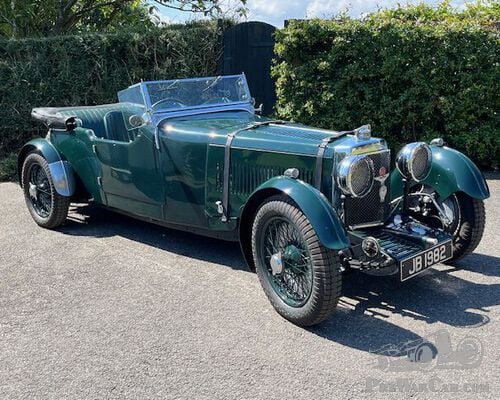
1933 Aston Martin Le Mans
Exceptional 1933 Astron Martin Le MansOriginally bodied as a Standard (Chassis No. L2/222), this unique vehicle was thoughtfully re-bodied i..
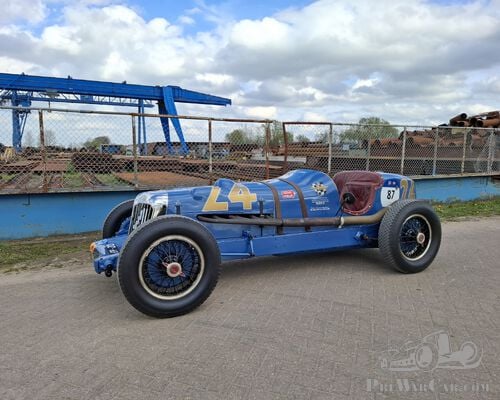
1932 - Graham " Lucenti " Indianapolis
Original participant of the 1932, 1934 and 1935 Indy 500. Best result: finishing 10th overall in the 1934 Indy 500 with driver “Herb” Ardinger...
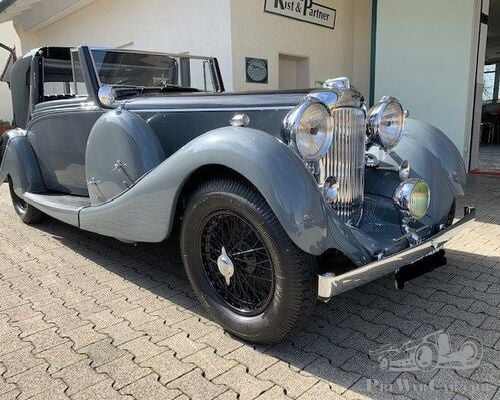
Lagonda LG 45 Coupe de Ville Sedanca by Mayfair
The successor to the M45, the LG45 was built around the same highly capable, competition-proven 4.5-litre Meadows inline-six engine, but featured r..