The global magazine and marketplace for classic car enthusiasts, by enthusiasts.


Filter
Classic Du Pont, Lasalle for sale - Du Pont, Lasalle cars for sale
-

1929 Du Pont Model G Two-Passenger Speedster by Merrimac | RM Sotheby's | The Monterey Auction
To Be OFFERED AT AUCTION at RM Sothebys' The Monterey Auction event, 13 - 15 August 2026. $800,000 - $1,200,000 USD One of the most beautiful American automobiles of its generationThe 1929 New York International Automobile Show display carOne of three two-passenger “taper tail” models with an external spareOne ..

Du Pont
US, 1920 – 1932
(1) Du Pont Motors Inc, Wilmington, Del., 1920 – 1923
(2) Du Pont Motors Inc, Moore, Pa., 1923 – 1932
E. Paul du Pont’s company built quality cars in limited numbers, total production being 537 vehicles of all Du Pont types. First of the line was a Du Pont 4.1-litre sv four with their own engine, selling for $2.600, but this gave way to proprietary-engined sixes, initially powered by Herschell-Spillman. The 1925 Du Pont Model D had a 6-cylinder 5-litre Wisconsin engine with overhead valves that developed 75bhp, a constant-mesh gearbox, and Lockheed hydraulic brakes to all four wheels. Its successor, the Du Pont Model E, could be had with a supercharger, but the best-known, and best, Du Pont was the Du Pont Model G speedster introduced in 1928. With its narrow straight wings copied from the Amilcar, Woodlite headlamps and grille concealing the radiator, the last a pioneering feature, the Du Pont Model G was not a good-looking car, but it was a very effective one. Like all the DuPont speedsters it had four forward speeds. The 5.3-litre, sv straight-8 engine, by Continental, gave 114bhp at 3600rpm with catalogued modifications. With the latter, 100mph was guaranteed. In the 1929 Le Mans 24 Hours race the Du Pont Model G proved itself faster than the other American entries, Stutz and Chrysler. Touring bodywork was, of course, available on the Du Pont car, and in 1931 came the long wheelbase (12ft 2 in) Du Pont Model H, built in a Stearns Knight frame. The later Du Pont cars were assembled in the Indian motorcycle factory at Springfield, after E. Paul du Pont had acquired this concern.
Source: Georgano, encyclopedia of motorcar; TRN
The information is written with the greatest of care. However, if you have any suggested amendments please contact us at office@prewarcar.com
LaSalle
US, 1927 – 1940
Cadillac Motor Car Co, Detroit, Mich.
Launched as a smaller and less expensive running-mate for the Cadillac, the LaSalle car was conceived in its entirety by General Motors’ stylist Harley J. Earl – a very unusual practice for the period. Unlike other makers ‘cheap lines’, the LaSalle car was manufactured to Cadillac standards throughout, though the wheelbase of the La Salle car was 7in shorter and at $2.495 a La Salle sedan was about $700 cheaper. The engine of the La Salle car was an sv V8 of 5-litres’ capacity. Synchromesh, safety glass and chromium plating were innovations of La Salle cars shared with Cadillac in 1929 and the La Salle car grew steadily in size: first to 5.4 litres, then to 5.6-litres, with a further increase to 5.8-litres in 1930. The whole concept of La Salle cars was changed in 1934 – though the La Salle car was the guinea-pig for the turret-top steel bodies to be used in 1935 by all G.M. divisions save Buick, the La Salle car was cheapened in other respects, having a 4.2-litre straight-8 engine as used in the bigger Oldsmobiles. The price of the La Salle car was $1.595 (£725 in England). A reversion was made to the traditional V8 in 1937, the La Salle cars sharing body shells with Oldsmobile and the more expensive Buicks, and the price of the La Salle car was cut again to $1.205. The La Salle car was squeezed out of the market by the lower list prices of the simpler Cadillac models. The 1940 La Salle cars were as good as their predecessors but at $1.446 as against $1.752 for a Cadillac, there was no longer room for the La Salle car marque.
Source: Georgano, encyclopedia of motorcar; MCS
The information is written with the greatest of care. However, if you have any suggested amendments please contact us at office@prewarcar.com


Featured
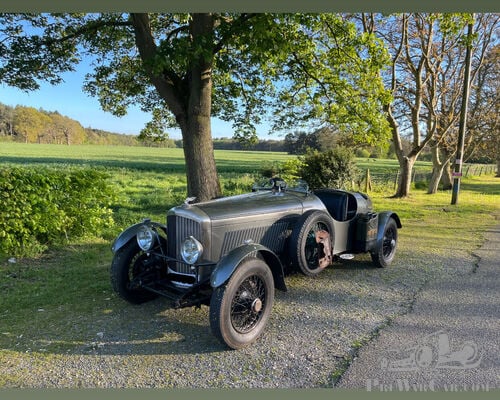
Derby Bentley Special 4-1/4
Sadly i am having to sell on my Bentley special ( Icarus). It is currently a work in progress and still needs finalising/ refining. A great o..
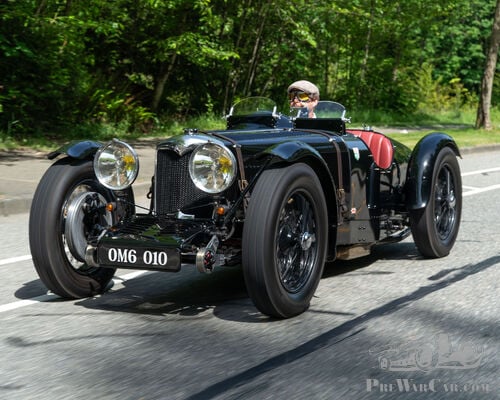
Riley 14/6 Special 1933
The ExperienceStep into the golden age of British motoring. This 1933 Riley 14/6 Special is a masterclass in pre-w..

Alfa 6C1750 Spider
Alfa 6C1750 Spider with complete history from delivery in 1930 to first owner in Firenze till today with copy Libretto/license plate all the years