The global magazine and marketplace for classic car enthusiasts, by enthusiasts.


Filter
Classic E.R.A., Lasalle for sale - E.R.A., Lasalle cars for sale
-

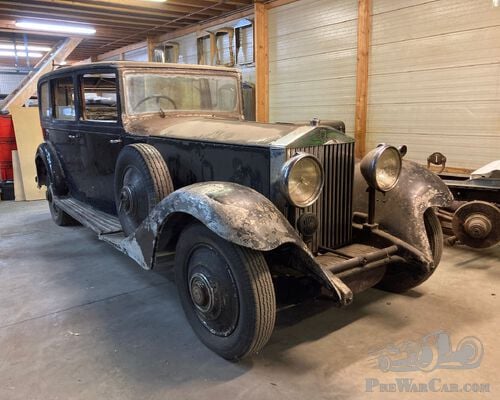
Beautiful Lasalle, light project
This is a light project car. Engine has been totally rebuild and needs to be re-assembly. The car is 100% complete and in very good condition. Odometer shows 26,000 miles only and believe to be original. Interior is perfect. Rebuild radiator. Swedish registration and documents in my name. Car is located in the south of Sweden, 100km. from Goth..

E.R.A.
GB, 1934 – 1952
(1) English Racing Automobiles Ltd, Bourne, Lincs., 1934 – 1945
(2) English Racing Automobiles Ltd, Dunstable, Bedfordshire, 1946 – 1952
The ERA was produced by Raymond Mays, Humphrey Cook and Peter Berthon as a challenger in the 1500cc racing class. The ERA used a conventional chassis, a 4-speed pre-selector gearbox and a highly-developed version of the blown 6-cylinder ohv Riley engine giving 165bhp. There were 1100cc and 2-litre power units as alternatives, and with the D-series Porsche trailing-arm independent front suspension was introduced. Only 16 ERA cars were made, but the ERA car dominated the voiturette class in the hands of such drivers as Mays, B. Bira, Seaman, Fairfield, Arthur Dobson and Earl Howe. Victories outside Britain included the Eifelrenne, the Coppa Acerbo, Berne and Masaryk in 1935; the Prince Rainier Cup and Albi in 1936; the Avus, Picardie, Albi and Berne in 1937; and Picardie again in 1938. The ERA cars also dominated British road racing in their day and Raymond Mays achieved numerous fastest times at Shelsley Walsh with his ERA 2-litre car. Fifteen ERA cars still survive and are prominent in ‘historic’ racing. A sports-car project in 1937 came to nothing, but a new ERA 240bhp short-stroke six, the E-type with torsion-bar independent front suspension, a De Dion rear axle, synchromesh gearbox and streamlined body, appeared in 1939.
After World War 2 Mays and Berthon worked on the BRM V16, while ERA, now under the control of Leslie Johnson, struggled on with the unsuccessful ERA E-types until 1949. The company assisted in the design of Jowett’s 1950 ‘Jupiter’ sports car, but their last racing machine, the ERA G-type, was designed for Formula 2, and had a 150bhp 6-cylinder Bristol engine and tubular frame to the designs of David Hodkin. This final ERA product was sold to Bristol’s for testing.
Source: Georgano, encyclopedia of motorcar; MCS
The information is written with the greatest of care. However, if you have any suggested amendments please contact us at office@prewarcar.com
LaSalle
US, 1927 – 1940
Cadillac Motor Car Co, Detroit, Mich.
Launched as a smaller and less expensive running-mate for the Cadillac, the LaSalle car was conceived in its entirety by General Motors’ stylist Harley J. Earl – a very unusual practice for the period. Unlike other makers ‘cheap lines’, the LaSalle car was manufactured to Cadillac standards throughout, though the wheelbase of the La Salle car was 7in shorter and at $2.495 a La Salle sedan was about $700 cheaper. The engine of the La Salle car was an sv V8 of 5-litres’ capacity. Synchromesh, safety glass and chromium plating were innovations of La Salle cars shared with Cadillac in 1929 and the La Salle car grew steadily in size: first to 5.4 litres, then to 5.6-litres, with a further increase to 5.8-litres in 1930. The whole concept of La Salle cars was changed in 1934 – though the La Salle car was the guinea-pig for the turret-top steel bodies to be used in 1935 by all G.M. divisions save Buick, the La Salle car was cheapened in other respects, having a 4.2-litre straight-8 engine as used in the bigger Oldsmobiles. The price of the La Salle car was $1.595 (£725 in England). A reversion was made to the traditional V8 in 1937, the La Salle cars sharing body shells with Oldsmobile and the more expensive Buicks, and the price of the La Salle car was cut again to $1.205. The La Salle car was squeezed out of the market by the lower list prices of the simpler Cadillac models. The 1940 La Salle cars were as good as their predecessors but at $1.446 as against $1.752 for a Cadillac, there was no longer room for the La Salle car marque.
Source: Georgano, encyclopedia of motorcar; MCS
The information is written with the greatest of care. However, if you have any suggested amendments please contact us at office@prewarcar.com


Featured
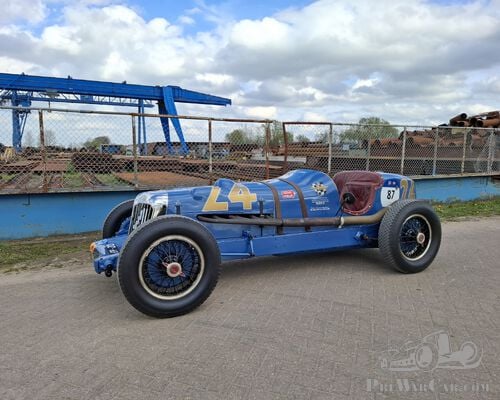
1932 - Graham " Lucenti " Indianapolis
Original participant of the 1932, 1934 and 1935 Indy 500. Best result: finishing 10th overall in the 1934 Indy 500 with driver “Herb” Ardinger...
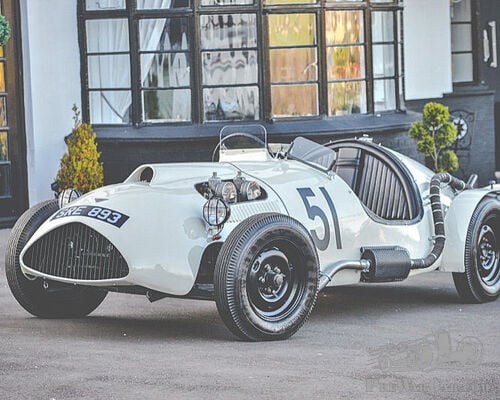
1933 Alvis 3.0 Special - One-Off Alloy Body | Period Competition Car | Featured in “Alvis – A Century of Drivers”
1933 Alvis 3. 0 Special - One-Off Alloy-Body | Period Competition Car | Featured in “Alvis – A Century of Drivers”