The global magazine and marketplace for classic car enthusiasts, by enthusiasts.


Filter
Classic Lea Francis, Mercury for sale - Lea Francis, Mercury cars for sale
-

1939 Mercury 8 Sport Convertible Hot Rod | RM Sotheby's | The Hershey Auction
To Be OFFERED AT AUCTION WITHOUT RESERVE at RM Sothebys' The Hershey Auction event, 7 - 8 October 2026. Offered Without Reserve | $30,000 - $40,000 USD Please check back soon as our dedicated cataloguing team is preparing the description for this lot. To view this car and others currently consigned to this auction, please visit the RM website a.. -
Lea Francis Hyper 4 Seater Tourer
The first time on the market since the 1970's, an elegant 4 seater tourer with a 4ED meadows supercharged engine.We have quite a bit of history with this car, at some point in its life it was converted to a two seater with a streamlined racing body and then rebulit to its original specification in 1995 by A.B Price Ltd, its original body..


Lea-Francis
GB, 1904 – 1906; 1920 – 1935; 1937 – 1953; 1960
(1) Lea & Francis Ltd, Coventry, Warwickshire, 1904 – 1935
(2) Lea-Francis Cars Ltd, Coventry, Warwickshire, 1937 – 1960
Lea Francis started as bicycle manufacturers, like so many car makers, but unlike most of the rest, never went over permanently and consistently to Lea Francis cars. These Lea Francis cars appeared in fits and starts. The first appeared in 1904, in the shape of a 15hp Lea Francis car with a 3-cylinder horizontal engine, the oddest feature of which was its connecting rods over 3ft long. In the same year, however, Lea Francis stopped making their cars, and Singer the Cycle Company began building Lea Francis cars under licence and under the Singer name. R.H. Lea had in fact worked for Singer before branching out on his own. Thus began another famous car name. Lea Francis made motor cycles from 1911, and they concentrated on these until 1920. In that year two Lea Francis cars reappeared beside the motorcycles; assembled 4-cylinder touring Lea Francis cars of 11.9 and 13.9hp. Few of either were made. Then, late in 1922, the Lea Francis car company found its feet at last, with an equally conventional assembled light Lea Francis car. This Lea Francis car had a 1.074cc 4-cylinder sv engine of 8.9hp by Coventry-Simplex, replaced in the following year by a 10hp Meadows unit of 1¼ litres with overhead valves. A Lea Francis car with 7hp Bradshaw flat-twin engine came to nothing. There were 3 forward speeds and quarter-elliptic springs at both ends. The 10hp Lea Francis car was very popular, and was made until 1928. Like other Lea Francise cars to come, it was well made, dependable, and lively. The great moment came for the Lea Francis cars in the very important RAC Small Car Trials of 1924, in which the Lea Francis car made the best all-round performance. During 1925 a wider family market was sought with the 12/22hp J-type Lea Francis car. This Lea Francis car had a longer wheelbase, allowing more spacious bodies, front-wheel brakes, a 1½-litre 4EC Meadows engine to cope with the weight and a 4-speed gearbox. For the sake of comfort, semi-elliptic springs were substituted at the rear on the P-type Lea Francis car introduced for 1928, which also had a plate clutch and 4ED meadows engine.
The Lea Francis car firm’s first serious sports car was the L-type with 4ED engine, announced for 1925. The Lea Francis 12/40hp was one of the best assembled cars in Britain, and appealed more widely than the light Lea Francis cars. It was, indeed, current until the second cessation of car production in 1935. However, Lea Francis also made some more ponderous, less lively Lea Francis cars, without the same degree of success. From 1925 until 1929, the Lea Francis range duplicated some of the heavy 6-cylinder machines offered by Vulcan of Southport, with whom Lea Francis cars had been associated since 1922. The 18hp Lea Francis car was a 2¼-litre car with cantilever rear springs and overhead worm drive. This Lea Francis car was succeeded by A.O. Lord’s Type T, with its advanced but unreliable Lea Francis LFS-type, double ohc engine of 1.7-litres. There was also, in 1928, a 2-litre six Lea Francis car. These Vulcan/ Lea Francis cars ended with the demise of the Vulcan. However, an excellent Lea Francis car with a six was at last introduced for 1931: the Lea Francis Ace of Spades model, with their own 2-litre, single ohc engine. This Lea Francis car continued alongside the old 12/40hp until 1935, together with a new 18hp Lea Francis car, which was a 2¼-litre enlargement of the Lea Francis Ace of Spades. However, a really powerful Lea Francis car was also listed from 1928. This Lea Francis Hyper Sports was a quite different car, with its heavily-modified, Cozette-supercharged Meadows 1½-litre engine, low build and raked radiator. The sports-racing two-seater Lea Francis car could attain 90mph, though a coupé and a short open tourer could also be had by those who did not intend to enter competitions. The Lea Francis Hyper Sports won the 1928 Ulster Trophy race.
A new company introduced two entirely new Lea Francis cars for 1938. These Lea Francis cars were designed by Hugh Rose, who had been responsible for the Riley Nine engine and, like the Riley, had 4-cylinder power units with push-rod overhead valves operated by two high camshafts. The Lea Francis car had ceased to be an entirely assembled car. A 12hp and a 14hp Lea Francis car were available, with cubic capacities of 1½ and 1.6-litres. Both had a 4-speed synchromesh gearbox. A sports version of the 1½-litre Lea Francis car was also sold, thus maintaining the old tradition. These two ‘Leafs’ were good cars, and as they were new, up-to-date Lea Francis carmodels, they could be continued after World War 2. Most of those built in this period were Lea Francis Fourteens, which were heavier but had a bigger bore and a capacity of 1.8-litres. A tuned sports Lea Francis car of the 14hp arrived for 1948. At the end of that year, an export version of the 14hp Lea Francis car, with torsion-bar independent front suspension, was shown and this suspension was adopted for both the 14hp and for the new 18hp, with a 2½-litre engine, in 1950. The sports model of the 18hp Lea Francis car was a fine car, with 100bhp available. The Lea Francis cars for 1953 had hydraulic brakes, but that was the last year in which the Lea Francis car appeared as a competitive production car. By mid-1952, output had fallen to six Lea Francis cars a week. An expensive car of specialist appeal, the post-war years were too hard for it. In 1960 a few prototypes of a new sports Lea Francis car, the Leaf-Lynx, were made, but it never reached production. The power unit of this Lea Francis car was a 2½-litre Ford Zephyr, there was independent front suspension and disc brakes were supplied, but the car was ill-favoured and ill received. No better luck attented the Lea Francis carfirm’s attempt to make the Nobel bubble-car.
Source: Georgano, encyclopedia of motorcar; TRN
The information is written with the greatest of care. However, if you have any suggested amendments please contact us at office@prewarcar.com
Mercury
US, 1904
Mercury Machine Co, Pittsburgh, Pa.
The Mercury car was a two-seater with a 2-cylinder water-cooled engine of 7hp. A liding-gear transmission was used and the weight of the Mercury car was 1.250lb. The price of the Mercury car was $295 and a top cost $100 extra.
GB, 1905
Ivanhoe Motor Co, Cricklewood, London N.W.
The Mercury car company made a small number of 24hp 4-cylinder Mercury cars which they also called Ivanhoes. In 1906 they became agents for Weigel and planned to show these cars on their stand at Olympia, but permission was refused because they had said in their application that they would show Ivanhoes. In fact, only second-hand Mercury cars were shown on the stand, but they stressed that the Weigel could be seen at the works.
GB, 1914 – 1923
(1) Medina Engineering Co Ltd, Twickenham, Middlesex, 1914 – 1920
(2) Mercury Cars (production) Ltd., Twickenham, Middlesex, 1920 – 1923
The Mercury car was a conventional light car with a 10hp 4-cylinder monobloc engine and shaft drive. One Mercury car model only was made before the war, but in 1920 there were three Mercury cars, a 9.5, 10.2 and 11.9hp. Bodies were the usual two- and four-seaters.
US, 1914
Mercury Cyclecar Co, Detroit, Mich.
The Mercury cyclecar differed little from other of that breed, except that Mercury car had a self-supporting body which eliminated the chassis frame; in other words integral construction. The engine was a 9hp 2-cylinder air-cooled unit, and the Mercury car used friction transmission and belt final drive. Body styles were a monocarp, a tandem two-seater and a light van.
US, 1918 – 1920
Mercury Cars Inc, Hollis, N.Y.
A small, assembled car of limited production, the Mercury car used a Duesenberg or Weidely 4-cylinder engine and the Mercury car was equipped with a door in the floor to give the driver ready access to the service brake mechanism.
US, 1938 to date
Ford Motor Co, Detroit, Mich.
The Mercury car, a product of Ford’s Lincoln Division, was intended to rival GM’s Oldsmobile and Buick, and widen Ford penetration of the American market. The Mercury car was in effect an enlarged Model 91 Ford V8 with a 3.9-litre 95bhp engine. At $957 the Mercury car cost $230 more than its smaller sister, but the Mercury car was $40 less than Buick’s cheapest 4-door sedan. Hydraulic brakes were standard from the start on Mercury cars and evolution followed established Ford lines, with no drastic changes until 1949, when the new low silhouette, hypoid rear axle, and coil-spring independent front suspension were incorporated on the Mercury car. Capacity of the engine of the Mercury car went up to 4.2-litres and the front-end styling of the Mercury car emphasized the association with Lincoln. Mercury cars, like Ford, progressed to overhead valves and oversquare cylinder dimensions and in 1955 buyers of the Mercury car had a choice of two V8 engines of 188 and 198bhp. An inexpensive Mercury Medalist series was added in 1956 and in 1957 the standard power unit was a 255bhp. Mercury cars became bigger and more expensive in 1958 and 1959 to avoid clashing with the Edsel range from the same stable, and a 6.3-litre, 360bhp engine was available in Mercury cars.
In 1961 Mercury cars broke with tradition, and offered for the first time something other than a V8; not only was there the option of a 3.6-litre six in the regular Mercury car range, but there was also a semi-compact Mercury car, the 2.4-litre Mercury Comet, a Mercury car with a 9ft 6in wheelbase parallel with Ford’s Falcon. The Mercury Comet sold for $2.084 in 1962, when the largest of the standard V8s was a rather modest 4.8-litre. 1963 saw a return to bigger things on Mercury cars, with 6.4-litre and 6.8-litre engines available in the top-price Mercury Monterey models, which also included a Breezeway sedan with forward-sloped rear window as already used on Ford of Britain’s 1960 Anglia. Though the Mercury Comet was retained for 1966 with a 3.3-litre engine, the biggest Mercury cars looked like Lincoln’s Continental on a reduced scale; the wheelbase of the Mercury car is 10ft 3in, with 6.4-litre, 6.7-litre and 7-litre engines available. For the more sporting motorist there was the Mercury Comet Cyclone with compact dimensions and a 6.4-litre V8 unit. A 1967 sports coupé version, the Mercury Cougar, heralded a return to the waterfall-type radiator grille on the Mercury car so generally popular in the early 1950s.
Subsequent Mercury car developments were aimed at keeping station in the tricky medium-priced market, with the sporting element represented by the Mercury Cyclone and Mercury Cougar coupés (with V8 engines of up to 390bhp) and the luxury sector covered by the Marquis Brougham, which in 1969 form aped the Lincoln with its concealed headlamps, and came with 7-litre V8 unit and automatic as standard. Regular family Mercury cars were the Montego on a 9ft 9in wheelbase, and the stock Mercury car of 10ft 4in. In 1971 there was a Mercury edition of Ford’s Maverick compact, the Comet. Wheelbase was 8ft 7in, and engine options of the Mercury car were sixes of 2.8-litres, 3.3-litres or 4.1-litres, or a small 4.9-litre 210bhp V8. Basic price was a low $2.217, and it was continued into 1972 along with the Cougar, Montego, Monterey, Colony Park and Marquis lines, though new Federal regulations took their toll for Mercury cars, and the most powerful engine option gave only 266bhp, as against 375 in 1970. Mercury Montegos had front disc brakes as standard, as had 1973 Mercury Cougars, which came with a traditional radiator grill in Humber-Sunbeam style. Most of the 1973 improvements on Mercury cars concerned safety (e.g. reinforced bumpers and radial-ply tyres as standard on the big sedans). Ford’s Lincoln-Mercury Division also distributed the German Ford Capri with 2-litre or 2.6-litre engine.
Source: Georgano, encyclopedia of motorcar; GMN, GNG, KM, MCS
The information is written with the greatest of care. However, if you have any suggested amendments please contact us at office@prewarcar.com


Featured
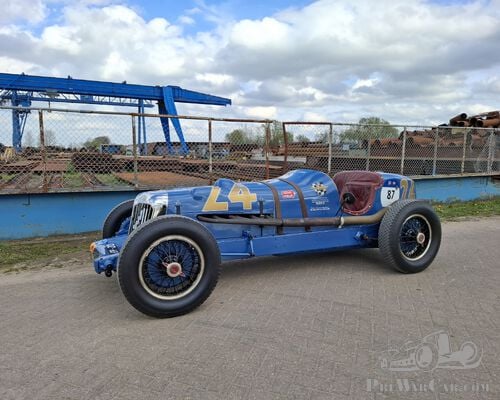
1932 - Graham " Lucenti " Indianapolis
Original participant of the 1932, 1934 and 1935 Indy 500. Best result: finishing 10th overall in the 1934 Indy 500 with driver “Herb” Ardinger...
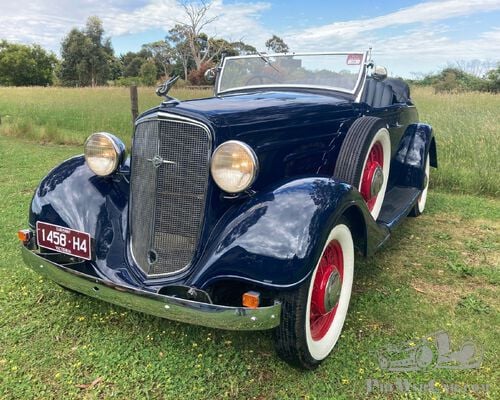
1934 Chevrolet Standard Roadster
1934 Chevrolet Standard Roadster This vehicle was delivered to Australia from Chevrolet and the body was manufactured by Holden Body Works w..
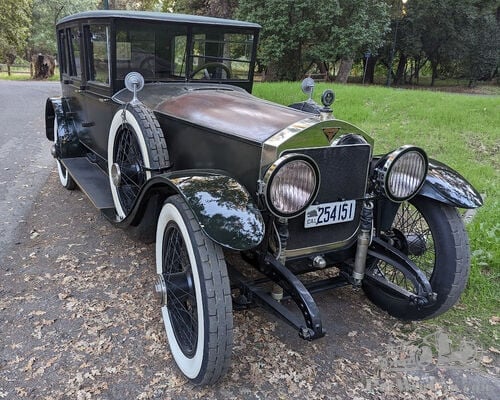
1916 Simplex, Crane model 5
1916 Simplex, Crane MODEL 5CUSTOM MADE HISTORIC PRESERVATION VEHICLE – READY TO TOUR!This Simplex recently completed th..