The global magazine and marketplace for classic car enthusiasts, by enthusiasts.


Filter
Classic Lea Francis, Morgan for sale - Lea Francis, Morgan cars for sale
-

Lea Francis Hyper 4 Seater Tourer
The first time on the market since the 1970's, an elegant 4 seater tourer with a 4ED meadows supercharged engine.We have quite a bit of history with this car, at some point in its life it was converted to a two seater with a streamlined racing body and then rebulit to its original specification in 1995 by A.B Price Ltd, its original body..

Lea-Francis
GB, 1904 – 1906; 1920 – 1935; 1937 – 1953; 1960
(1) Lea & Francis Ltd, Coventry, Warwickshire, 1904 – 1935
(2) Lea-Francis Cars Ltd, Coventry, Warwickshire, 1937 – 1960
Lea Francis started as bicycle manufacturers, like so many car makers, but unlike most of the rest, never went over permanently and consistently to Lea Francis cars. These Lea Francis cars appeared in fits and starts. The first appeared in 1904, in the shape of a 15hp Lea Francis car with a 3-cylinder horizontal engine, the oddest feature of which was its connecting rods over 3ft long. In the same year, however, Lea Francis stopped making their cars, and Singer the Cycle Company began building Lea Francis cars under licence and under the Singer name. R.H. Lea had in fact worked for Singer before branching out on his own. Thus began another famous car name. Lea Francis made motor cycles from 1911, and they concentrated on these until 1920. In that year two Lea Francis cars reappeared beside the motorcycles; assembled 4-cylinder touring Lea Francis cars of 11.9 and 13.9hp. Few of either were made. Then, late in 1922, the Lea Francis car company found its feet at last, with an equally conventional assembled light Lea Francis car. This Lea Francis car had a 1.074cc 4-cylinder sv engine of 8.9hp by Coventry-Simplex, replaced in the following year by a 10hp Meadows unit of 1¼ litres with overhead valves. A Lea Francis car with 7hp Bradshaw flat-twin engine came to nothing. There were 3 forward speeds and quarter-elliptic springs at both ends. The 10hp Lea Francis car was very popular, and was made until 1928. Like other Lea Francise cars to come, it was well made, dependable, and lively. The great moment came for the Lea Francis cars in the very important RAC Small Car Trials of 1924, in which the Lea Francis car made the best all-round performance. During 1925 a wider family market was sought with the 12/22hp J-type Lea Francis car. This Lea Francis car had a longer wheelbase, allowing more spacious bodies, front-wheel brakes, a 1½-litre 4EC Meadows engine to cope with the weight and a 4-speed gearbox. For the sake of comfort, semi-elliptic springs were substituted at the rear on the P-type Lea Francis car introduced for 1928, which also had a plate clutch and 4ED meadows engine.
The Lea Francis car firm’s first serious sports car was the L-type with 4ED engine, announced for 1925. The Lea Francis 12/40hp was one of the best assembled cars in Britain, and appealed more widely than the light Lea Francis cars. It was, indeed, current until the second cessation of car production in 1935. However, Lea Francis also made some more ponderous, less lively Lea Francis cars, without the same degree of success. From 1925 until 1929, the Lea Francis range duplicated some of the heavy 6-cylinder machines offered by Vulcan of Southport, with whom Lea Francis cars had been associated since 1922. The 18hp Lea Francis car was a 2¼-litre car with cantilever rear springs and overhead worm drive. This Lea Francis car was succeeded by A.O. Lord’s Type T, with its advanced but unreliable Lea Francis LFS-type, double ohc engine of 1.7-litres. There was also, in 1928, a 2-litre six Lea Francis car. These Vulcan/ Lea Francis cars ended with the demise of the Vulcan. However, an excellent Lea Francis car with a six was at last introduced for 1931: the Lea Francis Ace of Spades model, with their own 2-litre, single ohc engine. This Lea Francis car continued alongside the old 12/40hp until 1935, together with a new 18hp Lea Francis car, which was a 2¼-litre enlargement of the Lea Francis Ace of Spades. However, a really powerful Lea Francis car was also listed from 1928. This Lea Francis Hyper Sports was a quite different car, with its heavily-modified, Cozette-supercharged Meadows 1½-litre engine, low build and raked radiator. The sports-racing two-seater Lea Francis car could attain 90mph, though a coupé and a short open tourer could also be had by those who did not intend to enter competitions. The Lea Francis Hyper Sports won the 1928 Ulster Trophy race.
A new company introduced two entirely new Lea Francis cars for 1938. These Lea Francis cars were designed by Hugh Rose, who had been responsible for the Riley Nine engine and, like the Riley, had 4-cylinder power units with push-rod overhead valves operated by two high camshafts. The Lea Francis car had ceased to be an entirely assembled car. A 12hp and a 14hp Lea Francis car were available, with cubic capacities of 1½ and 1.6-litres. Both had a 4-speed synchromesh gearbox. A sports version of the 1½-litre Lea Francis car was also sold, thus maintaining the old tradition. These two ‘Leafs’ were good cars, and as they were new, up-to-date Lea Francis carmodels, they could be continued after World War 2. Most of those built in this period were Lea Francis Fourteens, which were heavier but had a bigger bore and a capacity of 1.8-litres. A tuned sports Lea Francis car of the 14hp arrived for 1948. At the end of that year, an export version of the 14hp Lea Francis car, with torsion-bar independent front suspension, was shown and this suspension was adopted for both the 14hp and for the new 18hp, with a 2½-litre engine, in 1950. The sports model of the 18hp Lea Francis car was a fine car, with 100bhp available. The Lea Francis cars for 1953 had hydraulic brakes, but that was the last year in which the Lea Francis car appeared as a competitive production car. By mid-1952, output had fallen to six Lea Francis cars a week. An expensive car of specialist appeal, the post-war years were too hard for it. In 1960 a few prototypes of a new sports Lea Francis car, the Leaf-Lynx, were made, but it never reached production. The power unit of this Lea Francis car was a 2½-litre Ford Zephyr, there was independent front suspension and disc brakes were supplied, but the car was ill-favoured and ill received. No better luck attented the Lea Francis carfirm’s attempt to make the Nobel bubble-car.
Source: Georgano, encyclopedia of motorcar; TRN
The information is written with the greatest of care. However, if you have any suggested amendments please contact us at office@prewarcar.com
Morgan
GB, 1905 – 1906
Morgan and Co Ltd, Leighton Buzzard, Beds.
Made by a well-known firm of coachbuilders, the Morgan car was a conventional shaft-driven car with 5.8-litre T-head 4-cylinder Mutel engine, distinguished only by the Sparks-Boothby hydraulic clutch on the Morgan car, soon abandoned in favour of an ordinary leather cone. Only about five Morgan cars were made and their lack of success resulted in Morgan cars becoming Adler concessionaires in 1907, and abandoning motor manufacture.
GB, 1910 to date
Morgan Motor Co Ltd, Malvern Link, Worcs.
This Morgan car was the best-known, and best, of the British 3-wheelers that were popular while the horsepower tax gave the Morgan cars an advantage. H.F.S. Morgan’s tricycle was also the first of its type, this Morgan car going into production in 1910. At the front of a tubular chassis frame was an sv, air-cooled V-twin motor-cycle engine of 1.100cc by JAP, transversely mounted. Transmission of the Morgan car was by dog clutches and chains, providing two forward speeds. The steering was direct. The front wheels of the Morgan car, had independent front suspension, by sliding pillars and coil springs. There were two seats. A reasonable amount of power plus light weight meant an excellent performance of the Morgan cars. The Morgan car was safer than most 3-wheelers because its road-holding was above average. This recipe made the Morgan car popular with sportsmen, for whom the Morgan Grand Prix model was produced in 1914: the first catalogued competition Morgan car. Soon afterwards, an exiguous four-seater Morgan car, the forerunner of the Morgan Family model of the 1920s, was listed.
After World War 1, Morgan carscontinued to cater for all markets. Names changed, but the Morgan Sports or Morgan Standard model was the normal two-seater, also available in De Luxe form; the Morgan Family model was the more capacious type Morgan car, and the long-tailed Morgan Aero, later the Morgan Super Sports, was the Morgan car intended for serious speed work. Engines of Morgan cars were water- or air-cooled to choice, most being supplied by JAP, or by Blackburne in the case of the competition Morgan cars. From 1925 all the latter’s power units had overhead valves. By 1927 the Super Sports Morgan car could attain 80mph in standard trim, while the less sporting Morgan cars now had internal expanding front wheel brakes and electric starting. Geared-down steering and (if required) three forward speeds followed on Morgan cars in 1929. Even so, Morgan cars were losing customers to new, cheap sports cars such as the M-type MG. Three speeds and reverse in a normal gearbox (though still with chain final drive) were available from 1931 and standard on the Morgan car after 1932, and a modified 8hp Ford 4-cylinder engine could later be had in the Morgan car instead of the twin. Four years later the first 4-wheeled Morgan car was introduced, the excellent little Morgan 4/4. This Morgan car used an 1.122cc 4-cylinder Coventry-Climax engine with overhead inlet valves, developing 34bhp. The Morgan car was still light in weight, and retained the Morgan independent front suspension, so the performance and handling qualities of Morgan cars were well up to form. The Morgan car could attain 75mph. The twins were last catalogued in 1939.
Just before World War 2, a 1.267cc Standard 10hp engine with ohv head was substituted in the Morgan 4/4. When this was no longer available, from 1950, Morgan fitted a tuned Standard Vanguard unit in the Morgan car giving 70bhp. In this Morgan Plus Four, as the Morgan car was renamed, performance became still more lively, and when the 90bhp Triumph TR2 engine became available in 1954, maximum speed of the Morgan car rose to 100mph for the first time. With the advent of the Morgan Plus Four, there was no longer a small Morgan car, but this gap was made good in 1955, when the Morgan Series 2 4/4 arrived. This Morgan car used the very hard-wearing 1.172cc sv Ford Ten engine which had powered F4 Morgan. (The latter was the last 3-wheeler Morgan car, which had been made until 1950.) The result was a cheap, pleasant and reliable sports Morgan car of the old school. Later, the ohv Ford 105E engine was substituted. The latest version Morgan car had a 1.599cc 98bhp engine, a 4-speed all-synchromesh gearbox, front disc brakes, and the traditional Morgan suspension. The Morgan Plus Four kept pace with Triumph’s TR engine development, also acquiring disc brakes and, eventually, the 2.138cc 105bhp TR4 unit. A streamlined coupé, the Morgan Plus Four Plus of 1964, was a brief deviation from the classical Morgan car line which met with little approval and was discontinued after only 50 of these Morgan cars had been sold. When Triumph changed to a six during 1968, Morgan cars adopted a new engine for their bigger Morgan cars, and the Morgan Plus Four became the Morgan Plus Eight, powered by Rover’s 3 ½-litre 160bhp V8 and capable of 125mph. The 1973 versions of the Morgan car use the 4-speed all-synchromesh Rover gearbox in place of the Moss box previously fitted.
Source: Georgano, encyclopedia of motorcar; MCS, TRN
The information is written with the greatest of care. However, if you have any suggested amendments please contact us at office@prewarcar.com


Featured
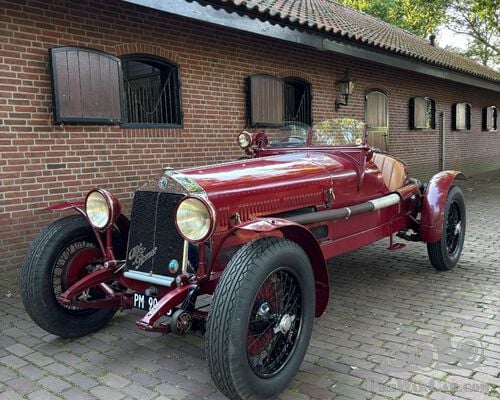
1930 Alfa Romeo 6C 1750 Spider
1930 Alfa Romeo 6C 1750 Spider with complete history from delivery to first owner in 1930 in Firenze till today with copy Libretto/license plate.
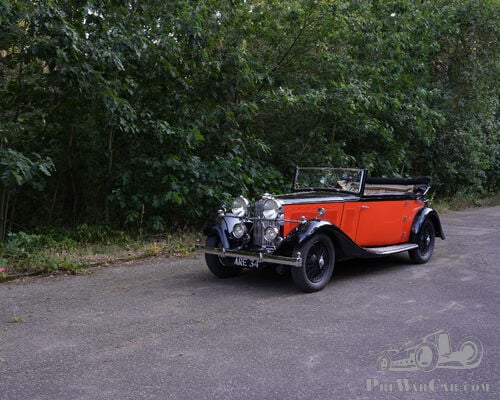
1934 Talbot AV105 Three Position Drophead Coupé
Registration no. ARE 34Chassis no. 35488 Much supporting paperworkRestored exampleVery usa..
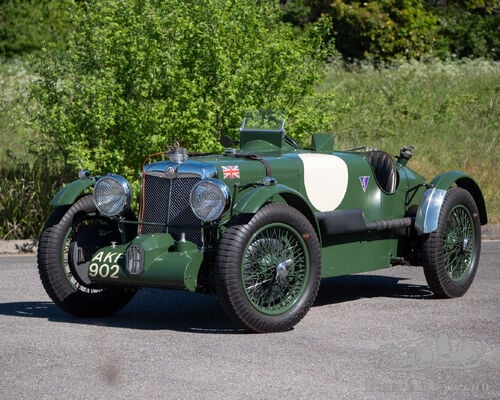
K3 Replica on KN Chassis
"The K3 Magnette must rank in the history books as the most famous and successful of all the record breaking MGs. With only 33 examples produced durin..