The global magazine and marketplace for classic car enthusiasts, by enthusiasts.


Filter
Classic Nash, Lea Francis for sale - Nash, Lea Francis cars for sale
-

1931 Nash 4 door special sedan
Model: series 870, model 877-1560, 4-door special saloon Colour: dark blueInterior: beige fabricEngine: 8-cylinder in-line, 227.5 cubic inches, 78 hpTransmission: manual, 3 gearsCondition: unrestoredPrice: € 25,000 Description:Incredibly beautiful unrestored car in superb condition. .. -
1931 Nash 480-455 Landaulette Sedan
Nash 480-455 Landaulette from 1931 only a few from these Landaulettes are made they say about 29 cars are produced like this. Frank Kennis Phone: 00.31.622.420.766 or mail me: info@KennisCars.NL www.KennisCars.NL Classic Car Dealer for Europe Cadillac ; Mercedes ; Rolls-Royce ; Delage ; Bugatti ; Bentley ; Dodge ; Opel.. -
Nash 1933 Club Sedan Big Six 1127
Beautifull Nash 1127 Club Sedan with 6 cylinder engine 3835 CC with 75 HP. The Nash has dutch documents and is in a good running condition. This could be your ultimate Bony and Clide car. Frank Kennis Phone: 00.31.622.420.766 or mail me: info@KennisCars.NL www.KennisCars.NL Classic Car Dealer for Europe Cadillac ; Mercedes ; Rolls-Royce ; .. -
Lea Francis Hyper 4 Seater Tourer
The first time on the market since the 1970's, an elegant 4 seater tourer with a 4ED meadows supercharged engine.We have quite a bit of history with this car, at some point in its life it was converted to a two seater with a streamlined racing body and then rebulit to its original specification in 1995 by A.B Price Ltd, its original body.. -
1931 Nash ”Eight-70” 871 2d Convertible Sedan Landau
The car has undergone a complete renovation regarding chassis, engine, driveline and convertible topThe engine is drilled, new pistons and connecting rod bearings and new frame bearings.The body is in new condition and the convertible top is newly manufactured. Some minor work remains to complete it for registration and inspection...


Nash
US, 1917 – 1957
(1) Nash Motor Co, Kenosha, Wisc., 1917 – 1954
(2) American Motors Corp, Kenosha, Wisc., 1954 – 1957
Charles W. Nash, the former President of General Motors, acquired the Thos. B. Jeffery Co in July 1916, and from the 1918 season onwards the cars were marketed under his name, Nash cars. The first Nash car was a 4-litre six with push-rod-operated overhead valves, followed in 1922 by a 4-cylinder Nash car which also had overhead valves at a time when most American manufacturers adhered to the L-head. Rubber-mounted engines appeared in the same year on Nash cars, when Nash sold 41.000 medium-priced Nash cars (the Nash four cost $985, the Nash six about $500 more). In 1924 Nash cars acquired the defunct Mitchell concern at Racine and the ailing Lafayette Co of Milwaukee, producers of a luxury V8 (when the latter name was revived in 1934 it was used for an uninspired sv 6-cylinder machine selling for under $600). They also produced, in 1925 – 1926, the 6-cylinder Nash Ajax, an sv Nash cars that they developed into a cheap line. During the latter part of the Vintage era the Nash carcompany concentrated on 6-cylinder Nash cars, with side valves in the cheaper Nash car models and overhead valves in the higher-priced range, though 1930 saw a Nash car with a 4.9-litre straight-8 with dual coil ignition and overhead valves, a type that was progressively developed until 1942. Engines of this type Nash car were used in the British Jensen of 1939.
The Nash car company successfully rode out the Depression though sales dropped to below 15.000 Nash cars in 1933, when the Nash car company were building a really big eight Nash car with an 11ft 10in wheelbase and a capacity of 5.3-litres as well as two sixes and a smaller straight-8. Synchromesh had been adopted on Nash cars in 1932, and overdrive became an option in 1935, when the bigger Nash cars had the fashionable fastbacks and spatted rear wheels. Other options on the Nash car widely publicized in the later 1930s were seats convertible into a bed and the Nash car firm’s ‘Weather Eye’ system of air conditioning. Coil-spring independent front suspension and steering-column gear-change followed in 1939, in which year a version of the Nash Ambassador Six was available in England with the option of a Perkins 4.7-litre diesel engine in place of the usual push-rod ohv petrol unit. Unitary construction appeared for the first time on the inexpensive sv 6-cylinder 600 Nash car sedan, introduced for 1941 at $785. This Nash car was the ancestor of the famous Rambler series and reappeared in 1945. Only 6-cylinder Nash cars were made from 1945 until 1954, and with the advent of the Nash Airflyte range in 1949 unitary construction was standardized. These Nash cars had all four wheels enclosed, and a one-piece wrap-around windscreen.
In 1950 there came the experimental NXI Nash car convertible with an Austin A40 engine, later made for Nash cars by Austin of Birmingham as the Metropolitan, while in 1951 there appeared the 3.8-litre Nash-Healey roadster, a British Healey with an ohv 6-cylinder Nash car engine. From 1950 onwards the Rambler accounted for most of Nash cars production, but the original Nash carname survived the amalgamation with Hudson and the creation of American Motors in 1954. In 1955 the big Nash cars were fitted with an ohv 5.244cc V8 engine, this and its Ultramatic transmission being made by Packard. A 5.8-litre AMC-built eight was adopted in 1957 by Nash cars, but sales were negligible and the 1958 Nash cars were known as Rambler Ambassadors.
Source: Georgano, encyclopedia of motorcar; MCS
The information is written with the greatest of care. However, if you have any suggested amendments please contact us at office@prewarcar.com
Lea-Francis
GB, 1904 – 1906; 1920 – 1935; 1937 – 1953; 1960
(1) Lea & Francis Ltd, Coventry, Warwickshire, 1904 – 1935
(2) Lea-Francis Cars Ltd, Coventry, Warwickshire, 1937 – 1960
Lea Francis started as bicycle manufacturers, like so many car makers, but unlike most of the rest, never went over permanently and consistently to Lea Francis cars. These Lea Francis cars appeared in fits and starts. The first appeared in 1904, in the shape of a 15hp Lea Francis car with a 3-cylinder horizontal engine, the oddest feature of which was its connecting rods over 3ft long. In the same year, however, Lea Francis stopped making their cars, and Singer the Cycle Company began building Lea Francis cars under licence and under the Singer name. R.H. Lea had in fact worked for Singer before branching out on his own. Thus began another famous car name. Lea Francis made motor cycles from 1911, and they concentrated on these until 1920. In that year two Lea Francis cars reappeared beside the motorcycles; assembled 4-cylinder touring Lea Francis cars of 11.9 and 13.9hp. Few of either were made. Then, late in 1922, the Lea Francis car company found its feet at last, with an equally conventional assembled light Lea Francis car. This Lea Francis car had a 1.074cc 4-cylinder sv engine of 8.9hp by Coventry-Simplex, replaced in the following year by a 10hp Meadows unit of 1¼ litres with overhead valves. A Lea Francis car with 7hp Bradshaw flat-twin engine came to nothing. There were 3 forward speeds and quarter-elliptic springs at both ends. The 10hp Lea Francis car was very popular, and was made until 1928. Like other Lea Francise cars to come, it was well made, dependable, and lively. The great moment came for the Lea Francis cars in the very important RAC Small Car Trials of 1924, in which the Lea Francis car made the best all-round performance. During 1925 a wider family market was sought with the 12/22hp J-type Lea Francis car. This Lea Francis car had a longer wheelbase, allowing more spacious bodies, front-wheel brakes, a 1½-litre 4EC Meadows engine to cope with the weight and a 4-speed gearbox. For the sake of comfort, semi-elliptic springs were substituted at the rear on the P-type Lea Francis car introduced for 1928, which also had a plate clutch and 4ED meadows engine.
The Lea Francis car firm’s first serious sports car was the L-type with 4ED engine, announced for 1925. The Lea Francis 12/40hp was one of the best assembled cars in Britain, and appealed more widely than the light Lea Francis cars. It was, indeed, current until the second cessation of car production in 1935. However, Lea Francis also made some more ponderous, less lively Lea Francis cars, without the same degree of success. From 1925 until 1929, the Lea Francis range duplicated some of the heavy 6-cylinder machines offered by Vulcan of Southport, with whom Lea Francis cars had been associated since 1922. The 18hp Lea Francis car was a 2¼-litre car with cantilever rear springs and overhead worm drive. This Lea Francis car was succeeded by A.O. Lord’s Type T, with its advanced but unreliable Lea Francis LFS-type, double ohc engine of 1.7-litres. There was also, in 1928, a 2-litre six Lea Francis car. These Vulcan/ Lea Francis cars ended with the demise of the Vulcan. However, an excellent Lea Francis car with a six was at last introduced for 1931: the Lea Francis Ace of Spades model, with their own 2-litre, single ohc engine. This Lea Francis car continued alongside the old 12/40hp until 1935, together with a new 18hp Lea Francis car, which was a 2¼-litre enlargement of the Lea Francis Ace of Spades. However, a really powerful Lea Francis car was also listed from 1928. This Lea Francis Hyper Sports was a quite different car, with its heavily-modified, Cozette-supercharged Meadows 1½-litre engine, low build and raked radiator. The sports-racing two-seater Lea Francis car could attain 90mph, though a coupé and a short open tourer could also be had by those who did not intend to enter competitions. The Lea Francis Hyper Sports won the 1928 Ulster Trophy race.
A new company introduced two entirely new Lea Francis cars for 1938. These Lea Francis cars were designed by Hugh Rose, who had been responsible for the Riley Nine engine and, like the Riley, had 4-cylinder power units with push-rod overhead valves operated by two high camshafts. The Lea Francis car had ceased to be an entirely assembled car. A 12hp and a 14hp Lea Francis car were available, with cubic capacities of 1½ and 1.6-litres. Both had a 4-speed synchromesh gearbox. A sports version of the 1½-litre Lea Francis car was also sold, thus maintaining the old tradition. These two ‘Leafs’ were good cars, and as they were new, up-to-date Lea Francis carmodels, they could be continued after World War 2. Most of those built in this period were Lea Francis Fourteens, which were heavier but had a bigger bore and a capacity of 1.8-litres. A tuned sports Lea Francis car of the 14hp arrived for 1948. At the end of that year, an export version of the 14hp Lea Francis car, with torsion-bar independent front suspension, was shown and this suspension was adopted for both the 14hp and for the new 18hp, with a 2½-litre engine, in 1950. The sports model of the 18hp Lea Francis car was a fine car, with 100bhp available. The Lea Francis cars for 1953 had hydraulic brakes, but that was the last year in which the Lea Francis car appeared as a competitive production car. By mid-1952, output had fallen to six Lea Francis cars a week. An expensive car of specialist appeal, the post-war years were too hard for it. In 1960 a few prototypes of a new sports Lea Francis car, the Leaf-Lynx, were made, but it never reached production. The power unit of this Lea Francis car was a 2½-litre Ford Zephyr, there was independent front suspension and disc brakes were supplied, but the car was ill-favoured and ill received. No better luck attented the Lea Francis carfirm’s attempt to make the Nobel bubble-car.
Source: Georgano, encyclopedia of motorcar; TRN
The information is written with the greatest of care. However, if you have any suggested amendments please contact us at office@prewarcar.com


Featured
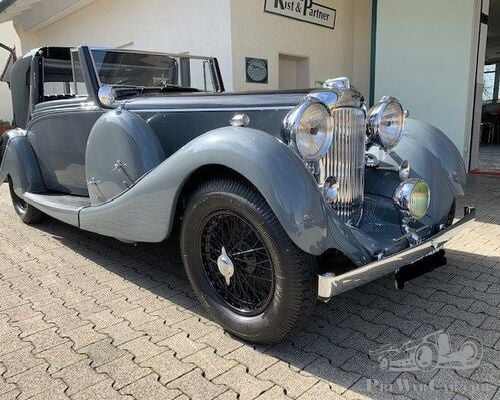
Lagonda LG 45 Coupe de Ville Sedanca by Mayfair
The successor to the M45, the LG45 was built around the same highly capable, competition-proven 4.5-litre Meadows inline-six engine, but featured r..
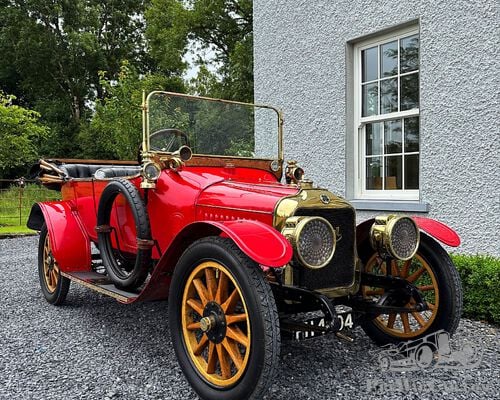
1914 Brasier
1914 Brasier Tourer 9ABrasier were a French manufacturer who were in business from 1901 until 1930, when the company became victim of the gr..
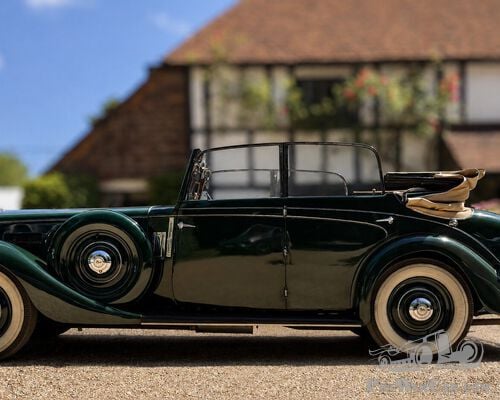
1936 Armstrong Siddeley 20/25 Cabriolet with Tickford coachwork by Salmons & Sons, Newport Pagnell
This exceptionally rare Armstrong Siddeley 20/25 Cabriolet with original Tickford coachwork by Salmons & Sons of Newport Pagnell was first reg..