The global magazine and marketplace for classic car enthusiasts, by enthusiasts.


Filter
Classic Lea Francis, Riley for sale - Lea Francis, Riley cars for sale
-

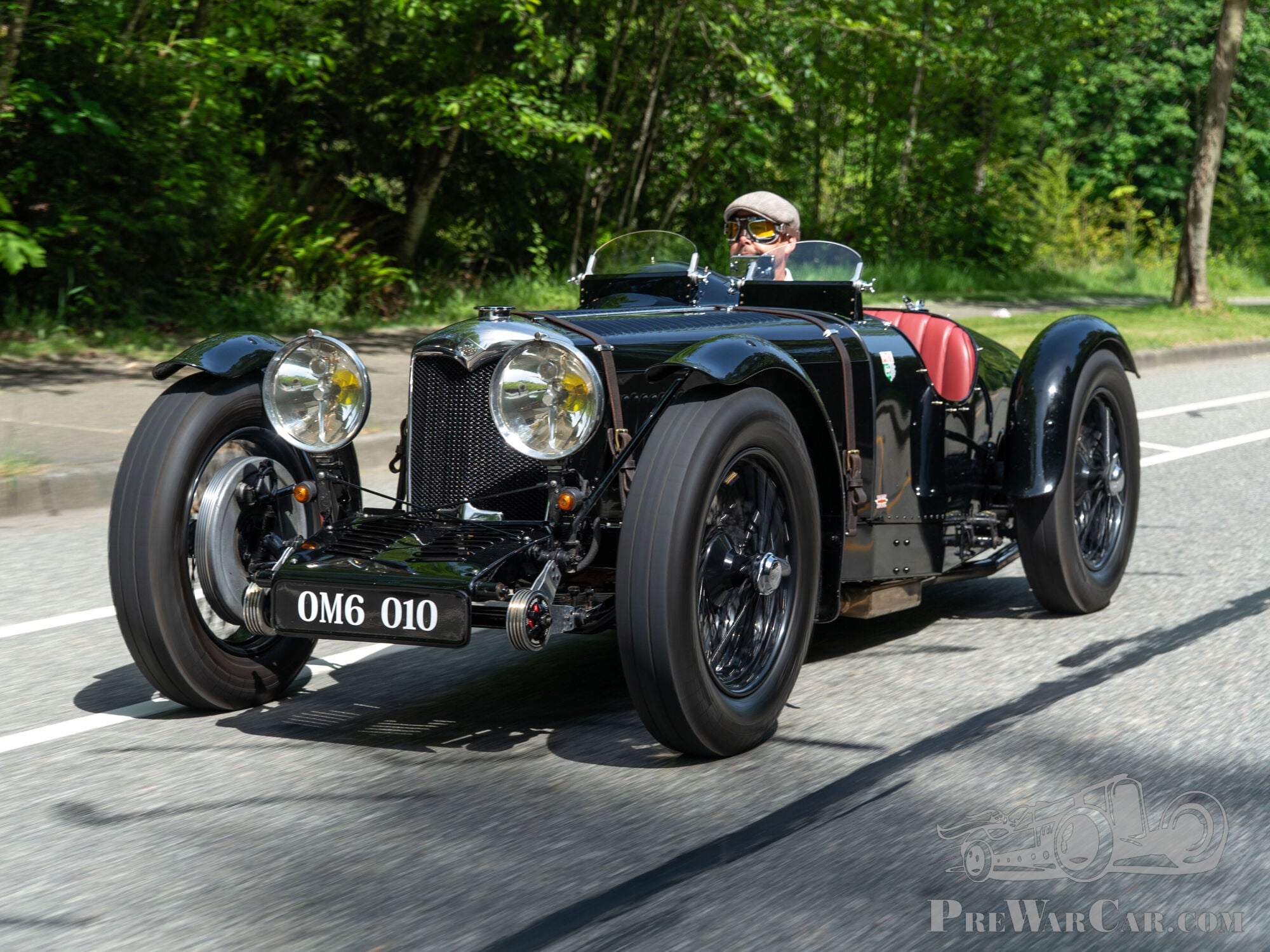
Riley 14/6 MPH Rep. 1936
This beautiful MPH Replica was accurately recreated by Riley Specialist Barrie Gillies circa 2002.Every detail is beautifully crafted, just like the original. This includes the interior and the storage compartments for the racing windows.Fast 6 cylinder engine that makes an impressive sound.Ideal car for rallies and events. -
1933 Riley Nine Lynx Tourer | Brightwells | Auction Ends: Wed 05th Aug
Believed to have been owned by the grandson of Percy Riley; considerable rebuilt between 1984 and 1984; owned by our vendor for the last 24 years; runs and drives During the late 1920s and early 1930s, Riley established itself as one of Britain's finest manufacturers of small sporting cars. Combining advanced engineering wit.. -
RILEY 12/4 Sport komplette Technik überholt
Riley 12/4 SportCompletely ooverhauled technique and rebuilt by a specialist companyEngine tuned for increased performancePreselector tested on a dynamometerAxles, steeringNew rims and tiresBuilt to a high standardSoft top and cockpit coverRuns very well.German registration (H) -
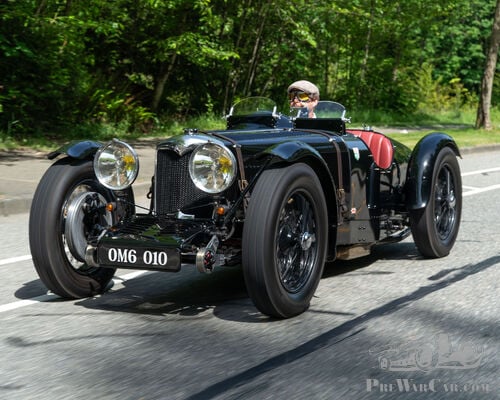
Riley 14/6 Special 1933
The ExperienceStep into the golden age of British motoring. This 1933 Riley 14/6 Special is a masterclass in pre-war engineering. It creates a rare sensation where the world slows down, leaving only the roar and rush of a true vintage racer. Meticulously built to pair breathtaking aesthetics with the power of the.. -
The famous white Riley 12/4 from 1936 with Race History ex New Zealand
The famous white Riley of racing driver Mrs. Ivy Stephenson , Riley 12/4 Kestrel Special from 1936A car which was built as a race car and still can be successfully raced today!- A known car with racing history in New Zealand -Restored in excellent state and condition-Comprehensively files and documentation .. -
Riley 12/4 Sports Special
The 1937 Riley 12/4 Sports Special sits at the intersection of two important British motoring traditions: Riley's sophisticated pre-war engineering and the long-standing culture of building "specials" from older chassis.The Riley 12/4: An Advanced Sporting CarThe underlying Riley 12/4 was introduced in 1935 as Ri.. -
1936 Riley Special
This beautiful 1936 Riley, started life as a 12/ 4 model whilst the running gear is all from the lauded nine, with a desirable preselector box. In super condition throughout and continuously maintained , this might be the ideal European tourer, with its sprightly performance and full weather equipment to include hood and side screens.Runn.. -
1933 Riley 9 Monaco Saloon 1089cc Twin Cam
Here for sale is a particularly attractive early metal-bodied Monaco, finished in dark blue over black with nicely proportioned four door all metal coachwork. Upright and purposeful in the way only a proper pre-war sporting saloon can be.Inside, the largely original black leather interior has just the right amount of age and character – h.. -
Riley 12/4 special Project
Zu verkaufen steht ein Riley Special Projekt. Das Fahrzeug wurde schon mit einer neuen Karosse versehen. Dazu wurden, wie für alle Rileys üblich der Kühler und Motor nach hinten versetzt und der hintere Teil des Rahmens abgeändert. Alle Änderungen sind so, wie in den meisten bekannten Riley Büchern beschrieben, durchgeführt worden.( dies.. -
Lea Francis Hyper 4 Seater Tourer
The first time on the market since the 1970's, an elegant 4 seater tourer with a 4ED meadows supercharged engine.We have quite a bit of history with this car, at some point in its life it was converted to a two seater with a streamlined racing body and then rebulit to its original specification in 1995 by A.B Price Ltd, its original body..




Lea-Francis
GB, 1904 – 1906; 1920 – 1935; 1937 – 1953; 1960
(1) Lea & Francis Ltd, Coventry, Warwickshire, 1904 – 1935
(2) Lea-Francis Cars Ltd, Coventry, Warwickshire, 1937 – 1960
Lea Francis started as bicycle manufacturers, like so many car makers, but unlike most of the rest, never went over permanently and consistently to Lea Francis cars. These Lea Francis cars appeared in fits and starts. The first appeared in 1904, in the shape of a 15hp Lea Francis car with a 3-cylinder horizontal engine, the oddest feature of which was its connecting rods over 3ft long. In the same year, however, Lea Francis stopped making their cars, and Singer the Cycle Company began building Lea Francis cars under licence and under the Singer name. R.H. Lea had in fact worked for Singer before branching out on his own. Thus began another famous car name. Lea Francis made motor cycles from 1911, and they concentrated on these until 1920. In that year two Lea Francis cars reappeared beside the motorcycles; assembled 4-cylinder touring Lea Francis cars of 11.9 and 13.9hp. Few of either were made. Then, late in 1922, the Lea Francis car company found its feet at last, with an equally conventional assembled light Lea Francis car. This Lea Francis car had a 1.074cc 4-cylinder sv engine of 8.9hp by Coventry-Simplex, replaced in the following year by a 10hp Meadows unit of 1¼ litres with overhead valves. A Lea Francis car with 7hp Bradshaw flat-twin engine came to nothing. There were 3 forward speeds and quarter-elliptic springs at both ends. The 10hp Lea Francis car was very popular, and was made until 1928. Like other Lea Francise cars to come, it was well made, dependable, and lively. The great moment came for the Lea Francis cars in the very important RAC Small Car Trials of 1924, in which the Lea Francis car made the best all-round performance. During 1925 a wider family market was sought with the 12/22hp J-type Lea Francis car. This Lea Francis car had a longer wheelbase, allowing more spacious bodies, front-wheel brakes, a 1½-litre 4EC Meadows engine to cope with the weight and a 4-speed gearbox. For the sake of comfort, semi-elliptic springs were substituted at the rear on the P-type Lea Francis car introduced for 1928, which also had a plate clutch and 4ED meadows engine.
The Lea Francis car firm’s first serious sports car was the L-type with 4ED engine, announced for 1925. The Lea Francis 12/40hp was one of the best assembled cars in Britain, and appealed more widely than the light Lea Francis cars. It was, indeed, current until the second cessation of car production in 1935. However, Lea Francis also made some more ponderous, less lively Lea Francis cars, without the same degree of success. From 1925 until 1929, the Lea Francis range duplicated some of the heavy 6-cylinder machines offered by Vulcan of Southport, with whom Lea Francis cars had been associated since 1922. The 18hp Lea Francis car was a 2¼-litre car with cantilever rear springs and overhead worm drive. This Lea Francis car was succeeded by A.O. Lord’s Type T, with its advanced but unreliable Lea Francis LFS-type, double ohc engine of 1.7-litres. There was also, in 1928, a 2-litre six Lea Francis car. These Vulcan/ Lea Francis cars ended with the demise of the Vulcan. However, an excellent Lea Francis car with a six was at last introduced for 1931: the Lea Francis Ace of Spades model, with their own 2-litre, single ohc engine. This Lea Francis car continued alongside the old 12/40hp until 1935, together with a new 18hp Lea Francis car, which was a 2¼-litre enlargement of the Lea Francis Ace of Spades. However, a really powerful Lea Francis car was also listed from 1928. This Lea Francis Hyper Sports was a quite different car, with its heavily-modified, Cozette-supercharged Meadows 1½-litre engine, low build and raked radiator. The sports-racing two-seater Lea Francis car could attain 90mph, though a coupé and a short open tourer could also be had by those who did not intend to enter competitions. The Lea Francis Hyper Sports won the 1928 Ulster Trophy race.
A new company introduced two entirely new Lea Francis cars for 1938. These Lea Francis cars were designed by Hugh Rose, who had been responsible for the Riley Nine engine and, like the Riley, had 4-cylinder power units with push-rod overhead valves operated by two high camshafts. The Lea Francis car had ceased to be an entirely assembled car. A 12hp and a 14hp Lea Francis car were available, with cubic capacities of 1½ and 1.6-litres. Both had a 4-speed synchromesh gearbox. A sports version of the 1½-litre Lea Francis car was also sold, thus maintaining the old tradition. These two ‘Leafs’ were good cars, and as they were new, up-to-date Lea Francis carmodels, they could be continued after World War 2. Most of those built in this period were Lea Francis Fourteens, which were heavier but had a bigger bore and a capacity of 1.8-litres. A tuned sports Lea Francis car of the 14hp arrived for 1948. At the end of that year, an export version of the 14hp Lea Francis car, with torsion-bar independent front suspension, was shown and this suspension was adopted for both the 14hp and for the new 18hp, with a 2½-litre engine, in 1950. The sports model of the 18hp Lea Francis car was a fine car, with 100bhp available. The Lea Francis cars for 1953 had hydraulic brakes, but that was the last year in which the Lea Francis car appeared as a competitive production car. By mid-1952, output had fallen to six Lea Francis cars a week. An expensive car of specialist appeal, the post-war years were too hard for it. In 1960 a few prototypes of a new sports Lea Francis car, the Leaf-Lynx, were made, but it never reached production. The power unit of this Lea Francis car was a 2½-litre Ford Zephyr, there was independent front suspension and disc brakes were supplied, but the car was ill-favoured and ill received. No better luck attented the Lea Francis carfirm’s attempt to make the Nobel bubble-car.
Source: Georgano, encyclopedia of motorcar; TRN
The information is written with the greatest of care. However, if you have any suggested amendments please contact us at office@prewarcar.com
Riley
GB, 1898 – 1969
(1) Riley Cycle Co Ltd, Coventry, Warwickshire, 1898 – 1912
(2) Riley (Coventry) Ltd, Coventry, Warwickshire, 1912 – 1948
(3) Riley Motors Ltd, Abingdon, Berks., 1948 – 1969
The first Riley car was a small single-cylinder belt-driven voiturette which Riley car did not go into production. Motor Riley tricycles followed n 1900, and a handlebar-steered Riley tricar with 2 forward speeds, and a 517cc engine with mechanically-operated inlet valves in 1903. Riley Tricars were made until 1907, later examples of these threewheeled Riley cars being twins with driver’s seats in place of saddles, water cooling and wheel steering. The 1.034cc V-twin engine was also fitted to the Riley car company’s first 4-wheelers, which Riley car had amidships-mounted power unit with their gearboxes alongside and chain drive, and the Riley car sold for £168. Bigger V-twins of 2-litres’ capacity, more conventional layout and round radiators were made from 1908 onwards. These Riley car incorporated pressure lubrication, shaft drive, constant-mesh 3-speed gearboxes, and Riley’s own patent detachable wheels, the demand for which brought Riley car production almost to a standstill and was responsible for the formation of the new Riley car company in 1912. In 1914 the 2-cylinder Riley cars were still being made, but there was also a new 2.9-litre sv monobloc four Riley car with worm drive, which was offered again after World War 1 by the Riley engine Co, though this Riley car soon disappeared from the market.
The first post-war 1 Riley cars were the Riley Elevens with sv 1½-litre 35bhp engines, alloy pistons and full electrical equipment which Riley cars were selling £550 in 1920, acquiring spiral bevel final drive in 1921. The Redwinger sports version of the Riley car, with wire wheels and polished-aluminium coachwork appeared in 1923, offering 70mph for £450, and the sv Riley cars were continued until 1928, with a 1.645cc engine and the option of front-wheel brakes in 1925. One of these Riley Twelves was used to prospect Kenya’s road system in 1926, and in 1927 there was even a supercharged development Riley car of the Redwinger available, though this Riley car was overshadowed by Percy Riley’s advanded new Riley Nine, with a 1.987cc 32bhp 4-cylinder engine, twin camshafts and high push-rods, a unit which was to form the basis of all Riley car designs made up to 1957.
In 1928 came the handsome Riley Monaco fabric sports saloon version at £298, a best-seller Riley car from the start, and the lowered and tuned Riley Brooklands sports, inspired by the late J.G. Parry Thomas, which Riley car weighed 1.120lb, had a twin-carburettor 50bhp engine, and was capable of 80mph, all for £395. A twin carburettor variant of the touring Riley Nine followed in 1929, along with a new 1.6-litre 6-cylinder Riley Fourteen of similar styling at £495.
Riley cars had a distinguished competition record in the following years: class wins with a Riley car in the 1929, 1930, and 1931 Tourist Trophies were followed by Whitcroft’s outright victory in 1932, while two more wins were recorded by F.W. Dixon on the later 1½-litre 4-cylinder Riley car in 1935 and 1936. A 4th place at Le Mans in 1933 led to 2nd, 3rd, 5th, 6th, 12th and 13th places in 1934, not to mention three successive wins – 1934, 1935, and 1936 – in the BRDC 500 Mile Race at Brooklands. Leverett won the light-car class of the 1931 Monte Carlo Rally on a Riley Nine, while the 6-cylinder racing Riley cars of 1933-1934 formed the genesis of the ERA, and nearly twenty years later the late Mike Hawthorn was to make his name in Club Racing on sports Riley Nines and 1½-litres. Both the Riley Nine and the Riley 14/6 were progressively developed, the former Riley car acquiring vacuum feed in 1931, a lowered chassis and semi-panelled bodywork in 1932, and an optional (later standard) preselector gearbox in 1934. A super-sports 6-cylinder 1½-litre Riley car with water-cooled centre main bearing appeared in 1932, being followed in 1933 by the touring Riley Mentone version at £348. 1933 also brought two advanced body styles of Riley cars, the fastback Riley Kestrel saloon (listed up to the end of the old Riley car company in 1938) and the more-conservatively styled Riley Falcon on which the doors opened into the roof. A Salerni automatic transmission was offered on the 14/6 Riley car, but did not go into regular production.
Two handsome sports two-seater variants Riley cars were listed in 1934/ 1935, the Riley 9hp Imp on a 7ft 6in wheelbase and the 1.654cc 6-cylinder Riley MPH which gave over 90mph for £550, while a newcomer in 1935 was the classic 1½-litre Four Riley car with Wilson gearbox, rod-operated Girling brakes and centralized chassis lubrication, a best-seller in its class at £335, and available in single- and twin-carburettor versions: subsequent developments were the 85mph Riley Sprite two-seater and the Riley Kestrel-Sprite and Riley Lynx-sprite saloon and tourer which offered more room but the same highly-tuned engine for £398. A cheaper Riley Nine, the Riley Merlin with pressed-steel bodywork, came on the market in 1936, along with the 1½-litre, a 6-cylinder 15/6 Riley car, and a 2.2-litre V8 Riley car, of which very few were made, the engine of the V8 Riley car made up of two 9hp blocks. 1937 Riley Nines came with new 6-light Riley Monaco bodies and twin-carburettor 42bhp engines as standard, while other new models of Riley cars were an abortive 3-litre luxury V8 made by a subsidiary company, Autovia Cars, and a more successful long-stroke 2.4-litre Big Four Riley car on classic lines, with an 85bhp engine and Borg-Warner 3-speed synchromesh gearbox incorporating an overdrive at £385. Overdrive was optional on 1938 1½-litres Riley cars.
Finances, however, were insecure and the Riley car company were acquired by the Nuffield Organization later in that year. Under the new management only the 1½-litre and the Big Four Riley cars were continued, with disc wheels, conventional synchromesh gearboxes and Wolseley-like bodywork. The post-World War 2 successors Riley cars used the same engines, but were altogether more handsome Riley cars with independent torsion-bar front suspension and fabric tops, the bigger engine’s output being boosted first to 90bhp and then to 100bhp: this Riley car unit was also used by Healey in the 1946 – 1954 period, while some open three-seater versions with column change were made by Riley cars for export. Hypoid back axles and full hydraulic brakes were incorporated in 1952 Riley cars.
After the Nuffield-Austin amalgamation the 1½-litre Riley car was continued into 1955 with relatively little change, but the 1954 2½-litre Riley Pathfinder shared its bodywork with Wolseley’s 6-90, the new chassis being a BMC design with coil rear suspension and cam-type steering. Even this disappeared after 1957 in favour of a version with a 2.6-litre 6-cylinder ohv BMC engine, and subsequent Riley cars were merely luxury versions of BMC themes, starting with the Riley One-Point-Five (basically a Wolseley 1500), and working through variations of the Farina-styled 1½-litre and 1.6-litre saloon Riley cars, the Mini, and, from 1966, the 1100/1300 family with Hydrolastic suspension, known in Riley cars guise as the Kestrel. Riley’s Mini, the Riley Elf, had a built-out boot and (from 1963) a 998cc engine in place of the standard 848cc Austin/ Morris type. This meaningeless badge-engineering was stopped by British Leyland in 1969.
Source: Georgano, encyclopedia of motorcar; MCS
The information is written with the greatest of care. However, if you have any suggested amendments please contact us at office@prewarcar.com


Featured
Riley 14/6 Special 1933
The ExperienceStep into the golden age of British motoring. This 1933 Riley 14/6 Special is a masterclass in pre-w..
1930 Alfa Romeo 6C 1750 Spider
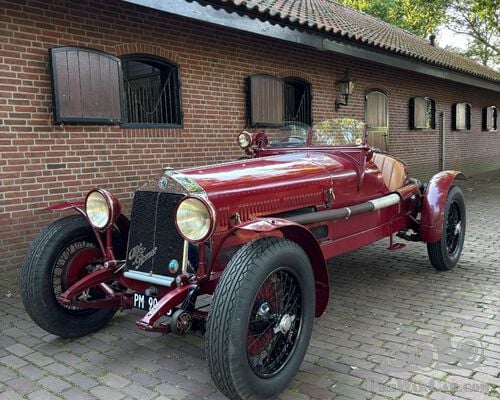
1930 Alfa Romeo 6C 1750 Spider with complete history from delivery to first owner in 1930 in Firenze till today with copy Libretto/license plate.
K3 Replica on KN Chassis
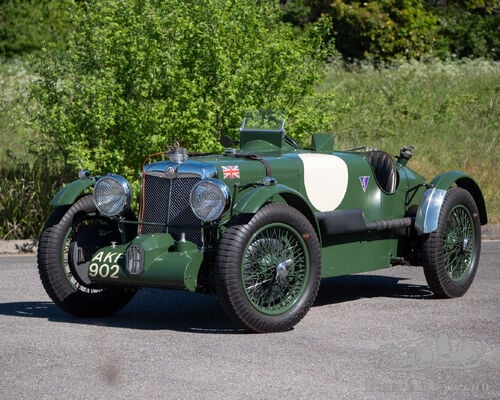
"The K3 Magnette must rank in the history books as the most famous and successful of all the record breaking MGs. With only 33 examples produced durin..