The global magazine and marketplace for classic car enthusiasts, by enthusiasts.


Filter
Classic DB, Léon Bollee for sale - DB, Léon Bollee cars for sale
-

D.B. 6 Monoposto; the first genuine single-seater by Deutsch & Bonnet
D.B. 6 Monoposte - Deutsch Bonnet Grand PrixThe very first D.B. monopostoExceptionally well-documented competition historyRaced extensively by René Bonnet (1947–1950)Eligible for events as Monaco Historic Grand Prix This D.B. 6 Monoposto is a unique survivor from the early post-war years..

D.B.
France, 1938 – 1961
Automobiles D.B., Champigny-sur-Marne, Seine
Deutsch and Bonnet were building ‘specials’ based on 11CV traction avant Citroëns in 1938. In 1947 limited production began again, the first DBs being competition machines largely built up from reconditioned components, using 1½-litre and 2-litre engines and 4-speed gearboxes. A new DB car based on the Dyna-Panhard ran at Montlhéry in 1948, while in 1949 the Deutsch and Bonnet (DB) company produced a 500cc single-seater version for Formula III, with the Panhard engine mounted in the nose, and independent swing-axle rear suspension. Some 100mph Citroën-based Deutsch and Bonnet (DB) convertibles were also made, but after 1950 Deutsch and Bonnet (DB) devoted all their energies to Panhard derivatives. Though never a major force in Formula III, the Deutsch and Bonnet (DB) cars gained numerous International Class Records and won the Index of Performance at Le Mans five times (1954, 1956, 1959, 1960 and 1961). Also Laureau’s Deutsch and Bonnet (DB) won the 1954 TT outright. An attempt to contest the 2½-litre GP Formula of 1954 with the alternative permitted size of 750cc supercharged was a fiasco, and little came of the curious Deutsch and Bonnet (DB) Monomills (the same cars with blowers removed) with which Deutsch and Bonnet tried to popularize one-class racing in France. Equally abortive were experiments with twin engines and 4-wheel drive (for sale in 1952) and with rear-mounted Renault engine and 5-speed gearboxes (for sale in 1953). The production Deutsch and Bonnet (DB) sports coupés used regular Panhard mechanical components allied to light alloy bodywork (fiberglass from 1955) and were marketed in various engine capacities from 610cc (30bhp) to 1300cc (65bhp). M.A.G. low-pressure superchargers were listed from 1954, and disc brakes were an option a year later on Deutsch and Bonnet (DB). The standard 1958 Deutsch and Bonnet (DB)model was the Rallye coupé with a 55bhp 850cc engine. Deutsch and Bonnet (DB) remained faithful to Panhard until the partnership was dissolved in 1961. René Bonnet continued the manufacture of cars in the Champigny works under his own name.
Source: Georgano, encyclopedia of motorcar; MCS
The information is written with the greatest of care. However, if you have any suggested amendments please contact us at office@prewarcar.com
Léon Bollee
France, 1895 – 1933
(1) Automobiles Léon Bollée, Le Mans, 1895 – 1924
(2) Morris Motors Ltd, Usines Léon Bollée, Le Mans, 1925 – 1931
(3) Sté Nouvelle Léon Bollée, Le Mans, 1931 – 1933
Leon Bollee was a son of Amédée Bolllée père, the most important pioneer of steam road vehicles in France. Leon Bollee, however, turned to really small petrol Leon Bollee cars. He was the first to do so, and therefore had to invent a new name for his Leon Bollee car of 1895 – he called it a Leon Bollee voiturette. This Leon Bollee car was a tandem two-seater 3-wheeler that was faster than any other petrol-engined vehicle on the road when the Leon Bollee car was working, thanks to a powerful 3hp engine and light weight, but the power unit was unreliable on the Leon Bollee car. The Leon Bollee car had a single air-cooled cylinder of 650cc and used hot-tube ignition. There were 3 forward speeds on the Leon Bollee car, with belt final drive. The frame was tubular. Four years after the Leon Bollee voiturette appeared, Leon Bollee superseded it with a 4-wheeler with independent front suspension by double transverse leaf springs. This Leon Bollee car had a single-cylinder, water-cooled engine. Unlike the Leon Bollee voiturette, this Leon Bollee car made no mark. The design rights were sold to Darracq, and around 1901 the name of Leon Bollee cars vanished. Meanwhile, the term voiturette had been taken up by the trade and public in general as the name for a small light car.
The Leon Bollee car reappeared in 1903 as an entirely normal, full-sized car in the more expensive class, backed by Vanderbilt money and designed for the American market. This Leon Bollee car was made in 28hp (4.6-litres) and 45hp (8-litres) versions, with four cylinders and chain drive, and led on to a 11.9-litre six Leon Bollee car in 1907, in which year the first shaft driven Leon Bollee car appeared. From 1909 there was also a small modern four, the Leon Bollee 10/14hp. The 1910 range embraced 9 Leon Bollee cars, including 2 of over 10-litres capacity. Electric lighting became available on Leon Bollee cars in 1913, but the Leon Bollee grew increasingly old-fashioned after World War 1 despite the introduction of ohv in 1922 on Leon Bollee cars and front wheel brakes in 1923. Late in 1924 Sir William Morris bought the Le Mans Leon Bollee car factory. From making a wide range of conservative French Leon Bollee fours, it turned to thinly-disguised products of Cowley, Oxford, the idea being to breach the French tariff walls from the inside. The first Morris- Leon Bollee had a 12CV 2½-litre 4-cylinder unit-construction engine made by Hotchkiss, the engine manufacturers controlled by Morris, but it had push-rod overhead valves and bore little evidence of its parentage. Not so the 18CV Morris- Leon Bollee car of 1928. This was a 3-litre straight-8 with single overhead camshaft that reflected Morris’ takeover of Wolseley two years earlier. Morris’ own new six of 1928 was mirrored in the 15CV 2.6-litre Le Mans product of 1929. The bodies for the Morris- Leon Bollee car were all made in France and were usually considerably more dashing and attractive than their British counterparts. Chassis of this Morris- Leon Bollee car were made in France, and all cars had a 4-speed gearbox. At one time, 50 12CV Morris- Leon Bollee cars were being turned out each week. However, Morris’ enterprise was not a success, and he discontinued it in the hard times of the Depression. A new syndicate was formed in September 1931 to sell the same range of cars under the name of Leon Bollee cars. This lasted for less than two years and few Leon Bollee cars were made.
Source: Georgano, encyclopedia of motorcar; TRN
The information is written with the greatest of care. However, if you have any suggested amendments please contact us at office@prewarcar.com


Featured
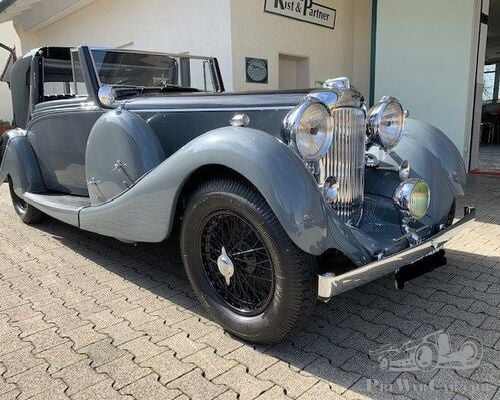
Lagonda LG 45 Coupe de Ville Sedanca by Mayfair
The successor to the M45, the LG45 was built around the same highly capable, competition-proven 4.5-litre Meadows inline-six engine, but featured r..

HORCH 930 V
For SaleHorch 930 VManufacturer: HorchModel and Variant: 930 VBody Type: 4-door sedanChassis Number: ..

1915 Rolls-Royce Silver Ghost Barker Tourer
⁃ An exceptionally rare original bodied pre-war Silver Ghost⁃ Desirable Barker tourer in exciting barn find condition⁃ ..