The global magazine and marketplace for classic car enthusiasts, by enthusiasts.


Filter
Classic Crossley, Lincoln for sale - Crossley, Lincoln cars for sale
-

Lincoln 1930 Tonneau Cowl Sport Pheaton 176-B
This beautifull shaped Lincoln 1930 Tonneau Cowl Sport Pheaton 176-B which was sold for 4.400,- USD in 1930 and weighed 4.900 Pounds, a total of 90 where built in 1930 For more information please contact me FRANK KENNIS phone: 00.31.622.420.766 or mail me: info@KennisCars.NL Frank Kennis Phone: 00.31.622.420.766 or mail me: info@KennisCars.NL www.. -
1929 Lincoln Model L Sport Phaeton
1929 Lincoln Model L Sport PhaetonA masterpiece of American automotive history!The 1929 Lincoln Model L Sport Phaeton tells the fascinating story of the Lincoln Motor Company and the vision of its founder, Henry Martyn Leland. Originally established to produce aircraft engines for World War I, Leland introduced the.. -
1925 Lincoln Model L Phaeton by Brunn
Retaining its original matching-numbers engine and chassis (both numbered 24576), the car benefits from an extensively documented history and a highly sympathetic restoration carried out overseveral years by Emilio Ripollés in Barcelona. Remarkably, the restoration preserved the original coachbuilt structure, original mechanical components.. -
1936 Lincoln Model K Coupe by LeBaron | RM Sotheby's | The Monterey Auction
To Be OFFERED AT AUCTION WITHOUT RESERVE at RM Sothebys' The Monterey Auction event, 13 - 15 August 2026. Offered Without Reserve | $75,000 - $100,000 USD Well-maintained and award-winning restoration in striking colorsOne of about 10 known surviving examples of 25 builtDelivered new to Philadelphia; known history back ..


Crossley
GB, 1904 – 1937
(1) Crossley Brothers Ltd, Gorton, Manchester, 1904 – 1910
(2) Crossley Motors Ltd, Gorton, Manchester, 1910 – 1937
The name of Crossley was famous on engines before it was famous on cars; in fact the Crossley company was the first in Britain to make 4-stroke internal combustion engines on the Otto principle. Later, Daimler engines were made under licence. The first Crossley car for sale, a chain-driven 22hp 4-cylinder, appeared for the 1904 season. A Crossley 28hp and Crossley 40hp followed, all three cars being of normal design and foreign inspiration. Their designer was J.S. Critchley, formerly of Daimler. Shaft drive appeared in 1906, and late in 1909, some were fitted with Allen-Liveredge front-wheel brakes, but Crossley cars, though excellent machines, made little impression until after 1910. The 4-litre 20hp Crossley which then made its bow was a well-constructed, durable and very popular car. Designed by A.W. Reeves, it lived on in modified form until 1925. Crossley’s finest hour came in World War 1, when, as the Crossley 20/25hp it achieved fame as a staff car in the Royal Flying Corps, and as an ambulance and light truck. The Crossley model was extremely popular with the British Royal Family after the war in its 25/30hp version. In its early years, however, it was rivalled by the 15hp. The efficiency of the latter’s otherwise conventional engine, a side-valve four like the rest, gave this Crossley a better performance than most cars in its class and encouraged the makers to offer a special sporting variant, the Crossley Shelsley.
The Crossley Fifteen was discontinued after 1914, but a new Crossley arrived for 1921. This Crossley 19.6hp was a rather more modern design, having a detachable cylinder head, and it was cheaper and lighter on fuel than its 25/30hp companion. The performance was about the same. It was also made in sporting form as the Crossley 20/70hp, but this model was heavy, like the ’Crossley 19.6’ itself, and the brakes were not good enough for the 75mph that was available. Crossley did not make a serious attempt to invade the middle-class market until 1923, when the Crossley 12/14hp, later called the Crossley Fourteen, was introduced. Like its brothers, this was a simple side-valve four, in this case of 2.4 litres, but was more modern, with its unit construction of engine and gearbox and central gear-change. The Crossley Fourteen was a very successful model, being flexile and, thanks to its light weight, both roomy and economical. It survived until 1927. By this time the two bigger Crossley cars were giving way to a much more up-to-date car; the Crossley company’s first six and its first overhead-valve machine. This Crossley 18/50hp model was a spacious, heavy 2.6-litre car with good brakes but somewhat lacking in power. Its engine was enlarged to 3.2-litres and 20.9hp for 1928. At the same time a new small Crossley of similar design, the 2-litre Crossley 15.7hp was introduced, to which a sporting alternative reviving the Shelsley name was added in 1929. Lagonda’s 16/80 model used this engine later. The 6-cylinder Crossley 15.7hp continued until 1934 and the Crossley 20.9hp until 1937. Wilson pre-selector gearboxes were fitted from 1934.
In 1932, the Crossley company had introduced a light car, the Crossley Ten. This was an assembled vehicle powered by an 1100cc Coventry-Climax engine with overhead inlet valves. It was too heavy (a drawback compounded by the pre-selector gearbox), it was very low-geared and its brakes were mediocre. Another mistake was Crossley’s attempt to market the Burney rear-engined car with all-independent suspension. It was given a 15.7hp Crossley engine and a Wilson box, but it was too unconventional in appearance and handling. Very few were made. In 1935, Crossley introduced its new Regis range of small cars with handsome bodies styled by C.F. Beauvais. They consisted of the Crossley Ten and a new Crossley 1½-litre six of the same design also powered by Coventry-Climax, both with a new lowered frame. Both cars, together with the last Crossley 20.9s, disappeared after 1937.
Crossley assembled other people’s cars as well as making their own, beginning with the Willys-Overland Model 4 in 1920. The Gorton-produced Willys came to include more and more British-made parts, such as a Morris Oxford engine. A less likely diversion was an attempt of Crossley in 1921 to make the Type 22 Bugatti in England, but only a handful of these Crossley-Bugattis appeared. In 1922-1933 the Crossley factory made the AJS as well.
Source: Georgano, encyclopedia of motorcar; TRN
The information is written with the greatest of care. However, if you have any suggested amendments please contact us at office@prewarcar.com
Lincoln
US, 1909
Lincoln Motor Vehicle Co, Lincoln, Ill.
This Lincoln car was a high-wheeler with solid rubber tyres, using a 4-stroke, 2-cylinder air-cooled engine of 1.7-litres. Three Lincoln car-models were made, two with shaft drive and one with a single chain.
US, 1911 – 1914
Lincoln Motor Car Works, Chicago, Ill.
After the closure of the Sears venture, the Lincoln Motor Car Works made a high wheeler of similar design to the Sears for a few years. Most Lincoln cars were commercial vehicles.
AUS, 1919 – 1924
Lincoln Motor Car Co, Sydney, N.S.W.
The Lincoln car was an attempt to place on the roads of Australia a car embodying the best of standard components and Australian workmanship, the latter including the radiator design and body. A Continental 6-cylinder engine was used on the Lincoln car for power and the touring Lincoln car sold in 1923 for £A590 with wire wheels extra. The Lincoln Motor Co of Detroit, Mich., requested the Lincoln car company to drop the Lincoln name in 1923, but it is not recorded that the Australian Lincoln car company did so.
US, 1920 to date
Lincoln Motor Co, Detroit, Mich.
After Henry M. Leland’s resignation from Cadillac in 1917, he evolved another big sv V8 which came on the market under the name of Lincoln in 1921. This Lincoln car had a capacity of 5.8-litres and developed 81bhp. Cylinder heads were detachable and full-pressure lubrication was adopted at a time when many American makers pinned their faith to splash systems. Over 70mph was possible with the Lincoln car and it was not excessively expensive at $4.300, but the style of the bodies did not match the quality of the mechanical components, and Henry Ford acquired the Lincoln car company after it had encountered financial difficulties in 1922. Both Leland and his son Wilfred resigned a few months later for the Lincoln car company , but Ford retained the traditions of quality, adding aluminium pistons from the time of his takeover. Lincoln cars were much used by both gangsters and police, the latter driving tuned versions capable of over 80mph and equipped with front wheel brakes, a luxury not available to the general public on Lincoln cars until 1927. President Coolidge bought a Lincoln car in 1924, establishing a link between the Lincoln car marque and the White House: Franklin D. Roosevelt’s Sunshine Special was one of the last 12-cylinder Lincoln car Ks, Harry S. Truman ordered an open Lincoln Cosmopolitan in 1950 and John F. Kennedy bought a Lincoln Continental in 1961.
Lincoln cars sold steadily in limited numbers – nearly 9.000 Lincoln cars in 1926. Engine capacity went up to 6.3-litres in 1928. 1931 Lincoln cars had a 12ft 1in wheelbase, downdraught carburation and 120bhp engines, but in 1932 there came a new 7.2-litre Lincoln KB-type V12 with vacuum booster brakes. This Lincoln car was joined the following year by a smaller 6.2-litre Lincoln KA-type 12 at $2.700, and all subsequent Lincoln cars made up to 1948 were to have 12-cylinder power units. In 1934 both Lincoln cars gave way to a 6.8-litre Lincoln K with aluminium cylinder heads, and a top speed of nearly 100mph. The Lincoln car Division could not, however, support itself on the dwindling prestige-car market, and for 1936 they offered a popular V12 Lincoln car, the 4.4-litre, 110bhp Lincoln Zephyr. Unitary construction was adopted on Lincoln cars; other characteristics were a synchromesh gearbox, headlamps faired into the front wings, a fastback style and an alligator-type bonnet. The brakes, however, were mechanical, and Ford’s traditional transverse suspension was used on Lincoln cars as well. It cost $1.320 and the engine of the Lincoln car was used in Anglo-American hybrids of the period: the Allard, Atalanta and Brough Superior. 1938 Lincoln Zephyrs had a dashboard gear change. Hydraulic brakes followed in 1939, and column change in 1940. Meanwhile the Model K Lincoln car had at last been dropped; sales for the combined 1939 and 1940 seasons had been 120 of these Lincoln cars and the black-bordered emblems on the last models were symbolic. To balance this, a new Lincoln car-product had been launched in 1939, the Lincoln Mercury. There were also some relatively inexpensive prestige Lincoln cars – Edsel Ford’s Zephyr-based Continental coupés and cabriolets, with 4.8-litre engines. Options on the Lincoln car in the last pre-war seasons included overdrive, a fluid coupling, and power-operated hoods and windows. No entirely new Lincoln cars appeared until 1949, when a change was made to Ford’s new styling and coil-spring independent front suspension for the Lincoln cars, while at the same time the 12-cylinder engine was replaced by an sv under-square 5½-litre V8. Manual transmission was dropped finally from Lincoln cars in 1951, and 1952 models swept the board in the touring-car class of that year’s Carrera Panamericana, the winning Lincoln car averaging 90mph. 205bhp ohv engines were introduced for 1953, and the 1956 line of Lincoln cars consisted of the 6-litre 285bhp Lincoln Premiere and Lincoln Capri, as well as a revived Lincoln Continental at $10.000 made in very limited numbers. Dual headlamps were adopted for the 1957 Lincoln cars, and 1958 Lincoln cars had unitary construction – this was the year of Lincoln-Mercury Division’s disastrous Edsel. After 1961 the Continental became the staple Lincoln car, and unusual body style being a 4-door convertible of a type not offered by the American motor industry for some years; this was discontinued in 1968, when Lincoln cars had 7.571cc 340bhp engines and front disc brakes (standardized in 1966 on Lincoln cars). This short-wheelbase Lincoln Continental III luxury 2-door hardtop introduced during the year reverted to the separate chassis and the traditional radiator grille. List price of the Lincoln car was $6.585. The company also built a $500.000 Lincoln car, a bullet-proof Lincoln Presidential limousine on a special 13ft 4in chassis.
All 1970 Lincoln carmodels had concealed headlamps an perimeter frames; that year’s production of 58.771 Lincoln cars was well below Cadillac’s level, but appreciably ahead of Chrysler’s prestige Imperial. By 1973 cylinder capacity was 7.359cc, and improvements on the Lincoln car for the year were mainly concerned with safety. Most expensive Lincoln car was the Lincoln Continental IV, basically the 1972 revision of the Continental III with a Rolls-Royce style grille. Prices for this Lincoln car ranged from $7.322 for the Continental 4-door sedan to $8.774 for the Continental Mark IV coupé.
Source: Georgano, encyclopedia of motorcar; GNG, GMN, MCS
The information is written with the greatest of care. However, if you have any suggested amendments please contact us at office@prewarcar.com


Featured

Lagonda LC Tourer 1934
The Lagonda story began in 1901 in Staines, a small town in the UK. The company enjoyed its greatest successes around 1935. During this period, the..
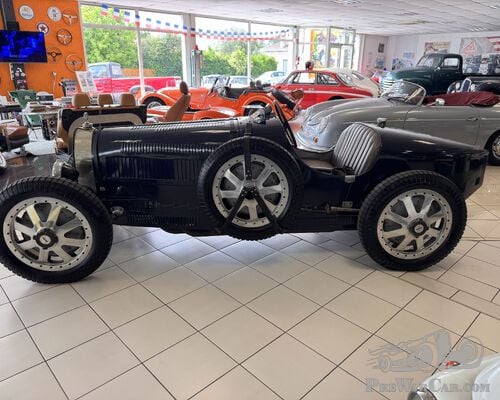
Bugatti 35 B Pur Sang
Bugatti 35 B Pur Sang,importée par un membre délégué de la FFVE il y’a une quinzaine d années.Participation à de nombreux Rallyes Bug..